Showing posts with label Art. Show all posts

Tuesday, July 01, 2014

Is this how the Bayeux Tapestry would have ended?

The Alderney Bayeux Tapestry

The famous Bayeux Tapestry ends with the defeat of King Harold's army and the flight of the Anglo-Saxon soldiers. However, most scholars believe that the original tapestry would have ended with the coronation of William the Conqueror. 

Now, a community project from the British island of Alderney has recreated the missing piece of the Bayeux Tapestry. It depicts several scenes that they believe would have been in the original tapestry, including a scene where William is crowned on Christmas Day, 1066. 

Professor Robert Bartlett of the University of St.Andrews tells the BBC: "It has often been pointed out that the opening of the tapestry has a figure of King Edward the Confessor enthroned, and that around the middle point of the tapestry there is an image of William's enemy Harold enthroned.

"It would be a neat symmetry and make perfect sense of the story if the end of the tapestry had showed the victorious William enthroned, which is what the Alderney team have chosen to do. The other 'new' scenes are more speculative, but they are modelled on scenes earlier in the tapestry so look convincing."

The recreation is now being displayed next to the original at the Bayeux Tapestry Museum in France - the exhibition will run until August 31st.

For the full story, please visit the BBC or the Daily Mail.


Here is a video report about the project from last year:

Friday, April 12, 2013

What to do if you have 10,000 hours of free time?

Andy Wilkinson has recreated a miniature version of the Bayeux Tapestry - the eleventh-century embroidery that depicts William the Conqueror's invasion of England and victory at the Battle of Hastings.  It took him 18 years to sew the 40 foot-long replica and he estimates that he spent about 10,000 hours to complete it.


In an article in the Daily Mail, Mr. Wilkinson explains, "I work a lot of night shifts and used to come home and find myself with not a lot to do for a few hours. I had seen a copied section of the tapestry at a medieval fair and thought that if they can do that so can I.

"Having never done a tapestry before, I came home and found a picture and just started to draw and sew. I had no formal training in sewing or drawing. I just drew the outlines of figures and animals like the horses onto a piece of calico material and then just stitched it."

This version of the Bayeux Tapestry depicts the portion of the Battle of Hastings. It will be going on display at Battle Abbey, the site of the battle that was fought in 1066.


Click here to visit the Battle Abbey website

Click here to learn more about the Bayeux Tapestry


Friday, January 18, 2013

Colosseum Cleaning Yields Ancient Art Discoveries Including Old Frescos, Graffiti

A long-delayed restoration of the Colosseum's only intact internal passageway has yielded ancient traces of red, black, green and blue frescoes – as well as graffiti and drawings of phallic symbols – indicating that the arena where gladiators fought was far more colorful than previously thought. 

Officials unveiled the discoveries Friday and said the passageway – between the second and third levels of the first century Colosseum – would open to the public starting this summer, after the 80,000 euro restoration is completed.


 The frescoes were hidden under decades of calcified rock and grime, and were revealed during a cleaning and restoration project over the last two months. The traces confirmed that while the Colosseum today is a fairly monochrome gray travertine rock, red brick and moss-covered marble, in its day its interior halls were a rich and expensive Technicolor.

 "We're used to thinking that during excavations, archaeological surprises are a risk for builders and for the city's development," Rome archaeological heritage superintendent Mariarosaria Barbera said. "But here is a beautiful archaeological surprise ... a monument that has been studied and known and appreciated across the world, yet still provides surprises."

Click here to read the full article from the Huffington Post

Wednesday, January 09, 2013

Medieval Painting Hints at Ties Between Blacks and Jews


The anonymous 16th-century painter who recorded a scene of everyday life at the king’s fountain (Chafariz d’El Rei) in Lisbon depicted an impressive range of people and animals. In addition to a swan, a seal, fish, horses, dogs and birds, the artist also included more than 150 human figures. There’s so much going on in the busy scene along Lisbon’s port that Joaneath Spicer, the James A. Murnaghan Curator of Renaissance and Baroque Art at the Walters Art Museum in Baltimore, can be forgiven for initially overlooking an important detail. Only after she had finished working on the exhibition catalog did Spicer notice how many Jews appeared in the work.


The artist depicted at least half a dozen Jewish men — the women’s religious identities are more difficult to discern — including two Jewish policemen hauling away a black man who appears, according to the wall text, to be “drunk and sheepish.” The latter figure and several other Africans explain the painting’s appearance in the exhibit “Revealing the African Presence in Renaissance Europe,” which is at the Walters through January 21. It subsequently travels to the Princeton University Art Museum, where it will be shown from February 16 to June 9.


“I was really unaware of the presence of so many Jews in this painting until I began to blow up details of a photo in preparation for installing the work,” says Spicer, who recognized the Jewish figures from research she conducted for a 1996 article, “The Star of David and Jewish Culture in Prague around 1600,” which appeared in The Journal of the Walters Art Gallery. “This is the only image I know of — certainly painting from this period that purports to show Jews from life.”

Click here tor read this article from the Jewish Daily Forward


Friday, December 21, 2012

Medieval pendant found by boy, 4, on show at British Museum


A 500-year-old gold reliquary, beautifully engraved with the names of the Magi and images of Christ and St Helena, which was found by a four-year-old playing with his father's metal detector, has gone on display for the first time at the British Museum.

It would once have been brilliantly coloured, with enamel work filling in the letters and decoration, and may once have contained a relic of the cross. It probably dropped from the neck of some wealthy and pious person, and lay undiscovered in the field for half a millennium.

Click here to read this article from The Guardian

Wednesday, December 19, 2012

Bosch and Bruegel: Four paintings magnified


Art Historians and scientists from the University of Glasgow have completed an international research project to trace the origins of four previously misattributed paintings.

The two year study which was funded by the European Culture Fund and the British Academy traced the paintings, which were previously thought to be by Hieronymus Bosch and Pieter Bruegel the Elder, back to workshops in 16th-century Antwerp.


The project, entitled ‘Bosch and Bruegel: Four paintings magnified’, involved the collaboration of conservators, conservation scientists and art historians from around Europe. Researchers used state of the art infra-red imaging, X-radiography, dendrochronology, pigment and binding-medium analysis to investigate the works, which all depict Christ driving the Traders from the Temple.

The groundbreaking technology used on the project gave the team a rare glimpse inside the artist’s studio of the era by allowing the experts to look through the layers of paint to see the secrets of composition. This close analysis yielded a greater understanding of materials, techniques and studio practice of the time.


Dr Erma Hermens, Senior Lecturer in Technical Art History, who led the project at the University of Glasgow, said: “Dr Erma Hermens, Senior Lecturer in Technical Art History, who led the project at the University of Glasgow, said: “The theme of Christ driving the Traders from the Temple was popular in the 16th-century merchant and bankers' city of Antwerp and works by Bruegel and Bosch were widely admired, imitated, copied and faked.

“This unique interdisciplinary and international research project made full use of the University of Glasgow's state of the art scientific research facilities, its unique strength in technical art history, and collaboration with colleagues from Copenhagen and Tallinn, to unlock  the many secrets in this intriguing story of the making and meaning of these four paintings, and what a great story it is.”

Councillor Archie Graham, Chair of Glasgow Life said: “Everyone loves a good detective story, especially one with such an international flavour. Working with other international museum organisations on this world class research project and using state of the art techniques, many of the mysteries of this painting are revealed in this exhibition at Kelvingrove Art Gallery and Museum. The exhibition represents a detailed examination of the most up to date methods there are of learning even more about objects in Glasgow’s collection.”

The findings are showcased in a book ‘On the Trail of Bosch and Bruegel: Four paintings under cross-examination’, and a multimedia exhibition, ’Art Detectives: Investigating Bosch and Bruegel’, organised together with Glasgow Museums, which will open in the Kelvingrove Museum on Thursday 22 November 2012, following exhibitions in Tallinn and Copenhagen.

The research used specialist technical art history facilities in Denmark, Estonia and Scotland, including Scanning Electron-Energy Dispersive X-ray Microanalysis at the University of Glasgow’s Imaging Spectroscopy and Analysis Centre (ISAAC).

See more at Four Paintings Magnified

Source: University of Glasgow

Wednesday, December 12, 2012

Hobbit Chic

Do you love J.R.R. Tolkien’s books so much that you could just wear them? One local designer has just answered your prayers.


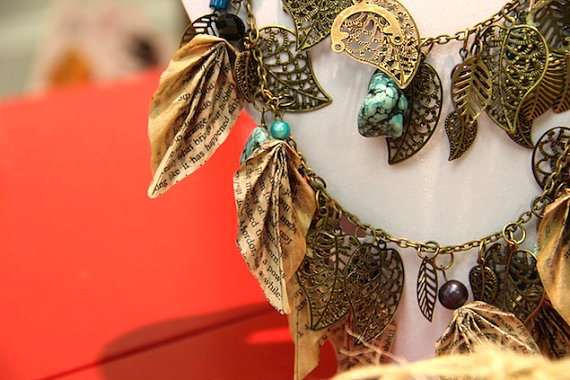
 Director Peter Jackson isn’t the only one repurposing J.R.R. Tolkien’s works this holiday season: U of T civil engineering student Lee Hamu has upcycled some of the author’s classic works to create eco-friendly jewelry, household items, and various paper products. Currently constructing Tolkien-themed glass Christmas bulbs (among other projects), the 23-year-old Hamu spoke to The Grid on the eve of The Hobbit‘s Dec. 14 theatrical release about some of the Frodo-friendly items for sale—or soon to be available—at her Etsy store.

 Click here to read this article from The Grid

Wednesday, December 05, 2012

'First tartan' discovered on statue of Roman emperor

The earliest depiction of Scottish tartan has been discovered – on a fragment of a Roman statue.

 The bronze statue once stood on top of a giant triumphal arch in the ancient Moroccan city of Volubilis, in the south-west corner of the Roman Empire, 1500 miles from Scotland. It depicted the Emperor Caracalla – the self-styled conqueror of the Caledonians – riding a six-horse chariot.

The statue, erected 1800 years ago, was destroyed centuries ago, and only a three-foot-long fragment of the emperor's cape remains in a museum in Rabat. Remarkably, the surviving bronze includes the image of a captive Caledonian warrior – wearing tartan trews.

 Dr Fraser Hunter, of the National Museum of Scotland, yesterday identified the carving – inlaid with bronze and silver to give texture to the Scottish weave – as the "first-ever depiction of tartan".

Click here to read this article from The Scotland Herald

Friday, November 23, 2012

How King's College Chapel Got Its Windows


When you enter King's College Chapel in Cambridge, England, the first thing you do is look up at the magnificent vault of the ceiling. For me, looking up at the beautiful fan-like splays of the ribs always made music resound in my head, perhaps a Bach chorale that I had heard performed there or perhaps something from the Festival of Nine Lessons and Carols that is broadcast from the chapel around the world at Christmastime. Then there is the light. On a summer's day, "the windows blaze into life, walls of floating light and colour that sparkle and ripple to the changing rhythm of the clouds and sun, 'flecking the vast interior with glory,' according to one former King's undergraduate, E. M. Forster." Thus Carola Hicks introduces the windows in The King's Glass: A Story of Tudor Power and Secret Art, newly reprinted by Pimlico. It was her last book published before her death in 2010; she had been, among other jobs in a varied career, the curator of the stained glass museum in nearby Ely Cathedral. Now I'd love to go back to the chapel; I had no idea that the lovely windows had such a tumultuous and fractious history, reflecting the complicated times in which they were planned and installed. Even if I never get back, though, I am, thanks to Hicks's book, seeing the windows with new clarity.

Click here to read this book review from The Columbus Dispatch

Tuesday, November 20, 2012

New research on how the Bayeux Tapestry was made


A University of Manchester researcher has thrown new light on how the world famous Bayeux Tapestry was made over 900 years ago. Alex Makin –a professional embroiderer who was trained at one the country’s most prestigious institutions – says the same group of people were likely to have worked on the 70-metre-long masterpiece under the same manager or managers.

Her conclusion casts doubt on the widely accepted theory that nuns based in different locations across England made the tapestry in nine sections which were then stitched together.


However, questions still remain over how many embroiderers worked on the Bayeux Tapestry, which is on permanent display at a museum in Normandy, France, who they were and where their ‘workshop’ or ‘workshops’ were located.

From observing the way the stitches overlap on the back of the tapestry, Mrs Makin is also able to say in what order its different parts were sewn. The outlines for individual sections were worked first, and then filled in with colours in a set order.

Click here to read this article from Medievalists.net

Who was the mysterious Ælfgyva in the Bayeux Tapestry?

A new theory has been put forward on a mysterious scene in the Bayeux Tapestry that appears to show some sort of sexual scandal that involved a woman named Ælfgyva. Joanna Laynesmith, a medieval historian from the University of Reading offers two possibilities in a new article that appears in the October issue of History Today.


In trying to understand ”the million dollar question” as Laynesmith puts it, several different explanations have been attempted.  Laynesmith believes that this Ælfgyva was most likely Emma, who was the wife of two Anglo-Saxon kings - Æthelred the Unready and Cnut, and was the mother of two more – Harthacnut and Edward the Confessor, or that it could be Ælfgyvva, the first wife of Æthelred.

Click here to read this article from Medievalists.net

Monday, November 12, 2012

The Fake Medieval Images in Canterbury Cathedral

Thousands of visitors come into Canterbury Cathedral each day, where they gaze upon the hundreds of years of history in one of England’s greatest churches. Many of them will see the great stained glass images in the windows of the cathedral, believing that these were created in the Middle Ages. Unfortunately two of the most iconic images in the Cathedral are actually fakes created in the first half of the 20th century.


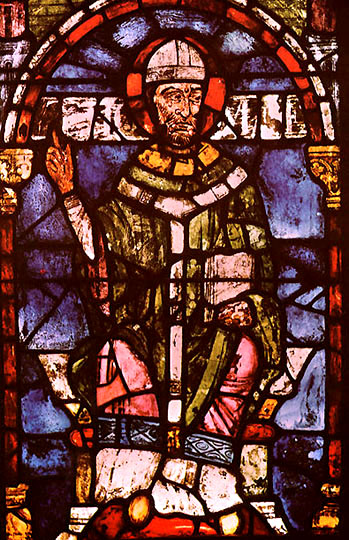
In ‘Fakes and Forgeries in Canterbury’s Stained Glass’, a lecture given last week at the University of Toronto, Rachel Koopmans explained how these images came into the cathedral and have fooled people for so long. One of the faked images is known as the Pilgrims panel, which shows four figures on the move and has been associated with the characters of the Canterbury Tales by Geoffrey Chaucer. The other is a portrait of the famous martyr and saint Thomas Becket, which some books have even described as being a contemporary depiction of the twelfth-century Archbishop.

Koopmans explains that both of these images, and many more in the Cathedral, were actually created by Samuel Caldwell Jr., who was the person in charge of restoring Canterbury’s glass for more than fifty years. During this time he created dozens of works and duped various church officials into believing they were genuine medieval images.

Click here to read this article from Medievalists.net

Saturday, October 06, 2012

Thousand-year-old Buddhist statue was created from a meteorite, new study reveals

It sounds like an artifact from an Indiana Jones film; a 1,000 year-old ancient Buddhist statue which was first recovered by a Nazi expedition in 1938 has been analysed by scientists and has been found to be carved from a meteorite. The findings, published in Meteoritics and Planetary Science, reveal the priceless statue to be a rare ataxite class of meteorite.

 The statue, known as the Iron Man, weighs 10kg and is believed to represent a stylistic hybrid between the Buddhist and pre-Buddhist Bon culture that portrays the god Vaisravana, the Buddhist King of the North, also known as Jambhala in Tibet.

Click here to read this article from Medievalists.net

Tuesday, October 02, 2012

Restoring medieval frescoes in Rome

The Superintendence for Archaeological Heritage of Rome announces the extraordinary opening to the public of the restoration site of the early medieval frescoes of Santa Maria Antiqua in the Roman Forum. Guided tours of the church will be held until November 4, 2012, which can be arranged by visiting www.coopculture.it


Monday, October 01, 2012

An earlier version of the Mona Lisa?

The Swiss-based Mona Lisa Foundation believes they have proven that Leonardo da Vinci painted an earlier version of the Mona Lisa.

 Known as the Isleworth Mona Lisa, the canvas painting is larger the original Mona Lisa, as well being brighter and with a different background. It appears to depict the famous lady in the Mona Lisa portrait, which is thought to be Lisa Del Giocondo, the wife of a wealthy Florentine merchant. Experts have debated if the work has also been an original Da Vinci work, but the Mona Lisa Foundation believes that its scientific tests prove that it was made about ten years earlier than the masterpiece.

Click here to read this article from Medievalists.net

Monday, July 23, 2012

Medieval demons found at Norfolk church

A set of grotesque and unique medieval carvings has been rediscovered at a church in the Fens after being forgotten for hundreds of years.


The discovery of 12 demons in the roof of the nave at St Clement’s Church, Outwell, has sparked calls for the relics to be preserved for posterity and made more accessible to parishioners and visitors.


The carvings were found by Dr Claire Daunton, a historian at Trinity Hall, Cambridge while studying equally unique stained glass in the church.

Because of the light entering the roof area of the nave, the carvings are almost impossible to see clearly but she suspected they were quite extraordinary-early 15th century examples of a type of carving found in some European churches – they appeared to have been carved the wrong way round with the evil demons apparently overcoming each of the smaller apostles.

Click here to read this article from EDP24

Tuesday, July 10, 2012

Amazon withdraws controversial Caravaggio book


The lavishly illustrated two-volume e-book , 'Young Caravaggio – One hundred rediscovered works', went on sale on Amazon just days ago and was available for download to Kindles.

But the book, which contained 1,000 images of Caravaggio's work and the supposed "new" drawings, was abruptly withdrawn from Amazon's website on Tuesday, with the title crossed out and a blank space where the cover of the book had been displayed.

Maurizio Bernardelli Curuz and Adriana Conconi Fedrigolli, the art historians who wrote it, claimed to have found 100 previously unrecognised sketches and drawings by the Baroque master after sifting through an archive of art work held by a castle in Milan.

Click here to read this article from the Telegraph

Saturday, July 07, 2012

Future Saint as Medieval Superhero

In Siena's Pinocateca Nazionale museum, four chairs have been placed in a row in front of Simone Martini's Altarpiece of Blessed Agostino Novello (c. 1328). Presumably, this is to give viewers in what is perhaps the best art-museum bargain in Europe—five euros ($6) for a gander in relative solitude at a trove of great Sienese art—a chance to relax and really ponder what is, in my opinion, the museum's masterpiece.


 Martini (b. 1284) was one of the most prominent figures in the "Siena school" of painting which, according to conventional art history, was less connected to the beginning of the Italian Renaissance and more an early part of something called "International Gothic"—which began in the 14th century and ended early in the 15th century—and was inferior to the rational, perspectival realism (what we generally refer to as "naturalism") of the larger, neighboring city of Florence. Sienese painting waxed mystical, went in for out-of-proportion figures in physically jumbled (but narratively quite coherent) spaces, and specialized in crisp juxtapositions of colors often so subtle that it's hard to find names for them.

 In 1315, Martini completed a huge fresco of the Maestà (the Virgin and Jesus being admired by all the saints) in the Palazzo Pubblico, the town hall of Siena's experiment in democratic government that lasted about 70 years before the Black Death killed more than half the city's population in 1348. After finishing his fresco, Martini went off to Naples and didn't return to Siena for a decade. When he did, the city had grown precipitously to a population of 50,000 (it's all of 54,000 today), and the Augustinian order of monks was ready to commission an altarpiece for its beloved future saint, Agostino Novello.

Click here to read this article from the Wall Street Journal

Monday, June 25, 2012

'Capitoline Wolf' could be 1,700 years younger

A study has shown that the “Capitoline Wolf,” a bronze statue representing Ancient Rome's most famous symbol, was probably sculpted during the Middle Ages, some 17 centuries later than what has long been thought, media reports said Saturday.

 Researchers at the University of Salento, who carried out radiocarbon and thermoluminescence tests, believe the statue dates from around the 12th century A.D. and not the 5th B.C., daily Corriere della Sera said.


 The statue, which is kept at Rome's Capitoline Musuems, depicts a she-wolf suckling human twins. The pair represent Romulus and Remus, brothers who, according to legend, founded Rome in 753 BC.

 Most experts believe the twins were added in the late 15th century A.D., probably by the sculptor Antonio Pollaiolo.

Click here to read this article from the China Post

See also Romulus and Remus symbol of Rome could be medieval replica

Saturday, June 16, 2012

The Roots of Art in Ancient Egypt

How art begins is one of mankind’s greatest enigmas to which an answer has yet to be found.

 If there is any hope of discovering the process out of which it emerges, ancient Egypt might be the place that will yield some clues.

 The admirable show, “Dawn of Egyptian Art,” put together at the Metropolitan Museum of Art by Diana Craig Patch, reveals a world of seething artistic creation headed in multiple directions. Much of it bears no recognizable connection to the statuary and objects from Egypt under its historic dynasties. 

The most startling revelation is the simultaneous existence by the end of the fourth millennium B.C. of pure abstraction, highly stylized figuration and representational art close to nature.

Click here to read this article from the New York Times