Recent research on medieval nuns shows that many of them were dressing in the latest fashions instead of simple religious habits. And while their were efforts by the church to make nuns dress more humbly, by the 14th and 15th centuries these rules were becoming less and less adhered to.
The article, “Best Clothes and Everyday Attire of Late Medieval Nuns,” by Eva Schlotheuber, appears in Fashion and Clothing in Late Medieval Europe, which was published last year in Switzerland. Basing her research on numerous sources from western Europe, such as reports on medieval nunneries by church officials, leads Schlotheuber to believe that “in the rhythm of daily life and feast days the nuns developed a great deal of creativity, and lived in a much more lively fashion than the morally and didactically coloured theological texts of the period want us to think.”
Click here to read this article from Medievalists.net
Showing posts with label Articles. Show all posts
Showing posts with label Articles. Show all posts
Monday, June 06, 2011
Friday, May 20, 2011
Dr. Tomás Ó Carragáin wins award for Irish Medieval Studies
Dr. Tomás Ó Carragáin, a lecturer at University College Cork, has been awarded the inaugural Four Courts Press Michael Adams Prize in Irish Medieval Studies for his essay “The Architectural Setting of the Mass in Early-medieval Ireland.”
This prize was awarded last week at the International Congress on Medieval Studies at Western Michigan University. It is given for the best peer-reviewed essay/article on Irish Medieval Studies published in a book or journal during the 2006–2010.
Click here to read this article from Medievalists.net
This prize was awarded last week at the International Congress on Medieval Studies at Western Michigan University. It is given for the best peer-reviewed essay/article on Irish Medieval Studies published in a book or journal during the 2006–2010.
Click here to read this article from Medievalists.net

Tuesday, May 03, 2011
Medievalists.net - All Request Sunday articles
Franchise Conflict: The Tide of Antipopes in the Aftermath of the Eastern Schism
European Women Patrons of Art and Architecture, c. 1500-1650. Some Patterns
The Military Revolutions of the Hundred Years’ War
Rashi and the First Crusade: Commentary, Liturgy, Legend
Care of the Children: the Aldermen and the Orphans
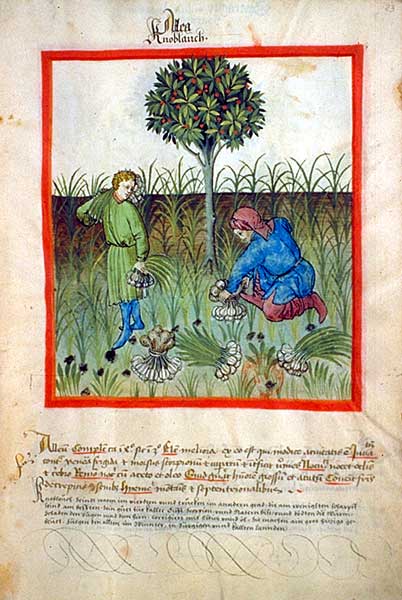
The Cucurbitaceae and Solanaceae illustrated in medieval manuscripts known as the Tacuinum Sanitatis
Coinage and Money in the Latin Empire of Constantinople
Thomas More’s History of King Richard III: Educating Citizens for Self-Government
The Physical Spell of Gregorian Chant
Who Was Who in Medieval Limerick; from Manuscript Sources
Sunday, April 24, 2011
Medievalists.net - All Request Sunday
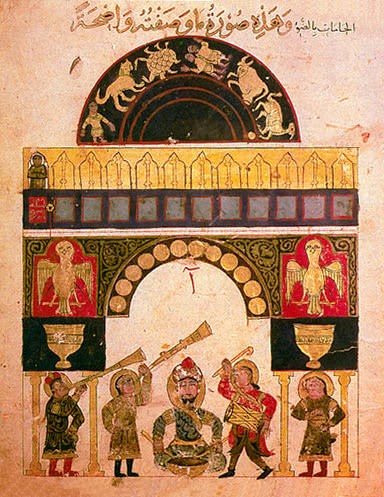
Music: An Instrument of Dialogue Christian Medieval Music and Arab Music, or the Need for Heresy
The Medieval Silver-Lead Miner: A Preliminary Study
Greek and Muslim Automata: Influence of Greek Knowledge in Medieval Islamic Science
Women and the Fabliaux: Villains or Victims?
The Motives of the Earliest Crusaders and the Settlement of Latin Palestine, 1095-1100
Negotiating Interfaith Relations in Eastern Christendom: Pope Gregory IX, Bela IV of Hungary, and the Latin Empire
The Lay of Igor’s Campaign and the Works It Has Inspired
Material and Meaning in Lead Pilgrims’ Signs
“With them she had her playful game”: The Performance of Gender and Genre in Ulrich von Lichtenstein’s Fraunendienst
The Tree of Virtues and the Tree of Vices in Beinecke MS 416
Illegal Sexual Behavior in Late Medieval Norway as Testified in Supplications to the Pope
Fra Bartolommeo and the Vision of Saint Bernard: An Examination of Savonarolan Influence
The machines of Francesco Di Giorgio: demonstrations of the world
To Rise beyond their Sex: The Representation of Female Cross-Dressing Saints in Caxton’s Vitas Patrum
The Church of the Resurrection, or of the Holy Sepulchre
Sir John Mandeville and the Rhizomatic Travel Book
Tuesday, March 22, 2011
How accurate were medieval chroniclers in describing warfare?
The Battle of Margate is one of the lesser-known episodes of the Hundred Years’ War, but a historian has recently analyzed this naval campaign to see how accurate the accounts of medieval chroniclers were.
In his article, “Medieval Chroniclers as War Correspondents during the Hundred Years War: The Earl of Arundel’s Naval Campaign of 1387,” Adrian R. Bell compares what can be learned from this episode from English government records and from the reports of four chroniclers, including Jean Froissart.
Click here to read this article on Medievalists.net
In his article, “Medieval Chroniclers as War Correspondents during the Hundred Years War: The Earl of Arundel’s Naval Campaign of 1387,” Adrian R. Bell compares what can be learned from this episode from English government records and from the reports of four chroniclers, including Jean Froissart.
Click here to read this article on Medievalists.net
Thursday, March 10, 2011
An English Royal Wedding – from the Middle Ages
A recent article has detailed the wedding of an English princess in the fourteenth century, showing how lavish the Middle Ages could be.
In her article, “Isabella da Coucy, Daughter of Edward III: The Exception who proves the rule,” Jessica Lutkin examines the life of the eldest daughter of the famous English monarch. Isabella was born in 1332 and lived through many of the important events that shaped England in the fourteenth century.
Click here to read this article from Medievalists.net
In her article, “Isabella da Coucy, Daughter of Edward III: The Exception who proves the rule,” Jessica Lutkin examines the life of the eldest daughter of the famous English monarch. Isabella was born in 1332 and lived through many of the important events that shaped England in the fourteenth century.
Click here to read this article from Medievalists.net
Thursday, June 03, 2010
Did the Crusaders have a Muslim ally in the First Crusade?

Abu-Munshar explains that both the Fatimids and the Crusaders wanted to "foster collaboration and form an alliance" with each other for their own reasons: the Fatimids believed that the main threat to their country was the Seljuk Turks, while the Crusaders wished to avoid a united Muslim front against them as they marched through the Middle East. The main evidence for this alliance lies in a delegation the Fatimids sent to the Crusaders while they were camped outside Antioch. Albert of Aachen, for example, describes how the Fatimid ruler, "sent fifteen envoys who were skilled in different languages to the army of the living God, about a mutual alliance for peace and his kingdom."
These envoys stayed in the Crusader camp for several weeks, and made a proposal to fight against the Seljuks. The Crusaders would be rewarded with northern Syria, while the Fatimids would regain Palestine including Jerusalem. The Crusaders did not seem to respond directly to this proposal, but instead sent their own envoys to Egypt to continue the discussions.
The situation then changed after the Fatimids took advantage of the Seljuks' problems to attack and regain Jerusalem. According to the 12th century writer William of Tyre, the Fatimids, "seemed to imply that they were conferring a great favour on the Christians by allowing unarmed pilgrims to go to Jerusalem in groups of two or three hundred and returned safely after completing their prayers. The leaders of the Christian forces regarded this message as an insult. They forced the envoy to return with the answer that the army would not consent to go thither in small detachments, according to the condition proposed. On the contrary, it would march on Jerusalem as one united host and threaten the Kingdom of their master."
The Crusaders did carry out their threat by laying siege to Jerusalem, and on capturing it killed thousands of it inhabitants.
Abu-Munshar also questions the assumption that the Fatimids were ignorant of the Crusader's ultimate goals. He writes, "How could the Fatimids misunderstand the crusaders’ aim when we know that the latter started their journey from Europe and took months, even years, to arrive in the east, with the clear aim of regaining Islamic Jerusalem from the Muslims? It is possible that most Muslims, Saljuqs and Fatimids alike, were at least partially aware of the crusaders’ intentions."
The article, "Fatimids, Crusaders and the Fall of Islamic Jerusalem: Foes or Allies?" appears in Volume 22, Issue 1 of Al-Masaq. Click here to access an online version.
Tuesday, April 06, 2010
Medieval document reveals new insights into a 13th century Welsh uprising

"The Penmachno Letter Patent and the Welsh Uprising of 1294-95" by G. Rex Smith appeared in the most recent issue of Cambrian Medieval Celtic Studies. The article details a letter patent signed by Madog ap Llywelyn, one of the main leaders of the revolt, in December 1294. Smith provides the text and translation of the document, in which Madog reasserts a land grant to a minor noble named Bleddyn Fychan of property in northern Wales.
Smith believes that while Fychan and his family had remained loyal to Edward I during the conflict, they also wanted to make sure their property was protected in case the Welsh proved victorious in the conflict.
The letter patent is also interesting in that Madog ap Llywelyn refers to himself as "prince of Wales, lord of Snowdonia", the latter of which refers to the Welsh tradition that Snowdonia was once the seat of power for previous Welsh princes. Smith writes that "Madog, willingly or unwillingly, had become the leader of the rebellion in the north and why not call himself prince of Wales and lord of Snowdonia to boost his position there, not to mention his morale."
The article also details the revolt, which Smith believes was a popular uprising caused by harsh treatment by Edward's officials in Wales. In September and October of 1294 Welsh forces overran several castles and took control of large parts of the territory - this forced Edward to abandon a planned campaign in Gascony and send his troops to Wales. In what Smith called "more of a show of strength, a flag-waving exercise, than a military campaign," Edward was able to regain most of his castles and territory, although at a cost of about £55 000. Madog ap Llywelyn either surrendered or was captured in the summer of 1295, and spent the rest of his life in the Tower of London.
"The Penmachno Letter Patent and the Welsh Uprising of 1294-95" by G. Rex Smith, can be found in Cambrian Medieval Celtic Studies, Vol.58 (Winter 2009).
Friday, March 26, 2010
Meals of The Last Supper grew bigger in the last thousand years
A new study examining artistic depictions of the Last Supper over the last thousand years has concluded that the food portions depicted in the famous scene have been getting larger throughout the centuries.
Brian Wansink, of Cornell University, and Craig Wansink, of Virginia Wesleyan College, examined 52 pieces of art that shows the Last Supper of Jesus Christ, an important event written about in the Christian gospels. The two brothers call this "perhaps the most commonly painted meal," making it their choice to see how artists portrayed the sizes of foods and plates.
Their premise was that, "if art imitates life and if food resources have become generally more available over the past millennium, we might expect the size of the food portions depicted in paintings to increase over time."

After examining the paintings, which date back roughly to the year 1000, and include many from the Middle Ages, they did find that the size of the entrées had grown by 69 percent, while plate size has increased 66 percent and bread size by about 23 percent.
They also discovered that while they were unable to tell what the main course was in nearly half of the depictions, they did find that fish or eel (18%), lamb (14%) and pork (7%) served as the main dishes in many of the scenes.
Their conclusions have been disputed by Carl Pyrdum III, a medieval scholar, who criticized the study on his blog Got Medieval. He notes that the authors only used 52 artworks of the Last Supper, which would be a small minority of those available, all of which were from the same book: Last Supper
 . "It's like they literally grabbed the first book on the Last Supper they saw and decided to end their research there," Pyrdum writes.
He also details various problems related to medieval art that the authors did not take into consideration, such as a lack of proportional representation. Pyrdum concludes "that comparing the size of pieces of food to holy apostolic body parts is so much nonsense, at least for the first 400 years that the study claims to discuss."
The article, "The largest Last Supper: depictions of food portions and plate size increased over the millennium" appears in the April issue of the International Journal of Obesity.
Sources: International Journal of Obesity, Cornell University, Got Medieval
Saturday, October 31, 2009
Renaissance Capitalist: New Research Answers Mystery About Illegitimate Daughter of Pope

In popular legend, Lucrezia Borgia, Duchess of Ferrara (1480- 1519), stands falsely accused of poisoning her second husband. Victor Hugo portrayed her in thinly veiled fiction as a tragic femme fatale. Buffalo Bill named his gun after her.
But new research by USC historian Diane Yvonne Ghirardo reveals that the only sister of Machiavelli's prince was less interested in political intrigue than in running a business, undertaking massive land development projects that, according to Ghirardo, "stand alone in the panorama of early sixteenth-century projects, not only those initiated by women."
Forced by an economic downturn to cut expenses and become an entrepreneur, the illegitimate daughter of Pope Alexander VI would control between 30,000 and 50,000 acres in northern Italy within six years.
"This is a classic case of seeing only what you're looking for and not getting the whole picture," Ghirardo says of the centuries-old mystery surrounding how Lucrezia accumulated her vast personal wealth. Ghirardo notes that historians have long dismissed Lucrezia as stupida because no record exists of her collecting art or antiquities.
"The information was there in the archives, but because she was a woman, scholars only looked at transactions for clothes, for jewelry, or for works of art. Nobody looked at the other entries in the account registers," says Ghirardo of the research project that took her more than seven years.
In a recent issue of Renaissance Quarterly, Ghirardo explains how Lucrezia turned seemingly worthless swampland into reclaimed land. The land was used to cultivate grains, barley, beans and olive trees; to grow flax for spinning into linen; to pasture livestock for milk, meat, wool and hides; and for vineyards.
"That's really a capitalist attitude: to leverage capital by getting the basic good -- in this case, land -- at the cheapest cost," Ghirardo says.
For example, Ghirardo details Lucrezia's first business venture with her husband's cousin Don Ercole d'Este. The don gave Lucrezia title to half his land in Diamantia, a large marshy district west of Ferrara. In exchange, Lucrezia agreed to fund improvements to the land, including drainage, building embankments and digging canals.
As Ghirardo explains, "Lucrezia grasped the untapped potential of thousands of acres of marginal, waterlogged land, but she was too shrewd to employ her own resources to purchase it unless absolutely necessary."
Surviving documents also indicate Lucrezia's knowledge of contract terms, border disputes and even the skill of various hydraulic engineers, according to Ghirardo. Other records show her pawning an extremely valuable ruby-and-pearl piece of jewelry in order to buy more water buffalo (especially to produce mozzarella).
"It's not just what Lucrezia did and how she did it, but the immensity of her enterprises, that stands out," Ghirardo says. "Nobody else was doing this on such a large scale, not even men. Nobody was prepared to put in that kind of money."
Notably, Lucrezia held titles to the land she acquired in her own name, not in her husband's. Profits from Lucrezia's entrepreneurial activities were also for her use alone, according to Ghirardo.
"She could have purchased property that was already arable, but instead she got land that wasn't useful and transformed it," Ghirardo says. "I really believe that she thought of this as her Christian duty, to transform the land and make it better, and then to use money to help fund her spiritual and religious interests."
In account registers that the Duke of Ferrara would not have seen, Ghirardo found indication of significant cash gifts to Lucrezia's confessors, preachers and other religious figures, as well as unexplained cash dispersals, possibly for a love child.
"It's a little like trying to reconstruct a life from a credit card statement. There's a lot you can tell, but a lot that remains obscure," Ghirardo says.
Lucrezia Borgia -- widely described by her contemporaries as beautiful and blond, with a sunny disposition -- died at 39, following complications from the birth of her eighth child. Three decades would pass before another comparable land reclamation project emerged in northern Italy.
As Ghirardo says, "Lucrezia defied the conventions of her class and her gender."
Diane Yvonne Ghirardo's article, "Lucrezia Borgia as Entrepreneur" can be found in Renaissance Quarterly Vol.61:1 (2008).
Monday, October 12, 2009
Research reveals the water supply system for Medieval Ypres
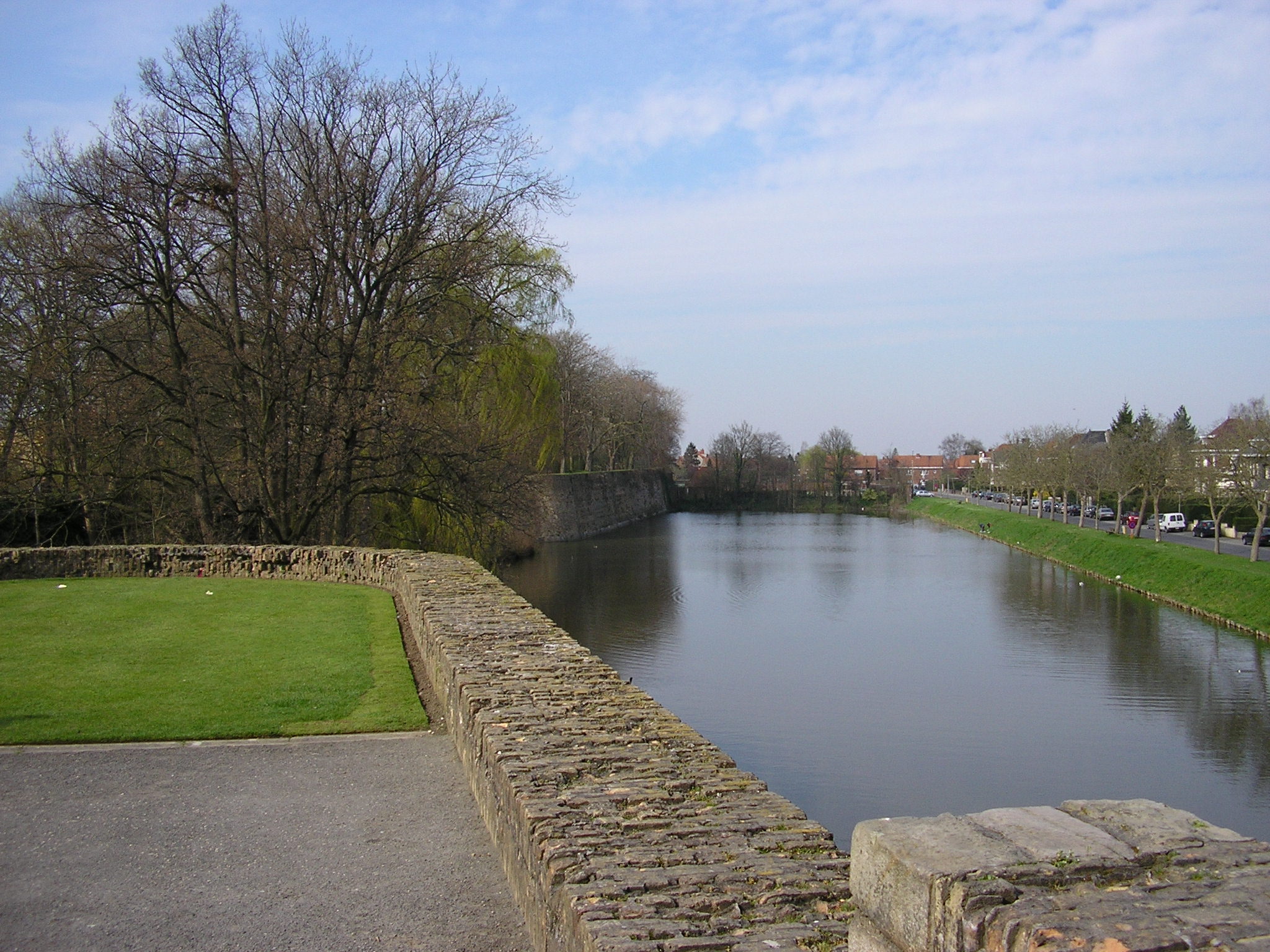
A new article has revealed the great extent to which the Belgian town of Ypres created a water supply system during the Middle Ages. In his article, "The Challenge for a Medieval Center of Industrial Growth: Ypres and the Drinking-Water Problem," Paul Trio uses archival and archaeological evidence to explain how fresh water was brought to the city for its population.
Because the city's booming textile industry required large amounts of water, the city's river, known as the Ieperlee, was not sufficient to meet its needs. Morover, the people of Ypres could not make use of wells because of the soil conditions in the region.
Trio details how city officials bought up land around the city that was turned into moats and ponds that collected water from nearby canals and streams. From there, a water supply network, "unrivalled both in the Low Countries and abroad," carried the water through underground pipes across Ypres.
This network grew over the Middle Ages, and a map of Ypres from 1847 shows that it consisted of "twenty-three kilometres of pipes that supplied eight-hundred and ninety-one cisterns or water reservoirs, public as well as private ones." Several examples of medieval pipes have been discovered, which show that they were made of either lead or wood, and could be as large as eleven and a half centimeters in diameter.
Furthermore, town accounts dating back to 1280 show that the town appointed four pipemasters ("pipemaistres") to oversee the water supply system, and who issued fines for improper use of water or for polluting it. A regulation from 1296, for example, stipulated that no cloth was to be bleached within two meters of a well.
The waste from used water was then transported through partially open sources out of the city to the Ieperlee downriver from Ypres. Trio concludes that "a complex and ingenious network of reservoirs and pipes was created very early on, probably during the course of the twelfth century. Not only did such a system weigh heavily on the urban budget, its mainetnance and - whenever necessary - its improvement or adaptation required a strong organization and rigorous control. That the water supply system of Ypres was an efficient one becomes clear from the fact that no major changes were implemented during the entire Ancien Regime."
The article can be found in The Nature and Function of Water, Baths, Bathing and Hygiene from Antiquity through the Renaissance
 , edited by Cynthia Kosso and Anne Scott. This book contains twenty-five articles which deal with a range of topics from Ancient Greece to the era of Shakespeare.
Wednesday, September 30, 2009
The Jewel Accounts of Henry III of England
An upcoming article will shed light on the large collection of gold and jewels held by a medieval English king.
"Secrecy, splendour and statecraft: the jewel accounts of King Henry III of England, 1216–72" was written by Benjamin Wild of King's College London. He analyzes a set of accounts which describe the gifts that were given and received by Henry III, the purchase of gems and specie, as well as expensive fabrics, such as cloth of gold.
In an interview with Medievalists.net, Dr. Wild said, "The jewel accounts are not merely a descriptive record of royal purchases. They also describe the flow of gifts in and out of the wardrobe. Gift-giving was ubiquitous in medieval society, helping to make, maintain and mend political and social relationships. The information within the jewel accounts is therefore very useful because it helps us to see who was doing the giving and receiving in and around Henry's court."
These records are part of the larger wardrobe accounts, which Dr.Wild explains, "preserve a record of the English king's personal expenditure. This includes everything from victuals, wine and spices, to clothes, building work and suits of armour."
The Jewel accounts are available for the reigns of Henry III up to Edward III. No other medieval state has similar kinds of surviving records.
The research reveals that the English king owned a surprisingly large amount of these treasures. The first surviving record, from 123, reveals that he had over 2000 items, including 173 rings, 103 gold brooches, 219 cloths of gold and hundreds of gold coins from as far away as North Africa.
By 1272, the collection had grown to over 2500 items, including 1168 rings. The Jewel Accounts also occasionally reveal more indepth information about some of his treasures. One record mentions a great bowl of silver, weighing 117 troy ounces, which Henry used to wash the feet of paupers during the Maundy celebrations. Another entry describes two miniature silver-gilt horses that had been given to King Henry by certain unnamed Jews.
Benjamin Wild's article goes on to reveal information about how the English King gave gifts of these treasures to his family, followers and to other European royalty, and how some of these items were sold off or got stolen.
"I think the most interesting discovery is that the jewel accounts show how Henry III increased the levels of his gift-giving at times of great political moment," said Dr.Wild. "According to the jewel accounts, the king distributed considerably more gifts (belts, cups, rings and brooches being the most common) during three crucial key periods: (1) 1234 (at the start of his so-called 'personal rule'); (2) between 1259 and 1260, when he was in France to ratify the controversial Treaty of Paris (by which Henry and his heirs renounced their claims to Normandy, Anjou and Poitou, in return for Gascony, which was to be held from the king of France); (3) after August 1265, when King Henry was able to revive his authority after the brutal murder of his brother-in-law and former jailer, Simon de Montfort. Henry III is often thought to have distributed gifts and patronage in a rather profiligate manner. The evidence of the jewel accounts suggests Henry was actually much more shrewd."
The article will appear in an upcoming issue of Historical Research. Dr. Wild has recently completed his PhD dissertation and is now preparing to publish several volumes of the wardrobe accounts for the reigns of Henry II and his son Edward I for the Pipe Roll Society. He has also started work on a book, prospectively titled King Henry III and the Power of Aesthetics, which he says "will shed new light of Henry III's use of art, ceremony and architecture. The wardrobe accounts, which provide detailed information about the English king's personal expenditure, will be a major source for this study."
Subscribe to:
Posts (Atom)