Showing posts with label Austria. Show all posts
Friday, November 16, 2012
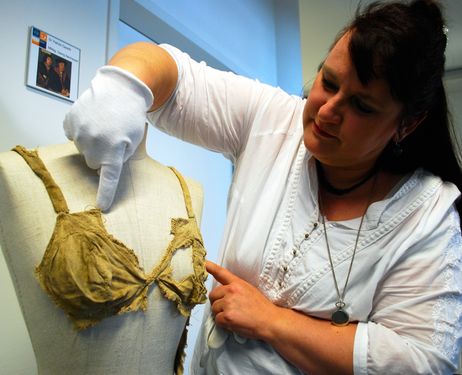
Medieval underwear points to racy history
Underwear dating from medieval times that was found under flooring of an Austrian castle is hardly racy by the standards of today.
But the discovery does suggest that women in 15th-century Europe took pride in their appearance, and perhaps not just the privileged classes.
The University of Innsbruck announced this summer that "the world's oldest brassieres" had been found at Longberg Castle in Tyrol, western Austria.
The cotton garments were decorated, much like today, with lace and embroidery. It might not be a stretch to suggest that such underwear was designed for those "special occasions," scholars say.
At the heart of Tyrol, an area lined with precipitous alpine peaks, is the city of Innsbruck. The items were found during renovations of the castle in summer 2008. The castle lies to the south of the city.
Four brassieres were found amid a heap of cotton material, clothing and leather footwear under the third floor.
Carbon dating by the university's archaeological research team dated the garments to between 1440 and 1485, making them the oldest in existence.
Click here to read this article from The Asahi Shimbun
See also Medieval lingerie? Discovery in Austria reveals what really was worn under those tunics
Friday, July 20, 2012
More on medieval bras – new details on 15th century find
The discovery of female undergarments from the 15th century is making international headlines. Now more details are being released by the University of Innsbruck.
The archaeological research was carried out at Lengberg Castle, East Tyrol, Austria, beginning in July 2008, when a renovation project for the medieval castle was stated. During the research a vault filled with waste was detected in the south wing of the castle in a room on the 2nd floor. The fill consisted of dry material in different layers, among them organic material such as twigs and straw, but also worked wood, leather – mainly shoes – and textiles.
The building history, as well as investigations on construction techniques and the archaeological features heavily suggested a dating of the finds to the 15th century, when another level was added to the castle by order of Virgil von Graben. The reconstruction is mentioned by Paolo Santonino in his itinerary, who also gives us a short description of the castle and mentions the reconstruction and the consecration of the castle chapel by Pietro Carlo (1472–1513), Bishop of Caorle, on October 13th 1485. The vault spandrel was most likely filled with waste during the addition of the 2nd storey as isolation or to level the floor.
Click here to read this article from Medievalists.net
Tuesday, July 17, 2012
Medieval lingerie? Discovery in Austria reveals what really was worn under those tunics
A recent discovery in an Austrian castle has revealed that bras existed back in the 15th century. It is among dozens of new textile artifacts that seem to have been preserved by a lucky accident, which will give historians a much better understanding of late medieval fashion.
The research, led by Beatrix Nutz of Innsbruck University, examines a room that was discovered in the south wing of Castle Lengberg in 2008. Evidence shows that the room was sealed off in the late 15th-century, and its dry conditions helped preserve organic material such as twigs and straw, as well as worked wood, leather (mainly shoes) and textiles.
In a paper given last year at the North European Symposium on Textiles, Professor Nutz explains that hundreds of textiles were discovered, some of which were clothing in very good condition. She said, “amid them were several nearly complete linen bras and fragments of corselettes, some rather coarsely made others more elaborately decorated with plaited borders and sprang worked parts. One of the bras even has a rather modern look.”
Click here to read this article from Medievalists.net
Friday, July 13, 2012
Medieval castle to be built in Austria
The Austrian town of Friesach will be home to a new medieval castle, to built using construction methods from the period. The project, which is being called a unique cooperation combining sustainable tourism and science, is expected to take thirty years and will involve work by a number of Austrian historians.
Medieval castles are regarded as buildings of particular stability: Even after 1,000 years, many have successfully withstood the ravages of time. Making the most of a construction site, where a castle is being constructed using medieval methods, historians are critically examining the existing knowledge about tools and materials, in an effort to gain new insights.
Click here to read this article from Medievalists.net
Tuesday, February 07, 2012
Austria's crown jewels offer a unique insight into medieval Europe
The octagonal crown fashioned from pure gold is studded with 144 precious stones and just as many pearls yet it is a priceless artifact for other reasons
.
The crown almost certainly once graced the head of the first German emperor Otto I more than 1,000 years ago. For hundreds of years it has been one of the most potent symbols of the Holy Roman Empire, the German kingdom which stretched across most of Central Europe.
Today it rests together with the other Austrian crown jewels behind reinforced glass in the Imperial Treasury or 'Schatzkammer' at the Hofburg palace in the Austrian capital Vienna.
'Around 280,000 visitors come here every year,' said Anja Priewe who works for the marketing department of the city's tourist authority. Tourists flock to see the imperial regalia but few of them take the time to look closely at particular objects.
Click here to read this article from Monsters and Critics
.
The crown almost certainly once graced the head of the first German emperor Otto I more than 1,000 years ago. For hundreds of years it has been one of the most potent symbols of the Holy Roman Empire, the German kingdom which stretched across most of Central Europe.
Today it rests together with the other Austrian crown jewels behind reinforced glass in the Imperial Treasury or 'Schatzkammer' at the Hofburg palace in the Austrian capital Vienna.
'Around 280,000 visitors come here every year,' said Anja Priewe who works for the marketing department of the city's tourist authority. Tourists flock to see the imperial regalia but few of them take the time to look closely at particular objects.
Click here to read this article from Monsters and Critics
Monday, September 05, 2011
School for Roman Gladiators discovered in Austria
A sensational discovery has been made by an international team from the Ludwig Boltzmann Institute for Archaeological Prospection and Virtual Archaeology (LBI-ArchPro), together with the Archaeological Park Carnuntum, using state-of-the-art ground penetrating radar devices. After a few hours of scanning, the interdisciplinary team has discovered a unique Roman building complex at Roman Carnuntum, 20 km east of Vienna in Austria and this will shed new light on how Roman gladiators lived and died in the provinces alongside the river Danube.
As the gladiators’ training and living quarters next to the Amphitheatre of the civilian city of Carnuntum (Petronell-Carnuntum), the newly discovered gladiator school has such clearly defined building structures that it can only be compared at the moment with the Amphitheatrum Flavium and Ludus Magnus in Rome.
Click here to read this article from History of the Ancient World
As the gladiators’ training and living quarters next to the Amphitheatre of the civilian city of Carnuntum (Petronell-Carnuntum), the newly discovered gladiator school has such clearly defined building structures that it can only be compared at the moment with the Amphitheatrum Flavium and Ludus Magnus in Rome.
Click here to read this article from History of the Ancient World
Tuesday, May 03, 2011
Austrian officials say unearthed treasure includes pieces made for royal court
A trove of medieval jewelry and other precious objects found by a man working in his backyard includes pieces made for a royal court and may be worth as much as 100,000 euros ($150,000) government experts said Monday.
The officials from Austria's department of national antiquities and the Academy of Sciences said they were only at the beginning of their investigation into the provenance and other details of the find.
"We have in front of us high-end products (made) for the highest consumer class of Central Europe" of the Middle Ages, academy member Thomas Kuehtreiber told reporters as security guards lifted a black velvet cloth from a glass case to reveal some of the rarer pieces.
The Federal Office for Memorials said the trove consists of more than 200 rings, brooches, ornate belt buckles, gold-plated silver plates and other pieces or fragments, many encrusted with pearls, fossilized coral and other ornaments. It says the objects are about 650 years old and weigh about 6.6 pounds (3 kilograms).
Click here to read this article from the Canadian Press
The officials from Austria's department of national antiquities and the Academy of Sciences said they were only at the beginning of their investigation into the provenance and other details of the find.
"We have in front of us high-end products (made) for the highest consumer class of Central Europe" of the Middle Ages, academy member Thomas Kuehtreiber told reporters as security guards lifted a black velvet cloth from a glass case to reveal some of the rarer pieces.
The Federal Office for Memorials said the trove consists of more than 200 rings, brooches, ornate belt buckles, gold-plated silver plates and other pieces or fragments, many encrusted with pearls, fossilized coral and other ornaments. It says the objects are about 650 years old and weigh about 6.6 pounds (3 kilograms).
Click here to read this article from the Canadian Press
Subscribe to:
Posts (Atom)


