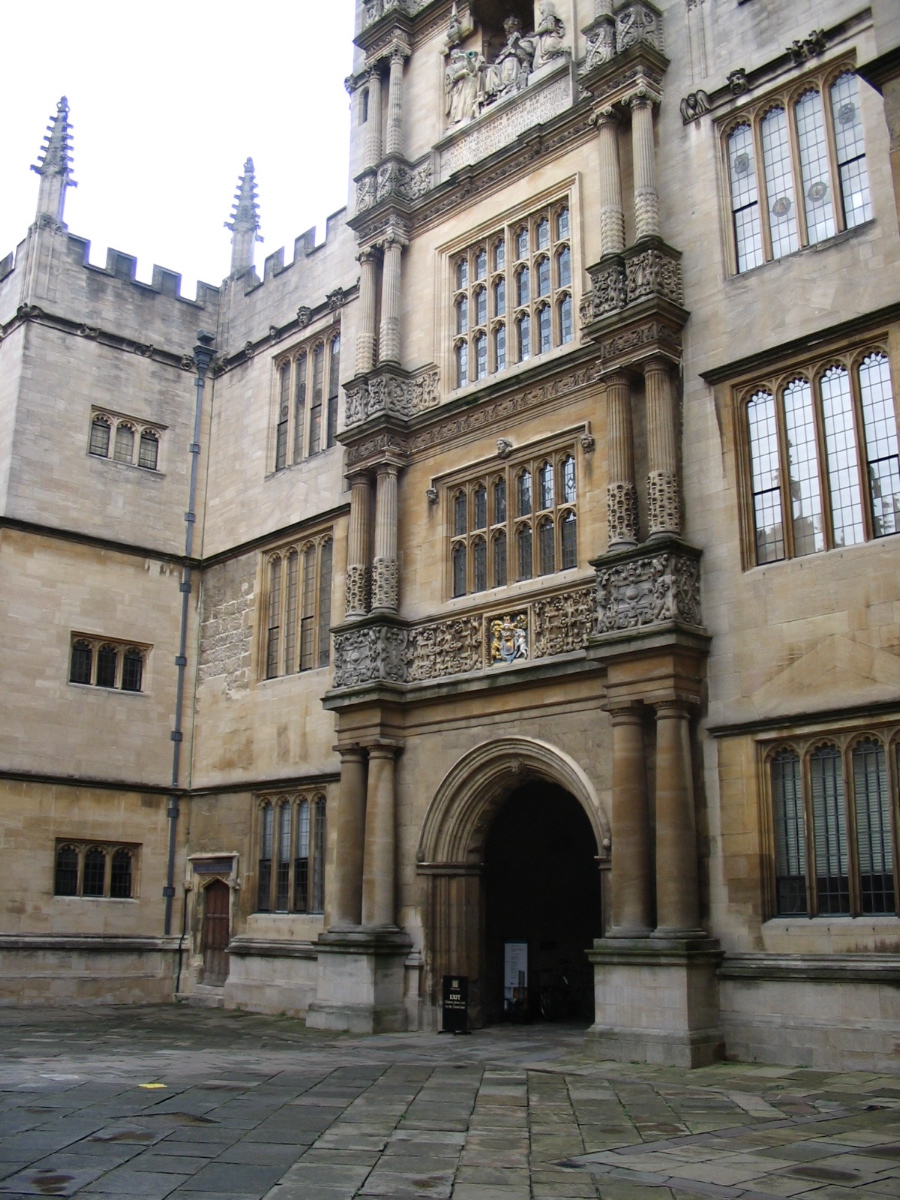
Showing posts with label Oxford University. Show all posts

Thursday, May 24, 2012

Burgers in the Bodleian? Professors fume (quietly)

Academics are aghast that manuscripts and rare books in one of the world's great research libraries may soon be mauled by undergraduates munching fast food.

 Paradoxically, what many see as a threat to the status of the Bodleian, founded in 1602, results from a £1 million ($1.6m) grant from the University of Oxford's most generous benefactor.

The university accepted the grant from the Oxford Martin School, a research institute endowed in 2005 by James Martin, an IT entrepreneur who has donated almost £100m to Oxford. In return,the school gets exclusive use of the university's Old Indian Institute building, displacing a large collection of history books.

Click here to read this article from The Australian


Thursday, April 12, 2012

University of Oxford and Vatican to digitize 1.5 million pages of historical texts


A collaboration between the University of Oxford’s Bodleian Library and the Biblioteca Apostolica Vaticana at the Vatican will bring historical texts dating back to the Middle Ages into the digital era. 1.5 million pages from both collections will be digitised and made publicly available.

The Bodleian Libraries and the Biblioteca Apostolica Vaticana will embark on a new collaborative digitisation project with the aim of opening up repositories of medieval and early modern texts and making a selection of their remarkable treasures freely available online to researchers and the general public worldwide.

The digitised collections will be in three subject areas: Greek manuscripts, 15th-century printed books (incunabula) and Hebrew manuscripts and early printed books. These areas have been chosen for the strength of the collections in both libraries and their importance for scholarship in their respective fields. The project will span four years and will result in approximately 1.5 million pages being made available in digital format

Click here to read this article from Medievalists.net

Monday, March 05, 2012

Bodleian Libraries Cairo Genizah collection now available online

The Bodleian Libraries have digitized and made available for the first time their exceptional collection of the Cairo Genizah fragments. The website launch is marked by a bequest of five Genizah fragments from the library of the late Eli Weinberg.

The Cairo Genizah is an accumulation of almost 280,000 medieval Jewish manuscript fragments, mostly written in Hebrew and Judeo-Arabic. They were discovered in the late nineteenth century in an annex of the Ben Ezra Synagogue in Fustat, presently Old Cairo, Egypt. Documents accumulated there from the ninth to the fourteenth centuries, and remained there until their value for scholarship was discovered in the 19th century.

Click here to read this article from Medievalists.net

Friday, September 30, 2011

Treasures of the Bodleian exhibition opens today

The Bodleian Libraries’ autumn exhibition ‘Treasures of the Bodleian’ opens to the public today (Friday 30 September). The exhibition will feature a selection of the Bodleian’s rarest, most important and most evocative items – from ancient papyri to medieval oriental manuscripts to twentieth-century printed books and ephemera.

The exhibits are arranged into broad themes: the classical heritage; mapping the world; the sacred word; the animal and plant kingdoms; works of the imagination; the sciences of observation and calculation; historical moments in time.

Click here to read this article from Medievalist.net

Friday, September 23, 2011

Pages from history: the best of the Bodleian

Deep underground, 20ft below the sandy-coloured stones of Oxford, mile upon mile of shelves lie dusty and empty. The entire contents of the New Bodleian Library – one of the most ancient and precious collections in the world, founded by Thomas Bodley in 1598 – have vanished.

It is a sight to instil fear into any scholar. Four editions of the Magna Carta; the First Folio of Shakespeare’s plays; and a document from the court of King Alfred that is reckoned to be the oldest in the English language. Three million books, a million maps, and countless priceless documents. All gone. But there is no need to worry: they have not been stolen, or teleported by culture-envying aliens. They have just been taken to Swindon.

Click here to read this article from The Telegraph

Wednesday, September 21, 2011

Oxford scanner reveals secrets of documents, ancient and modern

A scanner which combines the convenience of a desktop scanner with the functionality of a powerful laboratory imaging device has been developed at the University of Oxford’s Classics Department, and is now being commercialised by a new company Oxford Multi Spectral Limited which was today spun out by the University’s technology transfer company Isis Innovation.

The scanner was developed for imaging ancient papyri and the technology has been used to successfully scan, restore and archive over a quarter of a million historically significant manuscripts.

Click here to read this article from History of the Ancient World

Tuesday, July 19, 2011

Database explains strange survival of irregular verbs

An historical study of the development of irregular verbs in the hundreds of Romance languages including French, Spanish, Italian, Portuguese, Romanian and Catalan has revealed how these structures survive. Experts have also examined why they are learned by successive generations despite ‘making no sense’ or, apparently, having any function in the language.

Oxford University has published an online database displaying the irregularities of the verb systems of 80 Romance languages and dialects – those that developed from Latin – to highlight the research. The database is useful to specialists and others with an interest in Romance languages.

Click here to read this article from Medievalists.net 

Tuesday, June 14, 2011

Latin dictionary is a lifetime career

For 32 years, Dr David Howlett has been scouring medieval Latin texts, picking out unusual words and compiling them in one of the world’s most extraordinary dictionaries.

But, if that sounds like a lifetime’s work, it’s just a fraction of the time spent by scholars on a monumental effort to record the definitions of every Latin word used in Britain for more than 1,000 years.

A century after the idea was first floated to the British Academy, experts are only now compiling definitions of words beginning with ‘T’ for the Dictionary of Medieval Latin from British Sources.

Click here to read this article from the Oxford Mail

See also Dictionary of Medieval Latin from British Sources project nears completion

Thursday, May 19, 2011

Dictionary of Medieval Latin from British Sources project nears completion

A huge number of students ranging from linguists to those studying coins and family ancestry are benefiting from a 100 year project to compile the world’s most comprehensive dictionary of Medieval Latin.

Work started on the unique Dictionary of Medieval Latin from British Sources 50 years ago but experts began collecting material early in the 20th century.

Now the initiative is nearing completion and Professor Tobias Reinhardt, Corpus Christi Professor of the Latin Language and Literature at Oxford University is responsible for seeing it through.

Click here to read this article from Medievalists.net

Friday, October 22, 2010

Archeology digs at Roman sites

A new project has been launched this week to explore East Oxford’s Roman and medieval archaeological sites. Led by the University’s Department for Continuing Education, the project has been made possible by a £330,000 grant from the Heritage Lottery Fund.

Academics on the project will spend the next three years working with Oxford residents on digs, excavations, and surveys at sites believed to include Roman settlements, a medieval leper hospital and Civil War siege works.

Click here to read this article from the Cherwell

Oxford Centre for Asian Archaeology, Art and Culture officially opens

Oxford University has launch a new centre to study the archaeological and cultural heritage of Asia. The Oxford Centre for Asian Archaeology, Art and Culture, based in the University’s School of Archaeology, was officially opened yesterday and is set to become the only Asia-specialist centre of archaeological research and teaching in Europe.

Click here to read this article from Medievalists.net

Friday, May 21, 2010

Ivy offers protection for historical buildings, study says

It has been thought that ivy can cause damage to medieval and other historical buildings because of its roots slowly breaking into walls. But a new study suggests that the protective benefits of the plant are far more helpful for preserving heritage structures.

English Heritage commissioned a team of Oxford University academics to research the likely effects of ivy on historic buildings. In the three-year project, Oxford researchers analysed the effects of ivy growing on buildings in five different parts of England and discovered that the plant plays a protective role. They found that an ivy canopy was like a thermal shield, combating the extremes of temperature which often cause walls to crack.

Professor Heather Viles from Oxford University analysed the effect of common ivy (Hedera helix) to guide English Heritage in its important role as the steward of hundreds of historical sites. Professor Viles’s research team monitored the effect of ivy on walls situated in different parts of the country – with varying climates and challenges. They found that ivy acted as a thermal blanket, warming up walls by an average of 15 per cent in cold weather and cooling the surface temperature of the wall in hot weather by an average of 36 per cent. The ivy was also found to absorb some of the harmful pollutants in the atmosphere. Walls where ivy was growing were less prone to the damaging effects of freezing temperatures, temperature fluctuations, pollution and salts than exposed walls without ivy.

Heather Viles, Professor of Biogeomorphology and Heritage Conservation, said: "Ivy has been accused of destroying everything in its path and threatening some of our best loved heritage sites. Yet these findings suggest that there are many benefits to having ivy growing on the wall. It not only provides colourful foliage but also provides walls with weather-proofing and protection from the effects of pollution."

Garden walls at some of Oxford University ’s old colleges (Trinity, Pembroke and Worcester Colleges ) as well as the Old City Wall were test-sites in Oxfordshire. .

Other walls were tested at Byland, North Yorkshire; Nailsea near Bristol, and Leicester in the Midlands. The Oxford team used resistivity methods to monitor wall moisture levels and fixed monitors to measure the temperature and relative humidity of the microclimate beneath the ivy canopy as compared with uncovered walls. They also conducted laboratory analyses to examine the role of ivy in more detail.

The findings suggest that ivy has protective qualities for buildings that are intact; but they also showed that where walls are already damaged ivy rapidly finds its way into existing cracks and holes in walls. The researchers have built a test wall, planting ivy at the base, at Wytham Woods in Oxfordshire. The cube-shaped wall contains different flaws so researchers can measure and compare the different deterioration rates with and without ivy. The project provides those working for English Heritage as well as gardeners up and down the land with a better idea of how to treat ivy. Many might otherwise be unclear about whether to cut down ivy climbing up the walls of their garden and home.

Alan Cathersides, Senior Landscape Manager at English Heritage, said: "English Heritage are always keen to avoid unnecessary work to monuments and hope this research will lead to a more balanced approach to ivy. Removal should not be automatic as so often in the past, but a carefully considered element of long term management."

Source: English Heritage

Saturday, March 06, 2010

Bodleian Library unveils plans for renovation of New Bodleian

Oxford University’s world-famous Bodleian Library has unveiled its plans for the restoration and renovation of the New Bodleian library building. The long-awaited project has been designed by Wilkinson Eyre Architects; planning permission and Listed Building Consent will be applied for at the end of March. Once completed, it will be renamed the Weston Library, in honour of the £25 million donation given in March 2008 by the Garfield Weston Foundation.

The restoration project has three aims: to create high-quality storage for the library’s valuable Special Collections, which include the precious manuscripts, books and maps that the Bodleian preserves for the international world of scholarship; to develop the library’s facilities for the support of advanced research; and to expand public access to its great treasures through new exhibition galleries and other facilities.

Sarah Thomas, director of the Bodleian Libraries, said: ‘The improvements to the New Bodleian building are long overdue. Thanks to the generosity of the donors who have contributed to this project, we are at last able to move forward with this exciting and much-needed development. This major investment of £78 million will enable the library both to protect its great collections and to open them up to readers, researchers and the public in an historic building that has been reinterpreted for the 21st century.’

The plans have been unveiled at a public exhibition at the New Bodleian Library, Parks Road, Oxford. Planning permission and listed building consent will be applied for at the end of the month. Subject to this approval being received, the renovation and remodelling work will take five years and the building will reopen in 2015. The renovation of the New Bodleian is part of an integrated strategy to improve the management of and access to the Bodleian Libraries’ historic collections. To accommodate the books now housed in the New Bodleian and to provide space for the Libraries’ growing collections, the University is constructing a book storage facility in Swindon which will open in late 2010; it also plans to upgrade storage in the underground bookstore under Radcliffe Square to enable direct access to high-use books by readers.

Richard Ovenden, associate director and keeper of special collections, said: ‘Wilkinson Eyre Architects has created a stunning design that respects the building’s heritage while at the same time modernising our infrastructure and providing better facilities for students and researchers, as well as greater opportunities for collaboration with and outreach to the wider community.’

‘This is a major project for a working academic library. We need to move over 3.5 million books out of the building before work begins. As a working University library, we will continue to deliver our normal high standards of book and information delivery. We are fortunate to have excellent temporary facilities available for students and readers during the redevelopment.’

The New Bodleian building has been in urgent need of upgrading to modern standards appropriate for one of the largest and most important repositories of historical and legal deposit materials in the world. These will ensure the building complies with national standards for the storage of the library’s unique special collections. The Bodleian has consulted extensively with English Heritage, preservation groups and the city of Oxford to develop a plan that respects the best aspects of Giles Gilbert Scott’s classic 1930s building whilst opening it up to readers and visitors in a sympathetic fashion.

Jim Eyre, Director at Wilkinson Eyre Architects, commented: ‘This is a very exciting project for us. It is both a privilege and a challenge to be working within such an important historic context as this, and with such a unique collection of books and manuscripts. Our design aims to celebrate these precious objects by providing improved storage and preservation space, but also to increase public access and appreciation of this cultural and intellectual landmark.'

Thursday, December 03, 2009

Crossing Borders: Hebrew Manuscripts as a Meeting-place of Cultures


The Bodleian Library at Oxford University will start an exhibition next week, which tells the story of how Jews, Christians and Muslims have together contributed to the development of the book as an object of great cultural importance. The exhibition draws on the Bodleian's Hebrew holdings, one of the largest and most important collections of Hebrew manuscripts in the world.

Crossing Borders: Hebrew Manuscripts as a Meeting-place of Cultures runs from December 8th to May 3rd at the Exhibition Hall of the library. It will be open daily and admission is free.

Covering a time span of 300 years between the thirteenth century and fifteenth century, the exhibition brings to light different aspects of Jewish life across medieval Europe and the Middle East, in cultures that were non-Jewish.

The social and cultural interaction between Jews and non-Jews in both the Muslim and Christian world can be seen in the decorative patterns, writing styles, script types and text genres of the manuscripts themselves. As a result, Hebrew manuscripts produced in different regions look quite different, showing greater similarities to the non-Hebrew books produced in the same region than to other Hebrew books.

As this exhibition shows, by importing elements of the host culture, Hebrew manuscripts are proof of coexistence and cultural affinity, as well as practical cooperation between Jews and their non-Jewish neighbours, challenging received ideas about the treatment of Jews in the Middle Ages.

Highlights of the exhibition include:

- The Kennicott Bible, undoubtedly the most beautiful and extensively illustrated manuscript among Spanish Bibles of the fourteenth and fifteenth centuries. The illuminations reveal cross-cultural influences from Spanish Bible illustrations and popular European art to Islamic non-figurative carpet and vegetal decorations. The most striking illuminations will be shown through interactive digital technology, where visitors to the exhibition can 'Turn the pages' of this extraordinary treasure;

- A manuscript in the hand of the great Jewish philosopher Maimonides (1135-1204) a draft of his legal code Mishneh Torah.

- The Michael Mahzor: the earliest illuminated Jewish prayer book for the Festivals, produced in Germanyin 1258. The prayer book was illuminated by a Christian, who - not familiar with the Hebrew script- painted the first illustration upside down.

- The largest fragment of uninterrupted text of the book of Ben Sira (Ecclesiastics) in Hebrew, found at the Genizah of the synagogue in Fustat (Old Cairo). Dated 10th century it is one of the earliest examples of a Hebrew codex.

Piet van Boxel, Curator of Hebrew and Jewish Collections, Bodleian Library said: 'As the exhibition title suggests, Crossing Borders recounts the history of medieval culture at the intersection between Jewish, Christian and Muslim communities. It is a largely unfamiliar story which needs to be told and can help us to understand better the relationship between these communities even in our contemporary times.'

An exhibition catalogue is also available: Crossing Borders: Hebrew Manuscripts as a Meeting-place of Cultures, edited by Piet van Boxel and Sabine Arndt

Friday, November 27, 2009

Oxford scholar wins award for medieval music manuscript


An Oxford University Emeritus Fellow has received a prestigious award from the American Musicological Society for an 'outstanding scholarly edition in the field of musicology' that she has been working on for almost 35 years.

The 2009 Claude Palisca Award has been awarded to Bologna Q15: The Making and Remaking of a Musical Manuscript, an introductory study and facsimile edition by Dr Margaret Bent described as ‘a scholarly achievement of the highest order’.

Dr Bent’s work was the ‘unanimous choice’ for this year’s award. The Palisca Award committee said it was described by one of its members as ‘an exemplar of "regal musicology", a career-crowning achievement that will forever set a benchmark for facsimile editions.’ It described the quality of photography and reproduction as ‘breathtaking’.

Aside from Dr Bent's contributions, the publication has other links with the Oxford Music Faculty. DIAMM (the Digital Image Archive of Medieval Music), based in the Faculty, played a central role in providing the high-quality photography for the facsimile as its co-director Dr Julia Craig-McFeely undertook the photography, typesetting and layout. DIAMM is to be a key part of the Faculty's well-advanced plans to establish a Centre in Early Music.

Dr Bent said: 'I have been working on this manuscript for many years, alongside other projects. Compiled in the Veneto, it is the most important manuscript of international musical repertory of the early 15th century, and our only source for much music by major composers such as Du Fay.

'Codicologically it is extremely complex; its various revisions carry rare and valuable evidence about how a repertory underwent rapid renewal in the hands of its contemporaries – sorting it out is like a cross between a jigsaw puzzle and peeling the skins off an onion. My introductory study is a major new contribution to scholarship, and will enable future scholars to understand and use a central manuscript that has been puzzling and inaccessible.

'I'm particularly glad the citation not only praised my work, but the collaboration with Dr Julia Craig-McFeely, who did the photography, digital restorations, layout and typesetting for the whole volume so successfully that DIAMM is about to launch its own series of music facsimile publications, starting with the famous Eton Choirbook.'


The committee said: ‘Photographed in colour when it was disbound, with illegible pages digitally restored, the edition allows us to read some music for the very first time. Initials have been filmed on both sides enabling the editor to discern music that was discarded when the manuscript was recopied. Reproducing the original cover, watermarks, and gathering signatures, the facsimile can actually claim to be more useful and informative than having the original on one's desk.

'The editor has prefaced the facsimile with a magisterial essay of 383 folio-sized pages, which provides a history of the manuscript, its structure and chronology, the circumstances surrounding its various recopyings and revisions, and an overview of the nature, style, and reception of the 328 compositions it transmits.’

Thursday, November 19, 2009

Oxford medievalist wins Philip Leverhulme Prize


Dr Laura Ashe is one of three young academics from Oxford University that were awarded the prestigious Philip Leverhulme Prize worth £70,000.

The awards were given out to just 24 academics under the age of 36 who have ‘made a substantial and recognised contribution to their particular field of study, are recognised at an international level, and whose future contributions are held to be of correspondingly high promise’.

Dr Laura Ashe is in the English Faculty at Oxford University. Her research is focused on the literatures and culture of England, c.1000–1400. The long twelfth century, from the Norman Conquest to Magna Carta, was a time of development and change in political, legal and cultural spheres – but because its literature was in Latin and French, Dr Ashe says it has been excluded from English literary history.

Her research is devoted to restoring this period to our understanding of English medieval literature, tracing the continuities, which bind Old English to post-Conquest literature, and Latin and French to later Middle English.

Dr Ashe will be taking her prize over two years, beginning in October next year. She said: ‘The prize is fantastic, I’m going to use most of it to buy out my college teaching for two years in order to work on a large book. I’ve been commissioned to write Oxford English Literary History volume I: 1000–1350, which I hope will contribute to this multilingual period’s being brought properly into the mainstream of English literary studies.’

Dr. Ashe's first book Fiction and History in England, 1066-1200is a study of the ideologies of national identity, the genres of romance and chronicle, and the colonial discourses of the English in medieval Ireland.