Showing posts with label Mongols. Show all posts

Monday, April 16, 2012

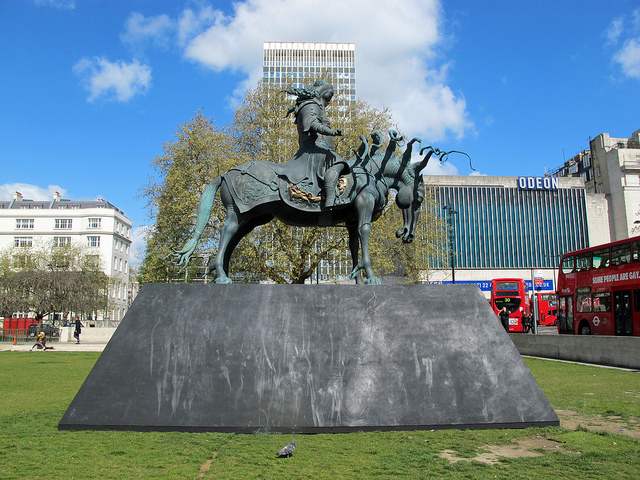
Genghis Khan sculpture unveiled in London

A bronze sculpture of Mongolian warrior Genghis Khan has been unveiled at Marble Arch in central London.
The 16ft tall (5m) statue captures the legendary leader wearing Mongolian armour on his steed.
The sculpture by artist Dashi Namdakov will stand next to Cumberland Gate until early September.
The artist, who had an interest in the nomadic tribes of Mongolia, wanted to honour the warrior on the 850th anniversary of his birth.
He said: "If I wanted to show him as a warrior I would have shown him as a warrior, but he is a thinker in this case. He is a divine figure in my country."

Click here to read this article from the BBC

Sunday, February 19, 2012

Seabed with 13th century Mongol shipwreck may become historic site

The Agency for Cultural Affairs plans to have the seabed off Nagasaki Prefecture where the wreck of a ship believed to have been used by 13th century Mongol invaders has been found declared a national historical site, agency sources said.

The declaration would make the area off Takashima Island in Matsuura, Nagasaki Prefecture, the first underwater ruins to be registered as such a site in Japan. The designation will in principle prohibit the area from being altered.

The agency sees the need to take immediate measures in the area, given that the relics there are expected to provide archeologists with crucial information on the 1274 and 1281 Mongol attacks that, until the discovery of the relatively intact shipwreck, has mostly been available only from documents and drawings.

Click here to read this article from the Japan Times

Wednesday, October 26, 2011

Shipwreck from Mongol Invasion fleet discovered off Japan

Archaeologists from the University of the Ryukyus in Japan have discovered large parts of a Mongolian/Chinese ship that was likely part of the Mongol invasion fleet that tried to invade the island in 1281. The find is the first intact wreck related to invasion attempts of Japan by the Mongolian ruler, Kublai Khan.

Led by Yoshifumi Ikeda, the archaeologists found the near complete hull structure about 1-meter under the seabed, and about 20-25 meters beneath the ocean’s surface off the Takashima Island near Nagasaki. The discovery is so monumental because much of the hull has remained intact, including a 12-meter section of the keels with rows of planks attached to the keel, Ikeda reported. The vessel appears to be well preserved due to the cover of sand.

Click here to read this article from Medievalists.net

Thursday, August 18, 2011

Golden Horde mausoleum discovered in Kazakhstan

A large mausoleum of the Golden Horde period was discovered in the Pavlodar region in Kazakhstan, the Pavlodar State Pedagogical Institute told Trend.

"The mausoleum, dated to the 14th century AD, is one of the largest archaeological buildings on the territory of Sary-Arka. The mausoleum’s height is 20 meters. The skeleton of a man who was the representative of the ruling elite was discovered at the bottom of the burial pit," the institute said.

Click here to read this article from Trend.Az

Thursday, April 07, 2011

In search of Genghis Khan's tomb

Albert Lin is hunting for Genghis Khan.

Legend has it that Khan, the ruthless conqueror who was the first emperor of the Mongol Empire, was buried in an unmarked tomb in northern Mongolia about 800 years ago.

But finding that tomb is a task that has eluded scientists for years. Mongolia encompasses more than 600,000 square miles of largely uncharted, rural territory, which makes Lin's mission extremely challenging.

Luckily, the explorer and research scientist at the University of California at San Diego has more than 7,000 people around the world helping with his mission, called the Valley of the Khans Project. The idea is to find the tombs of Genghis Khan and his descendants, and other ancient Mongolian artifacts.

Click here to read this article from the Minneapolis Star Tribune

Sunday, October 03, 2010

The Spirit of Xanadu, Morphing Across Borders

Art history is not a jigsaw puzzle waiting to be assembled. It’s more like a smashed sheet of reflective glass, continually reshattering, with splinters scattered here and there, many lost forever. With luck and work, scholars retrieve a few splinters, put them in a guessed-at order and turn on some lights. The result is an exhibition.

If the pieces are bright and the scholarship sharp, the show can be a subtle stunner, as is the case with “The World of Khubilai Khan: Chinese Art in the Yuan Dynasty,” the latest in the Metropolitan Museum of Art’s line of benchmark Chinese exhibitions. This one encompasses some 300 objects, from filigreed hairpins to a couple of megaton sculptures, most of them hard-won loans from China.


Click here to read this article from the New York Times

See also the earlier article The World of Khubilai Khan: Chinese Art in the Yuan Dynasty – Exhibition at the Met from Medievalists.net

Monday, September 27, 2010

The World of Khubilai Khan: Chinese Art in the Yuan Dynasty – Exhibition at the Met

The Metropolitan Museum of Art will present a major international exhibition devoted to the art of the Yuan dynasty (1271-1368)—one of the most dynamic and culturally rich periods in Chinese history—beginning September 28.

Bringing together over 200 works drawn principally from China, with additional loans from Taiwan, Japan, Russia, Germany, the United Kingdom, Canada, and the United States, The World of Khubilai Khan: Chinese Art in the Yuan Dynasty will explore the art and material culture that flourished during the pivotal and vibrant period in Chinese culture and history dating from 1215, the year of Khubilai Khan’s birth, to 1368, the fall of the Yuan dynasty.

Click here to read this article on Medievalists.net

Monday, January 11, 2010

The Decline and Fall of the Mongol Empire

A new article examines how the four Mongol empires collapsed, and concludes "that in all cases, ‘fall’ was the result of internal factors, about which there was nothing that was inevitable, and that there is little evidence of a long ‘decline’."


"The Decline and Fall of the Mongol Empire," by David Morgan, is published in a recent issue of the Journal of the Royal Asiatic Society. David Morgan is a Professor of History at the University of Wisconsin-Madison, and has written numerous articles and books about the Mongols and the Middle East.

He finds that many historians still take it as granted the idea first promulgated by Edward Gibbon from his book the Decline and Fall of the Roman Empire: “Empires may not fall until they have previously undergone a process of decline.” He asks if this was true for the Mongols.

In 1260 the Mongol Empire founded by Genghis Khan broke up into four smaller empires - the Yuan Dynasty in China, the Golden Horde in Russia and the Pontic Steppes, the Ilkhanate in Persia and the Middle East, and the Chaghatai in Central Asia. These four Mongol states each continued on and even expanded, at least until the 14th century. The Chaghatai Dynasty lasted until 1658.

Morgan analyzes each of these states and looks at the reasons behind for their collapse. He finds that in each case, they faced little outside threat, and fell because of internal factors.

The Yuan Dynasty, which was started by Qubilai Khan, ended in 1368, when the last Yuan (Mongol) emperor, Toghon Tem¨ur, was driven out of China and back to Mongolia. Morgan writes, "The predominant feature of the final years of Yuan rule, however – if one is looking for evidence of ‘decline’ – is the increasing frequency and seriousness of native Chinese revolts, especially in south China, and a loss of grip on the part of the central government. The Mongol armies were no longer of a quality to be able to deal effectively with these problems. More important, there were not enough of them; and the fourteenth-century neglect and impoverishment of Mongolia itself had meant that few new recruits could be hoped for from the homeland."

Despite this, Morgan believes the Yuan Dynasty could have fended off the Chinese rebellions and maintained their empire for years to come if had not been for some poor military decisions.

The article also deals with the Mongol empire in the Middle East, known as the Ilkhanate. Morgan rejects notions that there was a decline during the reign of the last Ilkhan Abu Sa’id (1316–35), citing some evidence that economically the Ilkhanate was more prosperous than ever. Instead, Morgan writes that " Abu Sa’id’s problem was much the same as Henry VIII of England’s: his difficulty in providing a male heir. Henry managed it in the end, after a fashion. Abu Sa’id did not, and there was therefore no unchallengeable member of the line of H¨uleg¨u available to succeed him when he died in 1335. Various expedients were tried by several factions. But essentially the throne was up for grabs, and the central government disintegrated as a result. Parts of the khanate fell under the control of what would now probably be called warlords – some Mongol, some not."

He also notes that two more nomadic empires - the Golden Horde and the Chaghatai Khanate - lasted much longer, and their collapses were due more to internal factors rather than any outside threat.

Morgan concludes, "Parts of the Mongol Empire continued for a very long time; and as it happens those were the parts which retained more of the traditional steppe lifestyle. Other parts collapsed much earlier, and those were the more sedentary areas, where more accommodation to local mores had been necessary, and where less of the nomadic lifestyle had survived. But even in those cases, an examination of the actual events suggests that the Mongol regimes could perfectly well have continued, had different decisions been taken at various points or had different circumstances prevailed." The article, "The Decline and Fall of the Mongol Empire" appears in Volume 19, Number 4 of the Journal of the Royal Asiatic Society (2009).
Click here to read more about the Mongols