Saint Louis University’s Center for Medieval and Renaissance Studies will host the 2012 Annual Meeting of the Medieval Academy of America Thursday-Saturday, March 22-24.
The international meeting will feature 50 concurrent sessions from a wide range of disciplines and approaches. Plenary speakers will include:
William Chester Jordan (Princeton University and President of the MAA Fellows) - ”The Gleaners”
Caroline A. Bruzelius (Duke University) - ”Inside/Outside: Friars and the Dynamics of Urban Space”
Alice-Mary Talbot (Dumbarton Oaks) - ”Searching for Women in the Archives of Mount Athos”
Richard C. Hoffmann (York University) - ”Too Many Catches? Consumption, Habitat, Climate, and Competition in Medieval European Fisheries”
Click here to read this article from Medievalists.net
Showing posts with label Medieval Academy of America. Show all posts
Showing posts with label Medieval Academy of America. Show all posts
Monday, March 19, 2012
Tuesday, April 12, 2011
Immigration issues take forefront at the Medieval Academy of America meeting
The subjects of immigration, migration and borders will be the focus of the Medieval Academy of America when it begins it annual meeting in Arizona this week. The academy and the Arizona Center for Medieval and Renaissance Studies (ACMRS) decided to make these topics a priority as a response to the controversy of having the conference take place in the state.
The annual meeting of the Medieval Academy of America is taking place from April 14th to 16th in the city of Scottsdale, and is one of the most important gatherings of medievalists in North America. Over 140 papers are being given.
Click here to read this article from Medievalists.net
The annual meeting of the Medieval Academy of America is taking place from April 14th to 16th in the city of Scottsdale, and is one of the most important gatherings of medievalists in North America. Over 140 papers are being given.
Click here to read this article from Medievalists.net

Saturday, August 21, 2010
Medieval-Studies Group Divided Over Whether to Hold Meeting in Arizona
A national organization devoted to medieval studies is facing a backlash from some of its members over its decision to go ahead with a conference next April in Arizona, where a controversial immigration law enacted this year has drawn sharp criticism from many academics.
Some members of the Medieval Academy of America wrote an open letter this month to the organization assailing its decision to keep the conference in Tempe, Ariz., despite previous complaints in May. The group that wrote the latest letter includes leaders of a scholarly organization called "Monsters" for short, for people who conduct research on examples of monstrosity in past and present societies.
Click here to read the article from The Chronicle of Higher Education
Some members of the Medieval Academy of America wrote an open letter this month to the organization assailing its decision to keep the conference in Tempe, Ariz., despite previous complaints in May. The group that wrote the latest letter includes leaders of a scholarly organization called "Monsters" for short, for people who conduct research on examples of monstrosity in past and present societies.
Click here to read the article from The Chronicle of Higher Education
Tuesday, August 03, 2010
Medieval Academy of America decides to keep its annual meeting in Arizona
The Medieval Academy of America announced today that its 2011 annual meeting will still be held in Arizona. The academic organization was under pressure to move the conference because of the recent immigration law adopted by the state.
An email was sent out to its membership and posted the Medieval Academy of America’s (MAA) website, which stated the MAA’s Executive Committee took into account a number of issues when making their decision, including the “fiduciary responsibility for the Academy’s endowment, the appropriateness of making collective political statements, the precedents that would be set if the Academy canceled the meeting, the scholarly effects of canceling the annual meeting, the work done by the Arizona programming committee, the difficulty of finding any alternative meeting place, the timing of cancellation, and the possibility of legal challenge to Arizona’s legislation.”
Click here to read the article on Medievalists.net
An email was sent out to its membership and posted the Medieval Academy of America’s (MAA) website, which stated the MAA’s Executive Committee took into account a number of issues when making their decision, including the “fiduciary responsibility for the Academy’s endowment, the appropriateness of making collective political statements, the precedents that would be set if the Academy canceled the meeting, the scholarly effects of canceling the annual meeting, the work done by the Arizona programming committee, the difficulty of finding any alternative meeting place, the timing of cancellation, and the possibility of legal challenge to Arizona’s legislation.”
Click here to read the article on Medievalists.net
Monday, May 24, 2010
Controversy over medieval conference location

Medieval blogs such as In the Middle have raised the issue in the last few days, and have drawn extensive discussion and interest. One of the In the Middle's editors, Jeffrey J. Cohen, has published an open letter to the Medieval Academy of America (MAA) calling on them to "seriously consider not holding its planned annual meeting" in Tempe, Arizona. Over seventy other scholars have also signed the letter.
Their main objection is the immigration law passed in Arizona last month which makes it a crime to be in the United States illegally. The law also requires legal immigrants to carry their registration documents at all times and allows police officers to ask people about their immigration status if they have reasonable grounds for suspicion. Critics of the law have called it racist and unconstitutional, and that is aimed against the large Hispanic community in Arizona.
The law, considered to be the toughest in the United States, has generated a great deal of debate across the country. Cohen, a professor of English and Director of the Medieval and Early Modern Studies Institute at George Washington University, wrote that the the law is "almost carte blanche for police intimidation and harassment is, to my mind, racist and just wrong."
Dozens of other medieval scholars and bloggers added their views about the law. In an interview with Medievalists.net, Cohen said, "I've been a bit surprised at -- and heartened by -- the passion medievalists have brought to the discussion. Despite the fact that most of us study a time period a millennium away, we obviously care deeply about contemporary social justice. Some of the comments made in support of not holding the annual meeting were personal, and affecting: one from someone who'd grown up in apartheid South Africa and seen how a boycott could work; another from someone who'd suffered from being labeled an alien herself.
"But I also liked that despite the way this Arizona law makes many of us feel, the discussion has been cautious and mainly level-headed. People have emphasized the complexity of the situation, and most trust that the MAA will make the right choice here. So it's good to see the confidence in the integrity of our professional organization and its elected leaders."
Officials with the Medieval Academy of America have already made responses to the situation. MAA President Elizabeth A.R. Brown wrote to Professor Cohen and remarked that "We have been concerned about this problem from the moment the governor of Arizona signed the bill concerning immigrants. We are all following developments closely and are keenly aware of the importance of the issues that are at stake."
MAA Executive Director Paul E. Szarmach told Medievalists.net that the controversy over the Arizona location has only emerged in the few last weeks, and that they are currently gathering views and suggestions on which course of action to take. He has confirmed that they are examining the option of moving the conference outside of Arizona, but that they would have to pay a cancellation fee of $30 000 to the Chaparral Suites Hotel. He notes that their are "strong feelings, strong ideas" about the issue, and that "people want to do the right thing." Szarmach expects a decision to be made within the next few weeks.
The annual meeting of the Medieval Academy of America is one of the largest medieval studies conferences in North America - the 2010 meeting was held at Yale University and drew over 150 speakers to give papers and participate in round table discussions. The location of the annual meeting changes every year, and it was last held in Tempe in 2001 - it is hosted by the Arizona State University, which is home to the Arizona Center for Medieval and Renaissance Studies. The decision to have the 2011 annual meeting be held in Arizona was made over two years ago, long before the anti-immigration legislation was even proposed.
Medievalists are not the only people thinking of boycotting the state - since the immigration law was passed at least 19 conferences have been cancelled in Arizona, and there have been calls for Major League Baseball to move its 2011 All Star Game from Pheonix unless the law is repealed.
Here are some background videos about the Immigration Law in Arizona:
Sources: In the Middle, Medieval Academy of America
Monday, April 20, 2009
World's top teaching award in Medieval Studies goes to Richard K. Emmerson
Professor Richard K. Emmerson, the chairman of the Department of Art History at The Florida State University and an internationally renowned scholar on the Middle Ages, has garnered the 2009 Excellence in Teaching Medieval Studies award from the Medieval Academy of America.

Worldwide, only one recipient of the distinguished honor is named each year by the Academy, which is the largest professional organization in the world devoted to medieval studies. About a third of its members are from outside the United States. This is the first time that a Florida State faculty member has won the Excellence in Teaching award.
"It is a great honor on an international scale not only for Professor Emmerson but also for our university and its College of Visual Arts, Theatre and Dance," said Sally McRorie, dean of the college. "It is noteworthy that Emmerson was nominated by no fewer than three of our graduate students in art history, and that additional letters of support came from among the foremost scholars and teachers in the field of medieval studies."
Emmerson, who also holds a courtesy faculty position in the Department of English, is the former executive director of the Medieval Academy of America. In the three decades since earning his Ph.D. at Stanford University, he taught at Georgetown University, Harvard University, Tufts University and Western Washington University (where he chaired the Department of English) prior to joining FSU´s faculty in 2006. His acclaimed interdisciplinary research has focused on apocalyptic themes in medieval art, drama and poetry and on illustrated manuscripts, primarily from England and France, from the 13th through 15th centuries.
"As a widely recognized medieval scholar, Emmerson has helped to enhance significantly the national reputation of Florida State´s art history department," McRorie said. "Moreover, the acknowledgment from scholarly peers worldwide of his great passion for teaching is a marvelous addition to his academic credentials. Sometimes scholars can become so immersed in their research and administrative and other leadership duties that they may become less directly dedicated to students and great teaching. But Rick clearly has maintained a strong and effective dedication to all aspects of his role, from teaching to research and service."
In 2008, Emmerson was the keynote speaker to more than 3,000 scholars at the 44th meeting of the International Congress of Medieval Studies. In 2007, the Council of Editors of Learned Journals named Emmerson "Distinguished Editor" for his work editing Speculum: A Journal of Medieval Studies from 1999 to 2006. He has served as the deputy director of Fellowships at the National Endowment for the Humanities, and is the incoming president of the Medieval and Renaissance Drama Society.
Emmerson has written nearly 40 articles and essays that have appeared in academic journals and scholarly collections and, so far, had six books published, including his first (1981) and best-known book, Antichrist in the Middle Ages: A Study of Medieval Apocalypticism, Art, and Drama. He now has been contracted as the editor of the new Dictionary of Medieval Civilization that is slated for publication in three or four years by Cambridge University Press. The huge reference work will involve about 175 scholars and 1,300 pages of text.
"Professionally, this teaching award means a lot to me because when I came to FSU in 2006 to chair the Department of Art History I switched disciplinary fields," Emmerson said. "My Ph.D. is in English, and in the past I have chaired an English department, so it is especially gratifying to be recognized in my new discipline. This honor means a great deal to me personally because the graduate students who nominated me, on their own and in confidence, invested the substantial time necessary to create the nomination file."
"The Department of Art History at Florida State is very lucky to have excellent students in our graduate program, many of whom concentrate on medieval art history," Emmerson said. "This facilitates excellent seminars and mutual support among students and thus makes our program in this area one of the very best in the nation."
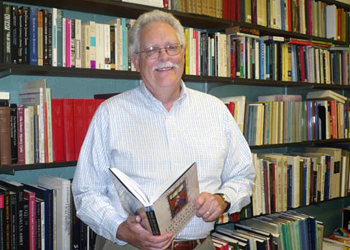
Worldwide, only one recipient of the distinguished honor is named each year by the Academy, which is the largest professional organization in the world devoted to medieval studies. About a third of its members are from outside the United States. This is the first time that a Florida State faculty member has won the Excellence in Teaching award.
"It is a great honor on an international scale not only for Professor Emmerson but also for our university and its College of Visual Arts, Theatre and Dance," said Sally McRorie, dean of the college. "It is noteworthy that Emmerson was nominated by no fewer than three of our graduate students in art history, and that additional letters of support came from among the foremost scholars and teachers in the field of medieval studies."
Emmerson, who also holds a courtesy faculty position in the Department of English, is the former executive director of the Medieval Academy of America. In the three decades since earning his Ph.D. at Stanford University, he taught at Georgetown University, Harvard University, Tufts University and Western Washington University (where he chaired the Department of English) prior to joining FSU´s faculty in 2006. His acclaimed interdisciplinary research has focused on apocalyptic themes in medieval art, drama and poetry and on illustrated manuscripts, primarily from England and France, from the 13th through 15th centuries.
"As a widely recognized medieval scholar, Emmerson has helped to enhance significantly the national reputation of Florida State´s art history department," McRorie said. "Moreover, the acknowledgment from scholarly peers worldwide of his great passion for teaching is a marvelous addition to his academic credentials. Sometimes scholars can become so immersed in their research and administrative and other leadership duties that they may become less directly dedicated to students and great teaching. But Rick clearly has maintained a strong and effective dedication to all aspects of his role, from teaching to research and service."
In 2008, Emmerson was the keynote speaker to more than 3,000 scholars at the 44th meeting of the International Congress of Medieval Studies. In 2007, the Council of Editors of Learned Journals named Emmerson "Distinguished Editor" for his work editing Speculum: A Journal of Medieval Studies from 1999 to 2006. He has served as the deputy director of Fellowships at the National Endowment for the Humanities, and is the incoming president of the Medieval and Renaissance Drama Society.
Emmerson has written nearly 40 articles and essays that have appeared in academic journals and scholarly collections and, so far, had six books published, including his first (1981) and best-known book, Antichrist in the Middle Ages: A Study of Medieval Apocalypticism, Art, and Drama. He now has been contracted as the editor of the new Dictionary of Medieval Civilization that is slated for publication in three or four years by Cambridge University Press. The huge reference work will involve about 175 scholars and 1,300 pages of text.
"Professionally, this teaching award means a lot to me because when I came to FSU in 2006 to chair the Department of Art History I switched disciplinary fields," Emmerson said. "My Ph.D. is in English, and in the past I have chaired an English department, so it is especially gratifying to be recognized in my new discipline. This honor means a great deal to me personally because the graduate students who nominated me, on their own and in confidence, invested the substantial time necessary to create the nomination file."
"The Department of Art History at Florida State is very lucky to have excellent students in our graduate program, many of whom concentrate on medieval art history," Emmerson said. "This facilitates excellent seminars and mutual support among students and thus makes our program in this area one of the very best in the nation."
Subscribe to:
Posts (Atom)