
Showing posts with label Food. Show all posts
Showing posts with label Food. Show all posts
Monday, October 27, 2014
Westminster Abbey, Ukek and York: Medieval News Roundup
From archaeological discoveries in Russia and England, to a 15th century recipe on 'Caudell of Almondys', here is some of the things we found in the news, on the blogs, and on Twitter.


Saturday, December 22, 2012
Tourtiere's deep roots traced to 1,600-year-old cookbook
Quebec has two basic tourtieres, and many variations for each type, gastronomy historian Jean-Pierre Lemasson told the McCord Museum conference. There is the shallow style, filled with pork and/or other meats, and a deep-dish Lac St. Jean, or Saguenay, style that contains cubes of meats with vegetables.

Marcus Gavius Apicius, credited with writing the recipes in what is believed to be the first cookbook (about AD 400), gave us what might be the earliest written recipe for the deep-dish version, he said. It's a pie called La Patina that was made in a bronze pot with four layers of pastry, the top crust with a hole in the centre.
Medieval predecessors of the tourtiere described by Lemasson include Italy's tourte parmesane, pasticchio, timballo, and timpanno. France has a tourte parmenienne, he said, followed by the timbale and the casserole. British meat pies included the Parmesan and Battle Pye, the raised pie, and the Yorkshire Christmas pie.
Click here to read this article from the Montreal Gazette

Marcus Gavius Apicius, credited with writing the recipes in what is believed to be the first cookbook (about AD 400), gave us what might be the earliest written recipe for the deep-dish version, he said. It's a pie called La Patina that was made in a bronze pot with four layers of pastry, the top crust with a hole in the centre.
Medieval predecessors of the tourtiere described by Lemasson include Italy's tourte parmesane, pasticchio, timballo, and timpanno. France has a tourte parmenienne, he said, followed by the timbale and the casserole. British meat pies included the Parmesan and Battle Pye, the raised pie, and the Yorkshire Christmas pie.
Click here to read this article from the Montreal Gazette
Friday, June 29, 2012
History, Chemistry, and Cold Beer

That's OK. Just know you are participating on one of humanities oldest and most popular activities. After water and tea, beer is the third most favored drink in the world. It is one of the first by-products of human agriculture. Beer may, in fact, be a reason for civilization.
The United States is a splendid place to drink beer, said British-born expert Charles Bamforth of the University of California, Davis. The market is huge and diverse, with an enormous variety of the stuff available from breweries large and small. Beer is made of fermented cereal grains. Usually, the grain is barley, but wheat beer is common, sometimes rye, rice, corn, or even sorghum.
The drink was discovered about 8,000 years ago, historians believe, likely the result of accidents in bakeries.
Click here to read this article from Inside Science News Service
Wednesday, June 13, 2012
New cookbook looks at old recipes — live frog pie, anyone?

"You could cook a meal, but it could be quite a strange meal," said Ross, the chief librarian at Guildhall Library in London and the author of The Curious Cookbook, which looks at a wild range of cookery from medieval times right through to the Second World War.
"It's mostly the medieval recipes where you're going to have a problem — because they were eating things like swans, peacocks, porpoises."
The new book also features a live frog pie that dates from the 17th century.
Ross said the dish containing live frogs was "basically an entertainment" that was served during a high-class meal.
Click here to read this article and listen to an interview with the author from the CBC
Monday, June 04, 2012
The Medieval Cookbook and The Classical Cookbook published in revised editions
The Getty Museum and British Museum have published two cookbooks for those wanting to try recipes dating back to the Middle Ages or ancient times. The Medieval Cookbook, by food hisorian Maggie Black offers collection of medieval recipes, but a social history of the time.
This revised edition has eighty recipes, drawn from the earliest English cookbooks of the fourteenth and fifteenth centuries, are presented in two formats: the original Middle English version and one adapted and tested for the modern cook. The author also describes the range of available ingredients in medieval times and the meals that could be prepared from them—from simple daily snacks to celebratory feasts—as well as the preparation of the table, prescribed dining etiquette, and the various entertainments that accompanied elite banquets.
Click here to read this article from Medievalists.net
This revised edition has eighty recipes, drawn from the earliest English cookbooks of the fourteenth and fifteenth centuries, are presented in two formats: the original Middle English version and one adapted and tested for the modern cook. The author also describes the range of available ingredients in medieval times and the meals that could be prepared from them—from simple daily snacks to celebratory feasts—as well as the preparation of the table, prescribed dining etiquette, and the various entertainments that accompanied elite banquets.
Click here to read this article from Medievalists.net
Wednesday, April 11, 2012
What's the closest thing to a medieval dining experience in London?

This is the home of Medieval Banquet London. Think brave knights, troubadours, minstrels with lutes and jugglers (all played by professional actors), turning your meal into a medieval extravaganza. Enjoy music from 800-year-old manuscripts, hire medieval costumes and bang your fists on the table to demand more food from your serving wench.
Click here to read this article from the Daily Telegraph
Click here to visit the Medieval Banquet London website
Sunday, April 08, 2012
Lust, Lies And Empire: The Fishy Tale Behind Eating Fish On Friday

This "realpolitik" explanation of why Catholics eat fish on Friday has circulated for so long, many people grew up believing it as fact. Some, myself included, even learned it in Catholic school. It's a humdinger of a tale — the kind conspiracy theorists can really sink their teeth into. But is it true?
"Many people have searched the Vatican archives on this, but they have found nothing," says Brian Fagan, a professor emeritus of archaeology at the University of California, Santa Barbara, whose book, Fish On Friday, explores the impact of this practice on Western culture.
The real story behind fish on Fridays turns out to be much better.
Click here to read this article from NPR
Saturday, January 28, 2012
Medieval Energy Bars: They're Back!
It's dark, chewy and protein-packed. It's fruity-sweet and studded with nuts. Sticky on the inside but smooth on the outside, it travels well.
It's panforte, a traditional Tuscan spiced fruitcake so dense as to be almost candy. Invented in medieval Siena, where monks baked it for local Crusaders enroute to the Holy Land -- hey, Crusaders need comfort food too -- this flour-sugar-citron-almond-hazelnut-clove-cinnamon-nutmeg-honey melange is made to last. Its very name means "strong bread" -- strong-tasting and more durable than donuts. It's history's first energy bar.
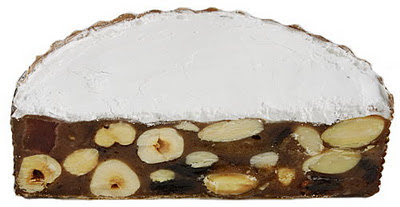
And it's back. At the 37th annual Fancy Food Show in San Francisco last week, no less than three different companies debuted brand-new versions of this glorious relic from an age when Istanbul was Constantinople, and sultans paid bounties for every severed Christian head.
Click here to read this article from the Huffington Post
It's panforte, a traditional Tuscan spiced fruitcake so dense as to be almost candy. Invented in medieval Siena, where monks baked it for local Crusaders enroute to the Holy Land -- hey, Crusaders need comfort food too -- this flour-sugar-citron-almond-hazelnut-clove-cinnamon-nutmeg-honey melange is made to last. Its very name means "strong bread" -- strong-tasting and more durable than donuts. It's history's first energy bar.

And it's back. At the 37th annual Fancy Food Show in San Francisco last week, no less than three different companies debuted brand-new versions of this glorious relic from an age when Istanbul was Constantinople, and sultans paid bounties for every severed Christian head.
Click here to read this article from the Huffington Post
Wednesday, January 18, 2012
At MIT, dine like a 14th-century nobleman

For over a decade, during the Independent Activities Period between semesters, Massachusetts Institute of Technology has offered a noncredit class on “old food’’ from the region around the Mediterranean Sea. The idea came from conversations History Department chair Anne McCants, who teaches the class, had with a colleague about how little students know about daily life in the past, she says. “Both of us liked to cook and I was especially interested in nutrition and health of past populations, as well as the productive capacity of agricultural societies. So all of that came together to suggest a fun but informative IAP class using ancient and medieval recipes.’’
This year’s participants were a diverse dozen from the university’s various academic departments, including budding engineers, staff, and at least one bona fide student of history. The hands-on, half-day class took place in the modern kitchen of Next House, a student dormitory. Electric ovens stood in for wood fires.
Click here to read this article from the Boston Globe
Saturday, August 27, 2011
500 years ago, yeast’s epic journey gave rise to lager beer
In the 15th century, when Europeans first began moving people and goods across the Atlantic, a microscopic stowaway somehow made its way to the caves and monasteries of Bavaria.
The stowaway, a yeast that may have been transported from a distant shore on a piece of wood or in the stomach of a fruit fly, was destined for great things. In the dank caves and monastery cellars where 15th century brewmeisters stored their product, the newly arrived yeast fused with a distant relative, the domesticated yeast used for millennia to make leavened bread and ferment wine and ale. The resulting hybrid – representing a marriage of species as evolutionarily separated as humans and chickens – would give us lager, the clear, cold-fermented beer first brewed by 15th century Bavarians and that today is among the most popular – if not the most popular – alcoholic beverage in the world.
Click here to read this article from Medievalists.net
The stowaway, a yeast that may have been transported from a distant shore on a piece of wood or in the stomach of a fruit fly, was destined for great things. In the dank caves and monastery cellars where 15th century brewmeisters stored their product, the newly arrived yeast fused with a distant relative, the domesticated yeast used for millennia to make leavened bread and ferment wine and ale. The resulting hybrid – representing a marriage of species as evolutionarily separated as humans and chickens – would give us lager, the clear, cold-fermented beer first brewed by 15th century Bavarians and that today is among the most popular – if not the most popular – alcoholic beverage in the world.
Click here to read this article from Medievalists.net
Thursday, August 18, 2011
Celebrity chef reinvents a long-lost Medieval recipe
Living every moment to the hilt, the characteristic that most describes Alan Coxon is his intense desire to make the past come alive on everybody’s food plate. His passion for how our past has shaped our food preferences, pushed cultures into inventing and experimenting with ingredients and of the history of food ingredients in itself is immense. He is tirelessly excited about it.
This passion is what led him to reinvent a classic and historically valuable recipe from Medieval England, which he has calls the Ale-Gar, putting him in the rare league of chefs who have invented food products of great value. A versatile and uniquely flavoured form of vinegar, to put it very broadly, Ale-Gar can be put to a variety of uses as well-known chefs in many restaurants in the West are attesting to.
Click here to read this article from Gulf News
This passion is what led him to reinvent a classic and historically valuable recipe from Medieval England, which he has calls the Ale-Gar, putting him in the rare league of chefs who have invented food products of great value. A versatile and uniquely flavoured form of vinegar, to put it very broadly, Ale-Gar can be put to a variety of uses as well-known chefs in many restaurants in the West are attesting to.
Click here to read this article from Gulf News
Tuesday, July 05, 2011
Medieval recipe book reveals wealth of Evesham's monks

They are all recipes the monks used to make at the abbey, founded in 701, by St. Ecgwine, third Bishop of Worcester. He said: "I managed to find a hard core of recipes which related to the abbey of St Mary and St Ecgwine."
Click here to read this article from the BBC
Sunday, June 12, 2011
How much meat did medieval people eat?
A recently published article has revealed some interesting new details about meat consumption in the Middle Ages, including how different regions in medieval Western Europe had their own preferences for these foods.
In the article, “Consumption of Meat in Western European Cities during the Late Middle Ages: A Contemporary Study,” Ramón Agustín Banegas López examines a wide range of evidence from England, France, Italy and the Iberian Peninsula to see what kinds of meat were eaten by its urban residents, including beef, mutton, pork and veal.
Click here to read this article from Medievalists.net
In the article, “Consumption of Meat in Western European Cities during the Late Middle Ages: A Contemporary Study,” Ramón Agustín Banegas López examines a wide range of evidence from England, France, Italy and the Iberian Peninsula to see what kinds of meat were eaten by its urban residents, including beef, mutton, pork and veal.
Click here to read this article from Medievalists.net
Wednesday, May 11, 2011
Leeds exhibition to host history of sugar
Modern thinking says sugar is best avoided but a new exhibition hopes to show that sugar can be good, as Neil Hudson found out.
Once upon a time, there was no sugar. There were no hard-boiled sweets, no sugar-coated breakfast cereals, no chocolate drops and certainly no delicate sponge cakes with icing on top and cups of sweet tea to wash them down with.
It’s hard to imagine a world without sugar. It’s something we all take for granted, partly because of its ubiquity. It is on every coffee table, in every cupboard, ever corner shop and visit your local supermarket and it’s odds-on you’ll find a couple of split bags oozing white granules on to the aisle.
Travel back in time just 500 years, however, and sugar was a luxury with ‘superfood’ status.
Click here to read this article from the Yorkshire Evening Post
See also this article from the University of Leeds
Once upon a time, there was no sugar. There were no hard-boiled sweets, no sugar-coated breakfast cereals, no chocolate drops and certainly no delicate sponge cakes with icing on top and cups of sweet tea to wash them down with.
It’s hard to imagine a world without sugar. It’s something we all take for granted, partly because of its ubiquity. It is on every coffee table, in every cupboard, ever corner shop and visit your local supermarket and it’s odds-on you’ll find a couple of split bags oozing white granules on to the aisle.
Travel back in time just 500 years, however, and sugar was a luxury with ‘superfood’ status.
Click here to read this article from the Yorkshire Evening Post
See also this article from the University of Leeds
Thursday, March 31, 2011
Wakefield Museum: Sugar and Spice and All Things Nice
Yorkshire academics have launched a mouth-watering new exhibition exploring the history of the sweet tooth.
The free-to-all exhibition at Wakefield Museum traces the evolution of sweet foods through history, examining their different nutritional roles and reputations within societies dating back to the medieval era.
Visitors will learn the surprising fact that while today we are taught that sugar is bad for us, it was once considered the medieval equivalent of a 'superfood' - a term nowadays reserved for fruits and vegetables full of anti-oxidants such as blueberries, pomegranate and broccoli. The global journey, from plant to plate, of sugar and cinnamon will also be revealed, starting with the story of medieval trade and finishing up with modern trends in nutritional research. A selection of spectacular sugar sculptures will be on display, along with images from 500 year old manuscripts.
Sugar and Spice and All Things Nice runs until October and forms part of the You Are What You Ate project based at the University of Leeds and funded by the Wellcome Trust. It aims to inform a healthy balanced diet by displaying the enjoyable side of eating, focusing on fashions and customs linked to feasting and entertainment.
Click here to read this article from the University of Leeds
The free-to-all exhibition at Wakefield Museum traces the evolution of sweet foods through history, examining their different nutritional roles and reputations within societies dating back to the medieval era.
Visitors will learn the surprising fact that while today we are taught that sugar is bad for us, it was once considered the medieval equivalent of a 'superfood' - a term nowadays reserved for fruits and vegetables full of anti-oxidants such as blueberries, pomegranate and broccoli. The global journey, from plant to plate, of sugar and cinnamon will also be revealed, starting with the story of medieval trade and finishing up with modern trends in nutritional research. A selection of spectacular sugar sculptures will be on display, along with images from 500 year old manuscripts.
Sugar and Spice and All Things Nice runs until October and forms part of the You Are What You Ate project based at the University of Leeds and funded by the Wellcome Trust. It aims to inform a healthy balanced diet by displaying the enjoyable side of eating, focusing on fashions and customs linked to feasting and entertainment.
Click here to read this article from the University of Leeds
Monday, March 21, 2011
St Patrick's diet similar to today's health foods
Saint Patrick, the patron saint of Ireland, probably ate fare similar to today's pricey health foods such as cereal, fish and seaweed, according to a researcher who has studied the country's 5th century diet.
Food historian Regina Sexton said records kept by monks showed that Patrick, who is credited with ridding Ireland of snakes and spreading the Christian message, most likely drew his sustenance from cereals and dairy produce such as sour milk, flavored curd mixtures and a variety of soft and hard cheeses.
Click here to read this article from Reuters/Yahoo
Food historian Regina Sexton said records kept by monks showed that Patrick, who is credited with ridding Ireland of snakes and spreading the Christian message, most likely drew his sustenance from cereals and dairy produce such as sour milk, flavored curd mixtures and a variety of soft and hard cheeses.
Click here to read this article from Reuters/Yahoo
Monday, March 07, 2011
Medieval Feast at Durham University
A variety of authentic medieval foods will be served at a sold-out banquet at Durham University on March 9th. Organised by university’s Institute for Medieval and Renaissance Studies, it will feature food and drink from the Middle Ages and show how they were cooked during that period.
Dr Giles Gasper, co-director of the Institute for Medieval and Renaissance Studies, noted “It’s one thing to know the practices and customs of the Medieval Period, but to get the opportunity to bring them to life and experience some of the many flavours of the food and drink of the period is an emotive, engaging and therefore much more enjoyable way to understand the past.”
Click here to read this article from Medievalists.net
Dr Giles Gasper, co-director of the Institute for Medieval and Renaissance Studies, noted “It’s one thing to know the practices and customs of the Medieval Period, but to get the opportunity to bring them to life and experience some of the many flavours of the food and drink of the period is an emotive, engaging and therefore much more enjoyable way to understand the past.”
Click here to read this article from Medievalists.net
Saturday, October 16, 2010
Who Ate All the Pigs in Medieval Denmark?
It’s fair to assume that Valdemar the Conqueror, while ruling over Denmark in the early 1200s, ate like a king. But, what was the diet like for the peasants below him? The answer depends on where in Denmark the peasants called home.
Radford University anthropology professor Cassady Yoder researched the diets of peasants of medieval Denmark and found a significant difference in the foods consumed by those living in rural areas as opposed to city-dwelling peasants. Yoder’s research was published in the September issue of the Journal of Archaeological Science.
Click here to read this article from Medievalists.net
Radford University anthropology professor Cassady Yoder researched the diets of peasants of medieval Denmark and found a significant difference in the foods consumed by those living in rural areas as opposed to city-dwelling peasants. Yoder’s research was published in the September issue of the Journal of Archaeological Science.
Click here to read this article from Medievalists.net
Thursday, October 07, 2010
Archaeologists Establish What Fruit Russians Ate 1000 Years Ago
Archaeologists working at Desyatinny Pit in the historical centre of Veliki Novgorod have found remnants of gardens that used to grow there several centuries back. The find will make it possible to clear out what fruit trees ancient Russians cultivated. Most likely those were apple-trees and pear-trees.
The pit started by archeologists in 2010 has given them more than thousand various finds. Among them there are about 300 pendant lead seals. Recently they have unearthed knucklebones for national games, filled with lead for weighting.
Click here to read this article from Russia-IC.com
The pit started by archeologists in 2010 has given them more than thousand various finds. Among them there are about 300 pendant lead seals. Recently they have unearthed knucklebones for national games, filled with lead for weighting.
Click here to read this article from Russia-IC.com
Friday, March 26, 2010
Meals of The Last Supper grew bigger in the last thousand years
A new study examining artistic depictions of the Last Supper over the last thousand years has concluded that the food portions depicted in the famous scene have been getting larger throughout the centuries.
Brian Wansink, of Cornell University, and Craig Wansink, of Virginia Wesleyan College, examined 52 pieces of art that shows the Last Supper of Jesus Christ, an important event written about in the Christian gospels. The two brothers call this "perhaps the most commonly painted meal," making it their choice to see how artists portrayed the sizes of foods and plates.
Their premise was that, "if art imitates life and if food resources have become generally more available over the past millennium, we might expect the size of the food portions depicted in paintings to increase over time."

After examining the paintings, which date back roughly to the year 1000, and include many from the Middle Ages, they did find that the size of the entrées had grown by 69 percent, while plate size has increased 66 percent and bread size by about 23 percent.
They also discovered that while they were unable to tell what the main course was in nearly half of the depictions, they did find that fish or eel (18%), lamb (14%) and pork (7%) served as the main dishes in many of the scenes.
Their conclusions have been disputed by Carl Pyrdum III, a medieval scholar, who criticized the study on his blog Got Medieval. He notes that the authors only used 52 artworks of the Last Supper, which would be a small minority of those available, all of which were from the same book: Last Supper
 . "It's like they literally grabbed the first book on the Last Supper they saw and decided to end their research there," Pyrdum writes.
He also details various problems related to medieval art that the authors did not take into consideration, such as a lack of proportional representation. Pyrdum concludes "that comparing the size of pieces of food to holy apostolic body parts is so much nonsense, at least for the first 400 years that the study claims to discuss."
The article, "The largest Last Supper: depictions of food portions and plate size increased over the millennium" appears in the April issue of the International Journal of Obesity.
Sources: International Journal of Obesity, Cornell University, Got Medieval
Subscribe to:
Comments (Atom)