"A team of scent scientists" have developed a new body spray deodorant that promises to give you that medieval warrior smell! Norse Power is an actual product, created by Visit York and the Jorvik Viking Centre and it helps recreate what a Viking probably smelled like.
Photo courtesy Visit York
What do you get in a bottle of Norse Power Deodorant For Men?
Mead (imbibed generously by Viking warriors after a hard day’s raiding)
Blood and gore (spilled on the battlefields as the marauding Vikings conquered all in their path)
Smoke (from the settlements razed by Vikings during raids)
Seawater (From the journey by longship to British shores)
Mud (Vikings often travelled by foot over the sodden terrain)
Human sweat (which would have been deep soaked into a warrior’s clothes after a hard day’s raiding)
Animal meat, fruits and nuts (the essential ingredients of a hearty Viking feast)
Fresh pine (from traversing the many forests of Britain in search of places to conquer)
Michelle Brown, Marketing Manager of Visit York, explains, "Historical research indicates that the Vikings were quite particular about personal hygiene, especially when compared to the Anglo Saxons. But even so, this only meant washing once a week, which by today’s standards isn’t exactly the height of cleanliness! And for a Viking raider, who’d travelled hundreds of miles over land and sea, and spent their days fighting bloody skirmishes, it’s fair to say they wouldn’t always have carried the most alluring aromas around with them.
"With Norse Power we wanted to try and capture the sort of smells that would have been part and parcel of the lives of Viking warriors around the time that York was the Norse capital of England. But more than that, with all of the bath products, deodorants, perfumes and aftershaves available today, we wanted to give male visitors to York the unique chance to cast aside their allegiance to modern aromas and instead embrace the smells from an era of true warriors!"
There might be a few bottles of Norse Power still left at the Visit York Visitor Centre - go to http://www.visityork.org/ for more information.
Call it a card player's dream. A complete set of 52 silver playing cards gilded in gold and dating back 400 years has been discovered.
Created in Germany around 1616, the cards were engraved by a man named Michael Frömmer, who created at least one other set of silver cards.
According to a story, backed up by a 19th-century brass plate, the cards were at one point owned by a Portuguese princess who fled the country, cards in hand, after Napoleon's armies invaded in 1807.
At the time they were created in 1616 no standardized cards existed; different parts of Europe had their own card styles. This particular set uses a suit seen in Italy, with swords, coins, batons and cups in values from ace to 10. Each of these suits has three face cards — king, knight (also known as cavalier) and knave. There are no jokers.
Archaeologists have been impressed by the huge treasure trove of artefacts that have been discovered so far during excavations of a crannog in Northern Ireland. They are providing a “snap-shot” of life in Ireland between the 9th century AD to the 17th Century, and further work may reveal more items that could date back even centuries earlier.
The crannog – an artificial island in a lake – is located in County Fermanagh in the southwest corner of Norther Irland. Digging began in June, and has revealed a small settlement of about four or five houses. It is believed that the island was occupied between the years 600 AD to 1600 AD. The waterlogged site is turning up many kinds of objects related to daily life in the Middle Ages.
Some of the most striking finds are a wooden bowl that has a cross carved into its base, a unique find from an excavation in Ireland, parts of wooden vessels with interlace decoration, and exquisite combs made from antler and bone, status symbols of their day that date to between 1000 and 1100 AD.
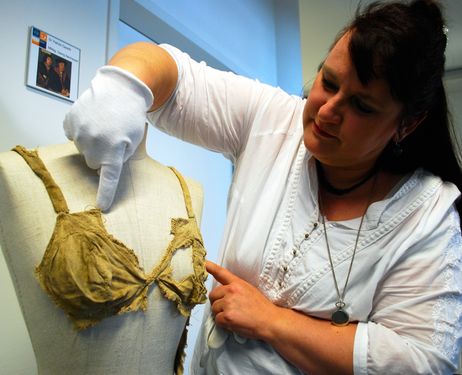
Underwear dating from medieval times that was found under flooring of an Austrian castle is hardly racy by the standards of today.
But the discovery does suggest that women in 15th-century Europe took pride in their appearance, and perhaps not just the privileged classes.
The University of Innsbruck announced this summer that "the world's oldest brassieres" had been found at Longberg Castle in Tyrol, western Austria.
The cotton garments were decorated, much like today, with lace and embroidery. It might not be a stretch to suggest that such underwear was designed for those "special occasions," scholars say.
At the heart of Tyrol, an area lined with precipitous alpine peaks, is the city of Innsbruck. The items were found during renovations of the castle in summer 2008. The castle lies to the south of the city.
Four brassieres were found amid a heap of cotton material, clothing and leather footwear under the third floor.
Carbon dating by the university's archaeological research team dated the garments to between 1440 and 1485, making them the oldest in existence.
Archaeologists in Cologne, Germany have uncovered a fascinating 13th-century Hebrew inscription on a lintel stone in the basement of a home near the city’s ancient synagogue. The Hebrew inscription reads “This is the window through which the feces are to be taken out.”
The inscription was discovered in December 2011 on the lintel above a walled-up window in the cellar of Lyvermann House, which was built in about 1266 and belonged to a wealthy Jewish family that lived right near the synagogue. Behind the wall was a cesspool, six meters deep.
According to Prof. David Assaf of Tel Aviv University’s Jewish History Department, “Such a serious-amusing inscription has never been found anywhere, not before and not since.”
Playing ball games is an activity played by children around the world. While today’s parents might worry that their sons and daughters might get scrapes and bruises, in the Viking world such a game could end with an axe being driven into an opponent’s head.
This detail comes from a new article, ‘What the Vikings did for fun? Sports and pastimes in medieval northern Europe’, which was published last month in the journal World Archaeology. In it Leszek Gardeła of the University of Aberdeen uses saga accounts and archaeological evidence to see what men, women and children from Scandinavia and Iceland amused themselves with during the Viking-era, and found that their were several popular pastimes.
Could Cleopatra have used these ancient glass bottles? Were these 3,000 year old figures ‘servants’ in the afterlife?
Questions which excited staff at Swansea University Egypt Centre are hoping to solve when they study a valuable collection of over 30 ancient Egyptian objects which has travelled from Surrey to Swansea, and arrived at the centre today.
The artefacts, donated by Woking College, includes two glass bottles (perhaps for scent or make-up) from late in Egyptian history (c100BC-AD200), around the time of Cleopatra and several shabtis (servant figurines) which the ancient Egyptians believed would do work for their deceased owners in the afterlife.
One of the shabtis is an ‘overseer shabti’. Shabtis, mirroring real life work teams, were organised in gangs of 10. Each gang would be overseen by a foreman, or overseer. The shabtis are around 3,000 years old.
Other objects include amulets, including an amulet of Sekhmet (a fiery, female goddess with a feline head) and another amulet of Shu (who separated heaven and earth); a head of the god Bes (protector of children and women in childbirth); a pendant in the shape of a lotus or papyrus sceptre; several pottery vessels and a Sokar hawk (Sokar was a god associated with rebirth).
Clothes in the early Iron Age were not grey and dull, as previously assumed. They were colourful and patterned.
This new discovery comes as a result of new analyses of 180 textile samples from 26 different bog finds, carried out by Ulla Mannering, a senior researcher and archaeologist at the Danish National Research Foundation’s Centre for Textile Research at the National Museum.
“The beginning of the Iron Age sparked a revolution in fashion in which clothes became coloured and patterned,” she says.
The conventional theory has so far been that colourful textiles only emerged in the centuries after the birth of Christ.
“But our analyses show – quite surprisingly – that colour and pattern came into fashion in the earliest part of the Iron Age. That’s 500 years earlier than previously thought.”
The new analyses also show that the bodies, buried in an ancient sacrificial bog, from which the textiles were taken are older than previously thought. Most of them date back to the centuries leading up to Christ’s birth, which makes them more than 2,000 years old.
Leonardo da Vinci (1452 - 1519) was an artist, inventor, scientist, architect, engineer, writer and even a musician. Now we know that he was also a fashion designer.
After several months of meticulous research, scholars have reconstructed some fragmented drawings of a unique bag designed by the Renaissance genius around 1497.
The sketch was first published in 1978 by Carlo Pedretti, a leading Da Vinci scholar, who identified it among the Atlantic Code's tens of thousands of drawings.
Overlooked for more than three decades, it has been reconstructed and reassembled by Agnese Sabato and Alessandro Vezzosi, director of the Museo Ideale in the Tuscan town of Vinci, where da Vinci was born in 1452.
"Leonardo designed several fashion accessories, but this bag is pretty unique. It blends beauty and functionality in a very harmonious way," Vezzosi told Discovery News in an exclusive interview.
Humans may have undergone a gradual rather than an abrupt transition from fishing, hunting and gathering to farming, according to a new study of ancient pottery.
Researchers at the University of York and the University of Bradford analysed cooking residues preserved in 133 ceramic vessels from the Western Baltic regions of Northern Europe to establish whether these residues were from terrestrial, marine or freshwater organisms.
The project team studied ceramic pots from 15 sites dating to around 4,000 BC– the time when the first evidence of domesticated animals and plants was found in the region. The research, which was funded by the Arts and Humanities Research Council, is published online in the latest edition of the Proceedings of the National Academy of Sciences (PNAS).
A study of male and female mummies has revealed the fashion-conscious Egyptians made use of a fat-based product to keep their hair in place. They used the styling gel on both long and short hair, tried to curl their hair with tongs and even plaited it in hair extensions to lengthen their tresses.
It is thought they used the product in both life and death, with corpses being styled to ensure they looked good in the afterlife. The incredible discovery was made by archaeological scientists who studied hair samples of 18 male and female mummies, aged from four to 58 years old.
If you’ve ever fancied yourself as the next dashing Mr Darcy or Elizabeth Bennett, Barley Hall in York is the place for you. The city’s medieval townhouse, Barley Hall, is host the first public appearance of costumes worn by Colin Firth and Helena Bonham Carter in the multi-award winning film, The King’s Speech, alongside a whole host of other BBC and Hollywood favourites.
The costume displays are part of York Archaeological Trust’s new “From Hamlet to Hollywood: fashion from film” exhibition which will run until May 2012. The exhibition displays costumes worn by some of the best-loved stars of stage and screen, and explores changes in fashion from Tudor times through to the 20th Century.
It’s fair to assume that Valdemar the Conqueror, while ruling over Denmark in the early 1200s, ate like a king. But, what was the diet like for the peasants below him? The answer depends on where in Denmark the peasants called home.
Radford University anthropology professor Cassady Yoder researched the diets of peasants of medieval Denmark and found a significant difference in the foods consumed by those living in rural areas as opposed to city-dwelling peasants. Yoder’s research was published in the September issue of the Journal of Archaeological Science.
The Lewis Chessmen are the most famous and important chess pieces in history. They have a long historical and scholarly record, part of which is that they were made in Norway roughly 800 years ago. But now two Icelandic men are challenging that belief and trying to prove that the pieces came from their country.
The pieces were discovered on the Isle of Lewis, in the Outer Hebrides, Scotland, in 1831 — hence their name. Carved mostly out of walrus tusk, they were found in a small carrying-case made of stone inside a sand dune. There are different theories about how they ended up there, including that they were left over from a shipwreck or that they were stolen and buried on the island and then forgotten.
We are all familiar with praying monks, but playing monks? A Book of Hours from Flanders finds them deep in a game of “Blind Man’s Bluff,” while on the opposite page peasant boys enjoy a rigorous game of hockey. Such delightful images of play are unexpectedly ubiquitous in medieval manuscripts. Neither stodgy nor perpetually pious, medieval people found time for amusement in the margins of their lives and their manuscripts.
This is the theme for a new exhibition at The Walters Art Museum in Baltimore, Maryland. Checkmate! Medieval People at Play looks at many different aspects of medieval play, including board games, sports, free play, visual ciphers and even games of love.
The Corning Museum of Glass in New York State has opened a new exhibit displaying over a hundred examples of glass that were made in the Middle Ages. The exhibition Medieval Glass for Popes, Princes, and Peasants will follow the evolution of glass production over 1,000 years, from its height in the Roman Empire until the golden age of Venetian glassmaking during the Renaissance.
The glass vessels and objects in the exhibit will range from highly decorated drinking vessels to church reliquaries—highlighting the many uses of glass in medieval society, and the significance of the material to local economies, religious ceremonies and scientific developments.
“The phrase ‘medieval glass’ often evokes an image of stained glass windows, but there exists a remarkable range of glass objects made for daily use which provide rare insight into a cross section of medieval society,” explains Dr. David Whitehouse, executive director of The Corning Museum of Glass and curator of this exhibition. “The objects in the exhibition trace the history of the Middle Ages in Europe through the lens of glassmaking. The story touches on politics, trade, urbanization and the disintegration of cities, religion, science, and technology and highlights the importance of the material to the development of the world we know today. Its arc spans a period of 1,000 years – nearly one quarter of the history of glassmaking – and depicts the rise of glassmaking from a dark period of reduced knowledge to an era of innovation.”
Glassmaking saw its greatest era in the ancient world during the Roman Empire, when glassmakers used a rich variety of techniques to meet the demands of wealthy patrons. As the Roman Empire disintegrated and Europe became politically fragmented, there were fewer glassmaking centers. The demand for glass and other luxury goods was reduced, and many glassmaking techniques were lost. It was not until the late Middle Ages, with the rise of craft guilds and cities, that glassmaking techniques were revived, setting the stage for the next great era of glassmaking: the emergence of Venice as the principal glassmaking center in the Renaissance.
The more than 100 objects in Medieval Glass are drawn from the Corning Museum’s collection, as well as from museums and cathedral treasuries in Europe, where many pieces were held for centuries without being properly identified. Some were discovered during archeological excavations—which gave scholars and archeologists a groundbreaking new vision of the richness and variety of medieval glass, its production centers and techniques used by medieval glassmakers.
One area of the exhibit will display glass objects used for eating and drinking, arranged chronologically to show the evolution of glass tableware through this thousand-year period, and to illustrate the increase in the decoration and complexity of the glass vessels as glassmaking techniques were rediscovered in the late Middle Ages. Copies of illuminated manuscripts and paintings throughout the exhibit will illustrate how these glass objects were used and valued in medieval society.
Other sections of the exhibit explore glass for the church and treasury, and glass used for science and medicine—including glass used in scientific instruments, for medical diagnosis and alchemy, as well as the critical development of reading spectacles and other lenses. A gallery reminiscent of a medieval cathedral will feature the sole stained glass window in the exhibition, as well as highlights of glass used in the church: ceremonial lamps, drinking vessels and glasses used to preserve relics. Examples of the rare and mysterious group of objects known as “Hedwig” beakers are a highlight of this section.
These beautiful glass cups, found in treasuries across Europe, are unlike any other medieval objects of glass or rock crystal from the Islamic world, Byzantium or western Christiandom. The group is named after Saint Hedwig of Silesia (d. 1243), a Germanic queen who was canonized as a saint for her piety—which extended to abstaining from wine drinking, much to the disdain and social embarrassment of her husband. Miraculously, her glass beakers, which bore the same engraving as the beakers in the exhibition, would fill with wine whenever the king’s spies were nearby. Scholars have variously argued about the origination of the beakers and many believe they were made in the medieval Islamic world. In this exhibition, Whitehouse attributes the beakers’ origination to glassmakers in Palermo, Sicily, under the reign of a Norman king. The objects likely made their way to Germany after the marriage of the king to a German noblewoman.
Videos in the galleries will illustrate how modern glassmakers have experimented with medieval techniques to identify and understand these objects in the exhibition were made.
The Corning Museum of Glass offers live glassblowing demonstrations all day, every day, as part of the visitor experience. At select shows each day during the run of the exhibition, visitors will be able to see how certain objects in the Medieval Glass exhibition were made.
The exhibition runs until January 3, 2011. The Corning Museum of Glass is located in the Finger Lakes Wine Country of New York State. Click here to go to their website.
Scientists in Cambridge have discovered that a lowly grape variety grown by peasants – but despised by noblemen – during the Middle Ages was the mother of many of today’s greatest grape varieties, including the Chardonnay used in Champagne.
Several venerable grape varieties - including Chardonnay and Gamay noir - stem from crosses between Pinot noir and Gouais blanc. Until now, which variety was the father and which the mother has been a mystery.
Using the same kind of genetic marker that forensic scientists use for human DNA fingerprinting, the team from the University of Cambridge examined DNA from the chloroplasts of 12 widely grown grape varieties.
Chloroplasts are structures in plant cells where photosynthesis takes place. Like most plants, the DNA in chloroplasts of grape vines is inherited from the mother.
The scientists looked at microsatellites - regions of DNA that are highly variable and are therefore useful for tracking family trees - and found that Gouais blanc was the maternal parent of Aligoté, Auxerrois, Bachet, Chardonnay, Franc noir, Gamay noir, Melon, Romorantin and Sacy. Pinot noir was the maternal parent for Aubin vert, Knipperlé and Roublot.
Scientists and wine producers are interested in grapes' maternal line because the mother provides more of the offspring's DNA than the father, and so is more important in genetic terms. In other economically significant plants the chloroplast genes can contribute to important characteristics such as tolerance to cold and fungal attack.
According to Professor Christopher Howe of the University of Cambridge, one of the study's authors: "It is ironic that the despised grape Gouais blanc was not just a parent for several of the world's best-known and most important varieties, such as Chardonnay and Gamay noir, it was the maternal parent, providing additional DNA and potentially determining important characteristics of the offspring."
"This is a striking conclusion, as Gouais is generally considered a highly inferior variety, and its cultivation was banned for many years in parts of Europe."
Both Pinot noir and Gouais blanc were widely grown in north-eastern France during the Middle Ages. But while Pinot was grown in vineyards owned by the church and aristocracy, peasants grew Gouais.
Between the late Sixteenth and the Eighteenth Centuries, several attempts were made to ban Gouais blanc. In 1732, an act of the Parlement of Besancon tried to eliminate the grape, describing it as "rustic", "inferior" but also "high-yielding". The Parlement of Metz took similar steps the same year.
Although their attempts to ban the grape failed, Gouais largely disappeared at the end of the Nineteenth Century and now survives only in a few vineyards and reference collections around the world.
Co-author of the study John Haeger of Stanford University said: "Gouais was held in low esteem in the late medieval and early modern periods. Typically, varieties of this sort were grown on flat land by peasants. Good vineyards, on the other hand, growing better and lower yielding varieties were owned and farmed under the supervision of the church or nobility."
"Many of the 'bans' were designed either to favour aristocrats and monastic orders over peasants, or force more arable land into the production of cereals and legumes to eliminate food shortages."
The results are published this month in Biology Letters.
A new book on Byzantine children is providing fascinating insights into how people viewed childhood and adolescence in the Middle Ages. Becoming Byzantine: Children and Childhood in Byzantium, is a collection of nine articles that reveal various aspects of childhood, ranging from their legal status to how they were treated when they died.
In her article, 'The Material Culture of Childhood in Byzantium,' Brigitte Pitarakis examines various physical objects associated with children, including clothes, food and toys. Pitarakis writes, "because toys were often presented to children as gifts, they served as an important mechanism of bonding between adults and children."
According to Pitarakis' research, the first toy an infant might receive would be a rattle, often made of clay, with pebbles or grains inside the hollow container. They were also usually painted in bright colours.
Once the child got a little older, his or her next toy would likely be a pull toy in the shape of horse on wheels or saddled with a rider. Another popular toy for kids were whistles, which were made of clay and often shaped like animals.
Pitarakis also writes about how ball games were popular in Byzantium, both with children and adults. Byzantine writers describe some of the games played by children, both boys and girls, which would use balls, hoops, knucklebones and pebbles. The love of some of these games continued on into adulthood for many Byzantines - Emperor Michael VI, for example, ordered that one of his palaces be cleaned because he had lost a knucklebone he was playing with somewhere inside.
Dolls were also important toy for Byzantine girls, and several examples of wooden and rag dolls have been found through archaeological investigations. Some dolls would come with clothes to dress them in, and at least one also used a strand real hair to serve as the doll's hair.
Becoming Byzantine is published by Dumbarton Oaks Research Library, which is one of North America's leading research centers in Byzantine history.
This 3 minute video from WatchMojo.com shows some interesting aspects of medieval daily life, including a game, stone sculpting, food, fighting with swords and shoes.