Showing posts with label Medieval Clothing. Show all posts

Friday, November 16, 2012

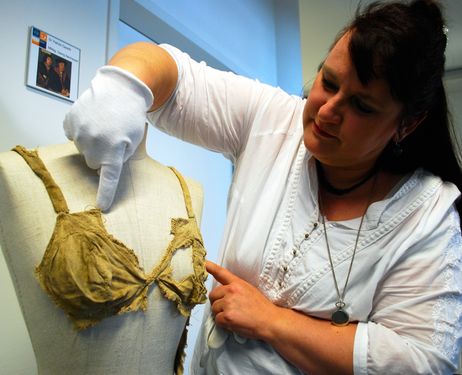
Medieval underwear points to racy history


Underwear dating from medieval times that was found under flooring of an Austrian castle is hardly racy by the standards of today.

But the discovery does suggest that women in 15th-century Europe took pride in their appearance, and perhaps not just the privileged classes.

The University of Innsbruck announced this summer that "the world's oldest brassieres" had been found at Longberg Castle in Tyrol, western Austria.

The cotton garments were decorated, much like today, with lace and embroidery. It might not be a stretch to suggest that such underwear was designed for those "special occasions," scholars say.

At the heart of Tyrol, an area lined with precipitous alpine peaks, is the city of Innsbruck. The items were found during renovations of the castle in summer 2008. The castle lies to the south of the city.

Four brassieres were found amid a heap of cotton material, clothing and leather footwear under the third floor.

Carbon dating by the university's archaeological research team dated the garments to between 1440 and 1485, making them the oldest in existence.

Click here to read this article from The Asahi Shimbun

See also Medieval lingerie? Discovery in Austria reveals what really was worn under those tunics

Friday, July 20, 2012

More on medieval bras – new details on 15th century find


The discovery of female undergarments from the 15th century is making international headlines. Now more details are being released by the University of Innsbruck.

The archaeological research was carried out at Lengberg Castle, East Tyrol, Austria, beginning in July 2008, when a renovation project for the medieval castle was stated. During the research a vault filled with waste was detected in the south wing of the castle in a room on the 2nd floor. The fill consisted of dry material in different layers, among them organic material such as twigs and straw, but also worked wood, leather – mainly shoes – and textiles.

The building history, as well as investigations on construction techniques and the archaeological features heavily suggested a dating of the finds to the 15th century, when another level was added to the castle by order of Virgil von Graben. The reconstruction is mentioned by Paolo Santonino in his itinerary, who also gives us a short description of the castle and mentions the reconstruction and the consecration of the castle chapel by Pietro Carlo (1472–1513), Bishop of Caorle, on October 13th 1485. The vault spandrel was most likely filled with waste during the addition of the 2nd storey as isolation or to level the floor.

Click here to read this article from Medievalists.net

Tuesday, July 17, 2012

Medieval lingerie? Discovery in Austria reveals what really was worn under those tunics


A recent discovery in an Austrian castle has revealed that bras existed back in the 15th century. It is among dozens of new textile artifacts that seem to have been preserved by a lucky accident, which will give historians a much better understanding of late medieval fashion.

The research, led by Beatrix Nutz of Innsbruck University, examines a room that was discovered in the south wing of Castle Lengberg in 2008. Evidence shows that the room was sealed off in the late 15th-century, and its dry conditions helped preserve organic material such as twigs and straw, as well as worked wood, leather (mainly shoes) and textiles.

In a paper given last year at the North European Symposium on Textiles, Professor Nutz explains that hundreds of textiles were discovered, some of which were clothing in very good condition. She said, “amid them were several nearly complete linen bras and fragments of corselettes, some rather coarsely made others more elaborately decorated with plaited borders and sprang worked parts. One of the bras even has a rather modern look.”

Click here to read this article from Medievalists.net

Thursday, May 31, 2012

Denmark: Dyed clothes came into fashion in early Iron Age


Clothes in the early Iron Age were not grey and dull, as previously assumed. They were colourful and patterned.

This new discovery comes as a result of new analyses of 180 textile samples from 26 different bog finds, carried out by Ulla Mannering, a senior researcher and archaeologist at the Danish National Research Foundation’s Centre for Textile Research at the National Museum.


“The beginning of the Iron Age sparked a revolution in fashion in which clothes became coloured and patterned,” she says.

The conventional theory has so far been that colourful textiles only emerged in the centuries after the birth of Christ.


“But our analyses show – quite surprisingly – that colour and pattern came into fashion in the earliest part of the Iron Age. That’s 500 years earlier than previously thought.”

The new analyses also show that the bodies, buried in an ancient sacrificial bog, from which the textiles were taken are older than previously thought. Most of them date back to the centuries leading up to Christ’s birth, which makes them more than 2,000 years old.

Click here to read this article from ScienceNordic

Click here to visit the Danish National Research Foundation’s Centre for Textile Research website

Monday, February 13, 2012

Shoes from the Middle Ages, Early Modern Period, topic of lecture in London

From the skin-tight boots sported by dandies in the early 19th century to the brothel-creepers currently making a come-back on the streets of trendy East London, footwear has long played a powerful role in the human imagination as a signifier of rank and status. On the eve of London Fashion Week, Cambridge University historian Dr Ulinka Rublack, a specialist in the cultural history of early modern Europe, will give a public talk in London tomorrow on the topic of luxury items – an exploration of the past through the life of things.

In investigating the history of the intricate interplay between people and their belongings, she will focus on leather and, in particular, on shoes and their potency as objects of desire in the 16th century. She will argue that in seeking to understand the Renaissance as a cultural movement we should not confine our gaze to the development of the fine arts – such as painting and sculpture – but should also explore the role of the decorative arts and crafts – such as fashion and textiles – with an open mind.

Dr Rublack challenges the unspoken hierarchy that frames our picture of the past: a ranking system that puts painting on a pedestal and confines many of the objects made to be worn and handled to the side-lines. She argues that it is only by looking at the ways in which objects were crafted and re-crafted that we get closer to the mind-set of those who lived during a period we think of as pivotal in ushering in a new age. “Design came first, whether bags or belts, hats or head-dresses, and the paintings portraying these items followed,” she said.

Click here to read this article from Medievalists.net

Wednesday, January 11, 2012

Leonardo da Vinci: Bag Designer

Leonardo da Vinci (1452 - 1519) was an artist, inventor, scientist, architect, engineer, writer and even a musician. Now we know that he was also a fashion designer.

After several months of meticulous research, scholars have reconstructed some fragmented drawings of a unique bag designed by the Renaissance genius around 1497.

The sketch was first published in 1978 by Carlo Pedretti, a leading Da Vinci scholar, who identified it among the Atlantic Code's tens of thousands of drawings.

Overlooked for more than three decades, it has been reconstructed and reassembled by Agnese Sabato and Alessandro Vezzosi, director of the Museo Ideale in the Tuscan town of Vinci, where da Vinci was born in 1452.

"Leonardo designed several fashion accessories, but this bag is pretty unique. It blends beauty and functionality in a very harmonious way," Vezzosi told Discovery News in an exclusive interview.

Click here to read this article from Discovery News

Wednesday, July 27, 2011

Medieval fashions all the rage at Clifford’s Tower

Fashion medieval style is all the rage at Clifford’s Tower in York this summer thanks to a team of travellers from the past.

English Heritage is offering children the chance to dress up in replica costumes from the dark ages to get a taste of life in medieval York.

The time travellers will be giving an insight into medieval table, manners, etiquette, traditions, customs and even how the people of old York would have washed their clothes.

Click here to read this article from The York Press

See also our feature on Medieval Dress

Monday, June 06, 2011

Medieval Nuns knew their fashion, historian finds

Recent research on medieval nuns shows that many of them were dressing in the latest fashions instead of simple religious habits. And while their were efforts by the church to make nuns dress more humbly, by the 14th and 15th centuries these rules were becoming less and less adhered to.

The article, “Best Clothes and Everyday Attire of Late Medieval Nuns,” by Eva Schlotheuber, appears in Fashion and Clothing in Late Medieval Europe, which was published last year in Switzerland. Basing her research on numerous sources from western Europe, such as reports on medieval nunneries by church officials, leads Schlotheuber to believe that “in the rhythm of daily life and feast days the nuns developed a great deal of creativity, and lived in a much more lively fashion than the morally and didactically coloured theological texts of the period want us to think.”

Click here to read this article from Medievalists.net

Monday, May 30, 2011

Fashion in the Middle Ages exhibition begins at the Getty

The J. Paul Getty Museum unveils a new medieval exhibition tomorrow, which will examine what people wore during this period. Fashion in the Middle Ages, on display from May 31 to August 14, 2011, explores how medieval artists used costumes to identify people by profession or to place them in a social hierarchy and at other times used fanciful or idealized images of clothing.

“People in the Middle Ages were highly skilled at reading the meaning of clothing,” says Kristen Collins, associate curator of manuscripts. “The way figures were dressed in manuscripts provided the book’s reader with clues to their social status, profession or ethnicity.”

Click here to read this article from Medievalists.net

Sunday, May 29, 2011

Costumes fit for a King…and a Queen, go on display in York

If you’ve ever fancied yourself as the next dashing Mr Darcy or Elizabeth Bennett, Barley Hall in York is the place for you. The city’s medieval townhouse, Barley Hall, is host the first public appearance of costumes worn by Colin Firth and Helena Bonham Carter in the multi-award winning film, The King’s Speech, alongside a whole host of other BBC and Hollywood favourites.

The costume displays are part of York Archaeological Trust’s new “From Hamlet to Hollywood: fashion from film” exhibition which will run until May 2012. The exhibition displays costumes worn by some of the best-loved stars of stage and screen, and explores changes in fashion from Tudor times through to the 20th Century.

Click here to read this article from Early Modern England

Saturday, May 21, 2011

Illuminating Fashion: Dress in the Art of Medieval France and the Netherlands – new exhibition at The Morgan Library and Museum

Medieval fashion, as seen in the manuscripts and early printed books from the Later Middle Ages, is the subject of a new exhibition at The Morgan Library and Museum entitled Illuminating Fashion: Dress in the Art of Medieval France and the Netherlands. The exhibition, which opened yesterday, includes more than 50 works of Northern European origin from the Morgan’s renowned collections, and also features four full-scale replicas of clothing seen in exhibited manuscripts. It will run through September 4.

Covering nearly 200 years prior to the beginning of the full Renaissance in France about 1515, Illuminating Fashion examines a period in which clothing styles changed more rapidly than had previously been the case, often from one decade to the next. Social custom, cultural influences, and politics—such as the Hundred Years’ War (1337–1453) and the occupation of Paris by the English (in the 1420s)—had a notable impact on fashion, and medieval illuminators deftly recorded these shifts in taste.

The exhibition also touches upon how artists used clothing (garments actually worn) and costume (fantastic garments not actually worn) to help contemporaneous viewers interpret a work of art. The garments depicted were often encoded clues to the wearer’s identity and character.

Click here to read this article from Medievalist.net

Friday, April 23, 2010

Conference to expose the hidden history of underwear in the Middle Ages

A topic that so far has received little attention from historians gets its moment in the open tomorrow when Binghampton University hosts a one day conference on Underpinnings: The Evolution of Underwear from the Middle Ages through Early Modernity. The conference, organized by the undergraduate students of the Center for Medieval and Renaissance Studies and the Medieval Studies Club, will feature seven speakers who will look at various aspects of undergarments from the medieval to the early modern periods.

The broad scope of the conference is described by organizers as: "From the trailing sleeves and towering headdresses of the High Middle Ages to the ornate, jewel-encrusted ensembles of Elizabethan England and the elaborate turbans of the Mamluk and Ottoman empires, clothing and headgear have captured the imagination of historians for decades. Few, however, have given thought to what lies beneath, which, even while having a functional role, comprises a system of sartorial signs that tell much with respect to social mores and shifting views of the body.

"This conference aims to explore the evolution of undergarments from the Middle Ages through the early modern era in a variety of contexts, from the material forms of the garments themselves to their symbolic associations and latent meaning."

Among the speakers will be Kristen Stewart of The Metropolitan Museum of Art, who will discuss “His and Hers: What can underwear tell us about evolving concepts of gender between 500 and 1750 AD”. Hattie Presnell of High Point University will give a paper on “Expanding a Nation: The evolution of farthingales during the reign of the Tudors”, while Carole Frick of Southern Illinois University will tackle the is“Under-Over-Under: the curious case of codpieces”

The conference takes place on April 24th, from 1:00 to 5:00 pm. The lectures will be followed by an exhibit and dinner. For more information about the conference, go to http://www2.binghamton.edu/cemers/conferences/Underpinnings.html

Tuesday, December 22, 2009

Article examines the Dress Accessories of Medieval Peasants in England


A study on medieval peasants in England shows that what clothes and dress accessories were important to them and that were resisting attempts by the English elite to force them to dress in humble garments.

Sally V. Smith's article, "Materializing Resistant Identities among the Medieval Peasanty," examines several archaelogical finds from rural villages throughout England, such as Wharram Percy and Bolton. Smith looks at the dress accessories that have been found at these sites, including the burial places, such as buckles, brooches and pins.

The research finds that were few of these items were made of poor quality metal, with most made of copper or iron, and even one item made from gold. Smith writes, "that medieval peasants were not choosing items made using the ‘worst’ or cheapest material available."

Secondly, over half of the objects were either decorated or were purely decorative in function. This is at odds with pictoral evidence about English peasants, where they are depicted as wearing very simple and bland clothes without decoration. These can be found in illustrations in the manuscripts like the Luttrell Psalter and in the stained-glass images found in churches.

Smith concludes that "in purchasing and wearing these items, which would have been highly visible on peasant clothing, the peasants were resisting the imposition of an identity that only represented their bodies as humble, servile and labouring."

She also points to several pieces of evidence to show how important dress was in medieval England, and how authorities tried to regulate what certain people wore. Church officials also stressed the people not wear fancy clothing.

Several medieval writers complained about the dress of women. For example, the chronicler
John of Reading, reporting on a later outbreak of the disease in 1365, blamed it in part on "the empty headedness of the English who remained wedded to a crazy range of outlandish clothing . . . They began to wear useless little hoods [and] extremely short garments which failed to conceal their arses or their private parts . . . these misshapen and tight clothes did not allow them to kneel to God or the saints."

The article, "Materializing Resistant Identities among the Medieval Peasanty," can be found in the Journal of Material Culture, Volume 14:3 (2009).

Monday, June 29, 2009

Medieval Scottish soldiers fought wearing bright yellow war shirts


Scottish newspapers have been reporting that medieval Scots who fought in battles like Bannockburn, and Flodden Field would have looked very different to the way they have traditionally been depicted.

Instead of kilts, he said they wore saffron-coloured tunics called "leine croich" and used a range of ingredients to get the boldest possible colours. Historian Fergus Cannan claims that some warriors even dyed the garments with horse urine in order to get the boldest possible colours.

Cannan, who claims he can trace his family roots back to the legendary monarch Robert the Bruce, makes the case for a saffron rather than a tartan army in the forthcoming book Scottish Arms And Armour. He asserts that the Scots armies who fought in the pivotal battles of Bannockburn and Flodden Field would have looked very different to the way they have traditionally been depicted.

Cannan said: "What the Scottish soldiers wore in the country's greatest battles is an area that, up until now, has not been properly studied. We know quite clearly what happened at Bannockburn and Flodden, but visual images of these hugely important episodes are very vague and have been muddled by 19th and 20th interpretations which put a romantic gloss on Scottish history. A lot of historians quite rightly stated that the film Braveheart was not terribly accurate, but what they didn't admit was that they didn't have a clue what would be accurate."

The military history specialist scoured original medieval eye-witness accounts, manuscripts, art, sculptures and tomb effigies to build up a picture of what members of Robert the Bruce's forces would have worn in 1314.

He was keen to debunk both the "Braveheart stereotype" of blue-faced, kilted hordes and the revisionist suggestion that medieval Scots soldiers were almost indistinguishable from their English opponents.

He said: "I believe both of these views are equally wrong. There is no need for this period to be shrouded in mystery as there is a wealth of evidence out there, which appears to have been almost completely ignored and overlooked.

"Forget about the plaid and tartan. What Highlanders did wear when they went into battle throughout the Middle Ages, right up until the end of the 16th century, was what English writers refer to as saffron war shirts, known in Gaelic as leine croich."

Cannan claims there were numerous contemporary references to the distinctive linen tunics which were usually worn with a belt round the middle. "The yellow war shirt is never shown in any film or popular image and yet it is something that all the original writers comment on. Saffron was a rare and expensive item to get hold of back then, so the poorer clansmen would have dyed the linen with things like horse urine, bark and crushed leaves to get the rich yellow colour. Historians of the time say the use of the real spice combined with the yards of material used was a symbol of status and the mark of a chieftain."

The author believes that the leine croich was worn for its practicality and could be used as bedding and well as an elementary form of armour. He said: "It was fairly thick and had so many yards of material that it was probably enough to stop a sword blow. When we hear from English writers of that time that Scots went into battle unprotected or semi-naked they didn't understand that what they wore was a form of armour.

"On top of the leine croich an average clansman would wear a deerskin or cowhide jerkin, which would be waxed or dipped in pitch to make it waterproof. However, a Scots nobleman of that era would have worn a long mail shirt or iron-riveted rings and a helmet."

Angus, Chief of Clan Chattan, recorded in 1572 that the "yellow war shirt" was still venerated by his people as "the badge of the Chieftaines".

However, the Gaelic historian Martin Martin, a native of Skye, wrote that saffron garments had fallen out of use at the end of the 16th century. Cannan claims the dyed garments were equally popular with Gaelic-speaking Irish warriors over the same periods in history.

Dr Clare Downham of Aberdeen University believes that Cannan's analysis fits with her knowledge of Celtic Scotland. She said: "The tartan kilt as we know it today is part of a romantic and more modern imagining of Scotland's past. But it is clear from records dating back to the 11th century that the Gaels were well known for going bare-legged and wearing a sort of form of plaid. The Norwegian king went to the Hebrides in 1098 and adopted the dress of the locals and became known as Magnus Barelegs when he returned home. This distinctive form of dress ethnically distinguished the Gaels at that time."