 |
| 14th century Book of Hours depicting the murder of Becket |
Showing posts with label Crusades. Show all posts
Showing posts with label Crusades. Show all posts
Thursday, June 08, 2017
Writing about the Crusades and talking about a "meddlesome priest"
The Middle Ages are in the news again, so here is a roundup of recent news articles. We start with three good reads from historians talking about the crusades

Tuesday, March 18, 2014
Jacques de Molay, Templar, died on this day in 1314

Dominic Selwood, the resident historian at The Telegraph, has penned a good account of the story of the fall of the Grand Master and his brethren. He writes:
To draw down the final curtain, on the 18th of March 1314 the four most senior living Templars were hauled to Paris. On a rostrum erected on the parvis before the great cathedral of Notre-Dame, they were publicly condemned to perpetual imprisonment. Hugues de Pairaud and Geoffroi de Gonneville accepted the sentences in silence. But Jacques de Molay and Geoffroi de Charney stunned the crowd by talking over the cardinals and professing their innocence and that of the Temple.Click here to read his full article
The electrifying news was rushed across the city to King Philip at the Louvre. Desperate to crush this dangerous new defiance, he abandoned all legal procedures and ordered the two old Templars to be burned without delay.
While the Knights Templar was destroyed in the fourteenth-century, their notoriety and story would continue on to the present day. In his article, Your Conspiracy Theories Began 700 Years Ago Today, Paul Fain notes that their mantle would be taken up by many others. For example:
The early Freemasons claimed ties to the Templars, despite a gap of a few hundred years between their creation and de Molay’s death. A dubious link to the old-school warriors apparently gave them some street cred.He adds:
The Templars also made an appearance in the news last week. Mexican police killed Nazario Moreno, the leader of a drug cartel that used the name Knights Templar. According to Time, Moreno’s followers wore white robes and kept statues of him wearing medieval armor. It’s unclear where he hid the Holy Grail.You can find a lot of information on the Templars - books, video games, even cheesy documentaries like this one:
You can find some articles about the Knights Templar on Medievalists.net. Check out also these accounts about the founding of Templars from De Re Militari: The Society for Medieval Military History.
Friday, June 28, 2013
Crusader Feces, Bat Feces, Latin swear words, and building a village - medieval news roundup
Here are some news stories from the medievalverse, and a few from beyond it...
 An article in the International Journal of Paleopathology shows that many Crusaders would have been suffering from worms or other diseases. Test done by two researchers from the University of Cambridge at Saranda Kolones castle in Cyrpus showed that two species of parasite, the roundworm and the whipworm, were prevalent among the crusaders. The castle was built after the Third Crusade and abandoned in 1222.
Evilena Anastasiou and Piers D. Mitchell write that "the discovery of these parasites highlights how medieval crusaders may have been at risk of malnutrition at times of siege and famine, as these worms competed with them for nutrients."
You can read more about this story from Reuters.
The article 'Human intestinal parasites from a latrine in the 12th century Frankish castle of Saranda Kolones in Cyprus' is available here.
Arkansas that are building medieval castles, we now have a team of 25 workers in Germany who have just started constructing a replica of a ninth century monastic settlement and town. Bert Geuten is leading the effort to build the medieval site near the southern German town of Meßkirch in Baden-Württemberg. Because they are using authentic historical tools and techniques, it will take over 40 years before the project is complete, which will include a 2,000 seat cathedral.
They began last weekend by starting construction on a small church. “In the ninth century the monks would have built a small church first – they didn't want to wait until the cathedral was ready to be able to pray. So we're doing the same,” Geuten explained.
Click here to read the full article from The Local.
 Churches in England are again facing danger, but not from thieves stealing their metal or declining attendance. Instead, bats are the new threat, according to a report in the Daily Telegraph. An environmental directive from the European Union prohibits building owners from killing bats or destroying their roosts, and this is apparently leading to church interiors being contaminated with bat droppings.
Tony Baldry, a Member of Parliament who officially speaks for the Church of England, said, "the church of St Peter ad Vincula at South Newington in my own constituency has some very fine, almost unique, medieval wall paintings which seem to have been spared Thomas Cromwell's men. But having survived the ravages of the Reformation they are now threatened by bat urine. And these are irreplaceable parts of our natural heritage."
Click here to read the article from Daily Telegraph
 The International Medieval Congress is taking place at the University of Leeds from June 30th to July 4th. Over 2000 people will be attending (I wish I was there too). Anthony Lowe, event manager for MeetInLeeds is in charge of making sure everything goes smoothly “This has been three years in the planning as it is the largest conference we have hosted on the campus,” he explains to ConferenceNews. “It’s been great working with all the different departments to create a medieval campus, with special exhibitions in the university art gallery, library and academic meeting rooms, as well as themed menus and medieval street food."
He adds, “It’s going to be incredibly busy but we’re extremely well-prepared for it and will be working hard to ensure that everyone has a fabulous experience and remembers their medieval experience for many years to come. Leeds is a very attractive campus and we are looking forward to showing it at its very best.”
Click here to read the full article from ConferenceNews
People went to coffeehouses not just to drink coffee, but to read and discuss the latest pamphlets and news-sheets and to catch up on rumor and gossip. Coffeehouses were also used as post offices. Patrons would visit their favorite coffeehouses several times a day to check for new mail, catch up on the news and talk to other coffee drinkers, both friends and strangers. Some coffeehouses specialized in discussion of particular topics, like science, politics, literature or shipping. As customers moved from one to the other, information circulated with them.
You can read the article here.
 Staying in Early Modern England, Penn State News has an interesting profile of Leah Orr, a specialist in 18th-century literature. She just completed her PhD on Did the Novel Rise? Fiction and Print Culture in England, 1690-1730, which "rebuts the longstanding notion that the novel as we now know it became a recognized form and rose to prominence during that time period. That conception of early fiction, she argues, is based on close readings of a few famous texts by major authors, such as Daniel Defoe and Aphra Behn, and neglects the broader literary context in which those texts were written and first read."
Click here to read more from Penn State.
Medieval Polish Treasures Revealed at Down Museum Exhibition
Rachel Koopmans wins Margaret Wade Labarge Prize for Books in Medieval Studies
Video: Students studying Archaeology at Queen's University take part in an excavation which discovers a Medieval Lime Kiln, which may have been used during the construction of Dundrum Castle.
Crusader Feces

Evilena Anastasiou and Piers D. Mitchell write that "the discovery of these parasites highlights how medieval crusaders may have been at risk of malnutrition at times of siege and famine, as these worms competed with them for nutrients."
You can read more about this story from Reuters.
The article 'Human intestinal parasites from a latrine in the 12th century Frankish castle of Saranda Kolones in Cyprus' is available here.
One stone at a time
While we have reported on groups in France andThey began last weekend by starting construction on a small church. “In the ninth century the monks would have built a small church first – they didn't want to wait until the cathedral was ready to be able to pray. So we're doing the same,” Geuten explained.
Click here to read the full article from The Local.
Bat Feces

Tony Baldry, a Member of Parliament who officially speaks for the Church of England, said, "the church of St Peter ad Vincula at South Newington in my own constituency has some very fine, almost unique, medieval wall paintings which seem to have been spared Thomas Cromwell's men. But having survived the ravages of the Reformation they are now threatened by bat urine. And these are irreplaceable parts of our natural heritage."
Click here to read the article from Daily Telegraph
How to Swear like a Roman
One of my daily reads The Atlantic magazine occasionally has articles related to history. Last month, they looked at ancient cursing with Futuo! How the Romans Swore. It focuses on the new book, Holy Sh*t! A Brief History of Swearing by Melissa Mohr, and explains the meaning behind Latin words such as futuo, landica, cinaedus, mingo, cacare and verecundum. You can read that article here.What it takes to run the IMC
He adds, “It’s going to be incredibly busy but we’re extremely well-prepared for it and will be working hard to ensure that everyone has a fabulous experience and remembers their medieval experience for many years to come. Leeds is a very attractive campus and we are looking forward to showing it at its very best.”
Click here to read the full article from ConferenceNews
Social Networking in the 1600s
Tom Standage is the author of the forthcoming book, Writing on the Wall: Social Media — The First 2,000 Years. In this article from the New York Times, he writes about how the coffeehouse was the social-networking site of the 17th century. He explains:People went to coffeehouses not just to drink coffee, but to read and discuss the latest pamphlets and news-sheets and to catch up on rumor and gossip. Coffeehouses were also used as post offices. Patrons would visit their favorite coffeehouses several times a day to check for new mail, catch up on the news and talk to other coffee drinkers, both friends and strangers. Some coffeehouses specialized in discussion of particular topics, like science, politics, literature or shipping. As customers moved from one to the other, information circulated with them.
You can read the article here.
The Rise of the Novel

Click here to read more from Penn State.
Other news bits:
Medieval herb garden unveiled at Northumberland ParkMedieval Polish Treasures Revealed at Down Museum Exhibition
Rachel Koopmans wins Margaret Wade Labarge Prize for Books in Medieval Studies
Video: Students studying Archaeology at Queen's University take part in an excavation which discovers a Medieval Lime Kiln, which may have been used during the construction of Dundrum Castle.
Wednesday, August 08, 2012
State of War: Syria’s Crusader Castles and Medieval Fortresses
The conflict in Syria is the product of very modern forces — a legacy of dictatorship and regional geo-politicking — but it’s taking place over a terrain with a rich and deep history. Syria’s deserts, river valleys and mountain passes bear the traces of some of the world’s oldest civilizations; its major cities, especially Damascus and Aleppo, are among the longest continually inhabited on the planet and have endured both the scourges of man (invasions, massacres) and the ravages of nature (earthquakes, plagues). As the rebellion against President Bashar Assad’s rule rages on, concern mounts over the state of the country’s antiquities. Veteran British correspondent Robert Fisk warned of “Syria’s pulverized past,” with precious artifacts disappearing from unattended museums and storehouses, all the while as the daily toll of war imperils some of Syria’s venerable monuments themselves.

Syria has been the site of bitter conflict before. Some nine hundred years ago, a motley band of Frankish, German and Italian soldiers and mercenaries turned up on Levantine soil under the Papal banner of the First Crusade. Seizing a number of important cities — Jerusalem, Tripoli (in today’s Lebanon), Antioch (modern day Antakya, Turkey) — they attempted to entrench themselves in the Holy Land permanently. This international coalition of the willing would ultimately be driven out, but not before leaving behind a host of beautiful fortresses, many of which, while astonishing testaments to medieval engineering and construction, bear the intractable scars of newer conflicts.
Click here to read this article from Time magazine
Friday, May 18, 2012
How did medieval Europeans deal with Greek debt? They sacked their capital city
Historians of the Fourth Crusade (1202-04) have been seeking explanations why the crusaders decided to sail to the Byzantine capital of Constantinople instead of Egypt. Some believe that the crusaders were tricked into doing it by the Doge of Venice or some other conspirator, while others argue that the decision to go to Constantinople was almost an accident, where unforeseen events led to the crusader army.
But Savvas Neocleous, writing in the latest issue of the Journal of Medieval History, states ”the real reason for the diversion to Constantinople in 1203 by the Venetians and the crusaders, and for their subsequent attack on the imperial capital in 1204, was a simpler and, in their minds, increasingly pressing concern: the payment of outstanding debts.”
Click here to read this article from Medievalists.net
Tuesday, May 08, 2012
Book Review: The First Crusade: The Call From the East, by Peter Frankopan

Whatever God’s actual intentions in the matter, and He is known to move in mysterious ways, His representatives on earth, Pope Urban II in Rome and the Emperor Alexios in Constantinople, quite clearly fostered this great martial enterprise for political purposes of their own. The emperor, assailed by enemies on his frontiers and by rivals within his family, was desperate for military aid, just as the pope was comparably eager for a galvanizing cause that would confirm his primacy as the leader of the Christian world.
Click here to read this review from the Washington Post
Monday, February 06, 2012
The First Crusade, by Peter Frankopan

Not true, says Peter Frankopan, an Oxford historian whose ambition is to restore Alexios I to his bold and rightful position, from which French and Italian chroniclers airbrushed him: as a figure who was crucial in galvanising a moribund 11th-century Europe to expand its horizons. “After more than 900 years in the gloom, Alexios should once again take centre stage in the history of the First Crusade.”
The First Crusade reshaped the medieval world. It restored the authority of a divided papacy set the course for the Reformation and is “one of the most written-about events in history”. And yet its narrative is one-sided, Frankopan argues, dominated by Western voices and by grossly over-promoted characters like the Frankish Prince Bohemond, a charismatic liability who failed three times to capture Ephesus and was not even present at the fall of Jerusalem in 1099.
Click here to read this review from the Daily Telegraph
Wednesday, November 30, 2011
Interview with Jay Rubenstein - Armies of Heaven: The First Crusade and the Quest for Apocalypse

Rubenstein, 44, grew up in Oklahoma, and received his Ph.D. from the University of California, Berkeley. His honors have included a Rhodes Scholarship at Oxford University, and, in 2007, selection as a MacArthur Fellow, a lucrative honor that brings a grant of $500,000 over a five-year period. He spoke with Haaretz from his home in Knoxville, Tennessee.
Click here to read this interview from Haaretz
Click here to read another interview with Professor Rubenstien from Metro Plus
Saturday, November 26, 2011
English-Language Companion to Chronicle of Henry of Livonia Published
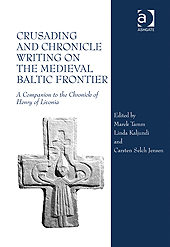
The Chronicle of Henry of Livonia, or Henricus Lettus, written by a missionary priest to record the history of the German crusades to Livonia and Estonia around 1186-1227, has become known as one of the most vivid literary examples of early 13th century crusading ideology.
Click here to read this article from Estonian Public Broadcasting
Tuesday, November 15, 2011
Crusader inscription by Frederick II discovered in Israel
An Arabic inscription that bears the name of the Holy Roman Emperor, Frederick II, and the date “1229 of the Incarnation of our Lord Jesus the Messiah”, was recently deciphered by Professor Moshe Sharon and Ami Shrager of the Hebrew University of Jerusalem. During the deciphering it became evident that this is a rare archaeological find – the only one of its kind.
The 800-years-old inscription was fixed years ago in the wall of a building in Tel Aviv. The original location of the gray marble slab, on which the inscription is engraved, was probably in Jaffa’s city wall.
Click here to read this article from Medievalists.net
The 800-years-old inscription was fixed years ago in the wall of a building in Tel Aviv. The original location of the gray marble slab, on which the inscription is engraved, was probably in Jaffa’s city wall.
Click here to read this article from Medievalists.net
Saturday, November 12, 2011
Wales and the Crusades
What was Wales’s involvement in the Crusades and what role did Welsh soldiers play in the campaign to halt Islamic expansion into Jerusalem? How did Welsh participation in the Crusades help cement English control over Wales?
Wales and the Crusades by Kathryn Hurlock is a new title, published by the University of Wales Press, which looks at the impact of the Crusades on Medieval Wales and what forces and reasons lay behind its participation in the doomed campaign.
Hurlock also considers why Welsh lords and their armies took part in the Crusades, supported military orders, and wrote about events in the Holy Land, despite then being perceived as religiously and culturally underdeveloped compared with the rest of Britain and Europe.
Click here to read this article from Medievalists.net
Thursday, October 20, 2011
Archaeologists examine medieval fortress on the Mediterranean coast
Archaeologists have long known that Yavneh-Yam, an archaeological site between the Israeli cities of Tel Aviv and Ashdod on the Mediterranean coast, was a functioning harbor from the second millennium B.C. until the Middle Ages. Now Tel Aviv University researchers have uncovered evidence to suggest that the site was one of the final strongholds of Early Islamic power in the region.
According to Professor Moshe Fischer of Tel Aviv University’s Department of Archaeology and Near Eastern Cultures and head of the Yavneh-Yam dig, the recent discovery of a bath house from the Early Islamic period which made use of Roman techniques such as heated floors and walls, indicates that Arabic rulers maintained control of the site up until the end of the Early Islamic period in the 12th century AD. Considered alongside other datable artefacts — such as pottery, oil lamps and rare glass weights — this architectural feature demonstrates that Arabic control was maintained in Yavneh-Yam at a time when 70 percent of the surrounding land was in the hands of Christian crusaders.
Click here to read this article from Medievalists.net
Monday, October 17, 2011
Historian Peter Frankopan is challenging a millennium of scholarship in his view of the First Crusade

According to Harvard University Press, a forthcoming book by the British historian Peter Frankopan is "countering nearly a millennium of scholarship" by emphasising the overlooked eastern origins of the Crusades.
Dr Frankopan, the director of the Centre for Byzantine Research at the University of Oxford, told The Times Cheltenham Literature Festival yesterday that "something is not quite right" with the traditional version. This has maintained, with remarkable consistency, that the First Crusade was a product of the Council of Clermont in central France in 1095, where Pope Urban II called on the faithful to free Jerusalem from occupation by Muslim Turks. The Pope's evangelism was prompted by "disturbing news" received from Jerusalem and Constantinople of atrocities committed against Christians by the Turks. The speech electrified Europe and helped to raise an army of between 80,000 and 90,000 men, 30 times larger than the Norman force that had conquered England a generation earlier.
Click here to read this article from The Australian
Wednesday, July 27, 2011
July issue of BBC History Magazine features the Crusades
BBC History Magazine, a leading monthly periodical on all things history, features an article about the Crusades and Christian-Muslim medieval interaction. “Traders and Crusaders”, by Thomas Asbridge of Queen Mary University of London, examines how relations between Europe and the Islamic Middle East “were about more than war and hatred.”
The article focuses on the trade relationships that developed between Muslim and Christian merchants, with Italian city-states such as Genoa and Venice establishing networks to bring in goods from Middle Eastern cities like Aleppo and Damascus. Asbridge writes, “these shared interests produced interdependency and promoted carefully regulated contact, even at times of heightened political and military conflict. In the end – even in the midst of holy war – trade was too important to be disrupted.”
Click here to read this article from Medievalists.net
Wednesday, June 22, 2011
Underground Crusader city revealed beneath streets of Acre
Archaeologists prepare to uncover entire compound built in medieval times and hidden for centuries under the rubble in northern Israel.
Off the track beaten by most Holy Land tourists lies one of the richest archaeological sites in a country full of them: the walled port of Acre, where the busy alleys of an Ottoman-era town cover a uniquely intact Crusader city now being rediscovered.
Preparing to open a new subterranean section to the public, workers cleaned stones this week in an arched passageway underground. Etched in plaster on one wall was a coat of arms — graffiti left by a medieval traveler. Nearby was a main street of cobblestones and a row of shops that once sold clay figurines and ampules for holy water, popular souvenirs for pilgrims.
Click here to read this article from Haaretz
Monday, May 30, 2011
Environmental Crusaders: How Medieval Knights remade Poland’s ecosystems
In 1280, victorious Teutonic Crusaders began building the world’s largest castle on a hill overlooking the River Nogat in what is now northern Poland. Malbork Castle became the hub of a powerful Teutonic state that crushed its pagan enemies and helped remake Medieval Europe. Now, ancient pollen samples show that in addition to converting heathens to Christians, the Crusaders also converted vast swathes of Medieval forests to farmlands.
Click here to read this article from Conservation Magazine
Click here to read this article from Conservation Magazine
Wednesday, May 18, 2011
Crusade, Liturgy, Ideology, and Devotion project
Cecilia Gaposchkin, assistant professor of history and assistant dean of faculty for pre-major advising, has accepted a fellowship at Princeton’s Shelby Cullom Davis Center for Historical Studies, where she will work on a project tentatively titled “Crusade, Liturgy, Ideology, and Devotion.”
“I am exploring the different ways that Western Christian ecclesiastical ritual underwrote crusade ideology in the period stretching from the 11th to the 15th century,” says Gaposchkin, a medieval historian. “I began teaching courses on the Crusades in 2005. This book grew out of that experience and has thoroughly informed it.”
Click here to read this article from Dartmouth College
Wednesday, April 06, 2011
Remains of Crusader / Templar army discovered in Israel
Archaeologists and historians working in northern Israel have discovered the remains of a Templar and Crusader army who were slaughtered by Saladin in one of the major battles of the Crusades. The results of the excavations are now being broadcast on the program “Last Stand of the Templars”, which is being shown this week on the National Geographic Channel.
The Battle of Jacob’s Ford, which was an intense siege of an important Crusader castle, took place in the late summer of 1179, ended with over 800 Templars and Crusaders being killed, and hundreds more being taken prisoner. It is considered one of the most important victories by the Muslim commander Saladin, allowing him to retake Jerusalem from the Crusaders eight years later.
Click here to read this article from Medievalist.net
Wednesday, February 23, 2011
Rick Santorum: The Crusades Get A Bad Rap!
If you were worried there wouldn't be a 2012 candidate touting the pro-Crusades platform, then today is your lucky day!
"The idea that the Crusades and the fight of Christendom against Islam is somehow an aggression on our part is absolutely anti-historical," former Sen. Rick Santorum (R-PA) told a South Carolina audience yesterday. "And that is what the perception is by the American left who hates Christendom."
Click here to read this article from TPM
See also Matthew Gabriel's view on this article from Modern Medieval
Monday, January 17, 2011
Historian dispels myths about Eleanor of Aquitaine and the role of women on the Second Crusade
One of the popular images of the Crusades is the story of Queen Eleanor of Aquitaine taking 300 of her ladies-in-waiting with her on the Second Crusade during the years 1147-49. While this particular tale has long-been debunked, a recent article has shown that many other aspects of Eleanor’s role, and the overall effort of women during the Second Crusade has been emphasized too much.
Conor Kostick’s article, “Eleanor of Aquitaine and the women of the Second Crusade,” which appears in the book Medieval Italy, Medieval and Early Modern Women: Essays in Honour of Christine Meek , shows that female participation was likely much smaller during the Second Crusade than it was for the First Crusade at the end of the eleventh century. Kostick believes that the crusade preaching that took place in the lead up to the march to the Holy Land was more aimed at getting people with a military background to commit to the crusade, and avoided encouraging non-combatants, including women, into participating.
Click here to read this article from Medievalists.net
Conor Kostick’s article, “Eleanor of Aquitaine and the women of the Second Crusade,” which appears in the book Medieval Italy, Medieval and Early Modern Women: Essays in Honour of Christine Meek
, shows that female participation was likely much smaller during the Second Crusade than it was for the First Crusade at the end of the eleventh century. Kostick believes that the crusade preaching that took place in the lead up to the march to the Holy Land was more aimed at getting people with a military background to commit to the crusade, and avoided encouraging non-combatants, including women, into participating.Click here to read this article from Medievalists.net
Subscribe to:
Posts (Atom)