Showing posts with label Explorers. Show all posts

Monday, October 08, 2012

How Columbus Day Fell Victim to Its Own Success

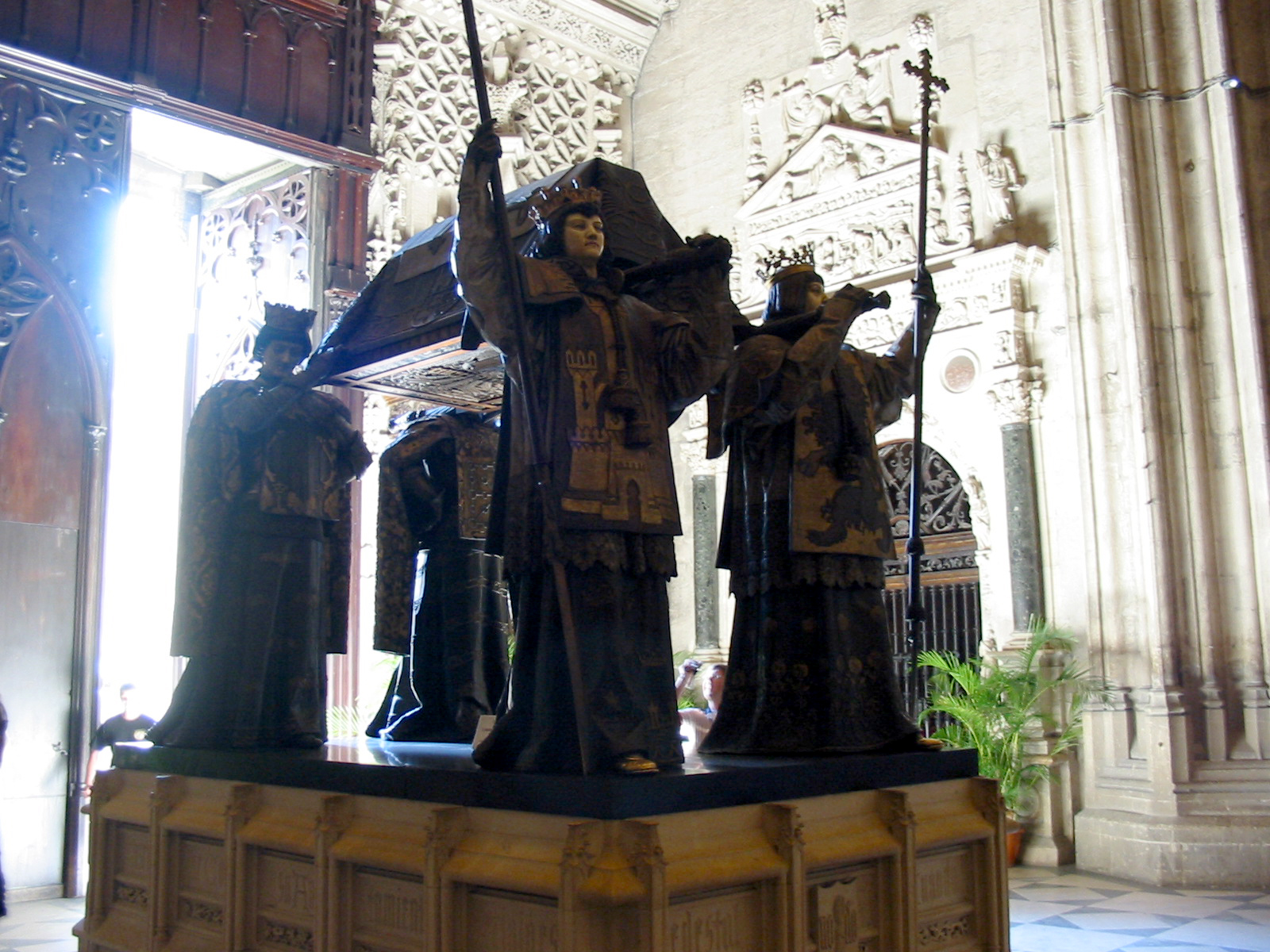
Today is Columbus Day, a solemn occasion marked by parades, pageantry, and buckets of fake blood splashed on statues of its namesake. Activists have turned the commemoration of Columbus' landfall in the New World into an annual protest against "the celebration of genocide." What the protesters may not know, however, is that the holiday they are protesting once played a crucial role in forging a society capable of listening to their concerns. This is the curious tale of how Columbus Day fell victim to its own remarkable success.

 Christopher Columbus has been, from the first, a powerful symbol of American nationalism. In the early American republic, Columbus provided a convenient means for the new nation to differentiate itself from the old world. His name, rendered as Columbia, became a byword for the United States. Americans represented their nation as a woman named Columbia, adopted Hail, Columbia! as an unofficial anthem, and located their capitol in the District of Columbia.


 Italian-Americans, arriving in large numbers in the late nineteenth century, took note of the reverence which their famous countryman enjoyed. It was a far cry from the treatment they themselves received. Many Americans believed Italians to be racially inferior, their difference made visible by their "swarthy" or "brown" skins. They were often portrayed as primitive, violent, and unassimilable, and their Catholicism brought them in for further abuse. After an 1891 lynching of Italians in New Orleans, a New York Times editorial proclaimed Sicilians "a pest without mitigation," adding, for good measure, that "our own rattlesnakes are as good citizens as they."

 Italians quickly adopted Columbus as a shield against the ethnic, racial, and religious discrimination they faced in their adoptive country. They promoted a narrative of national origins that traced back beyond Plymouth or Jamestown, all the way to San Salvador. How could a nation, they asked, reject the compatriots of its own discoverer?

Click here to read this article from The Atlantic

Wednesday, May 09, 2012

Research uncovers new details about John Cabot’s voyage to North America

Evidence that a Florentine merchant house financed the earliest English voyages to North America, has been published on-line in the academic journal Historical Research. 

The article by Dr Francesco Guidi-Bruscoli, a member of a project based at the University of Bristol, indicates that the Venetian merchant John Cabot (alias Zuan Caboto) received funding in April 1496 from the Bardi banking house in London.

The payment of 50 nobles (£16 13s. 4d.) was made so that ‘Giovanni Chabotte’ of Venice, as he is styled in the document, could undertake expeditions ‘to go and find the new land’.

Click here to read this article from Medievalists.net

Friday, May 04, 2012

Elizabethan Map of America provides clue to ‘Lost Colony’


After decades of unsuccessful searching, archaeologists may have their best evidence ever of the possible fate of Sir Walter Raleigh’s “Lost Colony.” It comes in the form of a clue from Sir Walter himself, secreted within the 425 year old “Virginea Pars” map drawn by his expedition to site the first English colony in the New World.

At a conference held yesterday at the University of North Carolina at Chapel Hill, archaeologists and scholars from the First Colony Foundation and the British Museum discussed the newly discovered information previously hidden within the map and possible implications for understanding the eventual fate of Raleigh’s “lost colonists.”

The “Virginea Pars” map was produced from explorations conducted by members of Sir Walter Raleigh’s Roanoke Colony of 1584-1590. The remarkably-accurate map depicts the coastal area from Chesapeake Bay to Cape Lookout, including the location of many native American villages visited by the colonists. However, until now the map provided little information about the location of his planned “Cittie of Ralegh.”

Click here to read this article from Early Modern England

Tuesday, May 01, 2012

Marco Polo really did go to China, new study finds


It has been said that Marco Polo did not really go to China; that he merely cobbled together his information about it from journeys to the Black Sea, Constantinople and Persia and from talking to merchants and reading now-lost Persian books. But in Marco Polo was in China: New Evidence from Currencies, Salts and Revenues, Hans Ulrich Vogel, Professor of Chinese Studies at the University of Tübingen, puts paid to such rumors.

He begins with a comprehensive review of the arguments for and against, and follows it up with evidence from relevant Chinese, Japanese, Italian, French, German and Spanish literature. The result is compelling: despite a few, well-known problems with Marco Polo’s writings, they are supported by an overwhelming number of verified accounts about China containing unique information given over centuries.

Click here to read this article from Medievalists.net

Wednesday, December 21, 2011

Skeletons point to Columbus voyage for syphilis origins

Skeletons don’t lie. But sometimes they may mislead, as in the case of bones that reputedly showed evidence of syphilis in Europe and other parts of the Old World before Christopher Columbus made his historic voyage in 1492.

None of this skeletal evidence, including 54 published reports, holds up when subjected to standardized analyses for both diagnosis and dating, according to an appraisal in the current Yearbook of Physical Anthropology. In fact, the skeletal data bolsters the case that syphilis did not exist in Europe before Columbus set sail.

“This is the first time that all 54 of these cases have been evaluated systematically,” says George Armelagos, an anthropologist at Emory University and co-author of the appraisal. “The evidence keeps accumulating that a progenitor of syphilis came from the New World with Columbus’ crew and rapidly evolved into the venereal disease that remains with us today.”

Click here to read this article from Medievalists.net

Wednesday, September 28, 2011

Scholar finds evidence of links between Vikings and North American natives

Old Norse sagas such as Saga of Erik the Red and the Saga of the Greenlanders have been long been considered among the most important sources of information about relations between Vikings and Native Americans. But new research suggests that accounts about a mysterious island known as Hvitramannaland are also other descriptions of the New World and its inhabitants.

In the article “Hvitramannaland and other fictional islands in the sea”, Else Mundal examines references in saga accounts about the island, which was described as being six days and nights of sailing west of Ireland. Other accounts suggest that it was close to Vinland, which is now considered to be somewhere along the eastern coast of North America.

Click here to read this article from Medievalists.net

Tuesday, August 09, 2011

Historians cast doubt on the story of Marco Polo's travels in China

His journeys across mountain ranges and deserts opened the eyes of medieval Europe to the exotic wonders of China and the Silk Road, establishing him as one of history's greatest explorers.

But a team of archaeologists believe Marco Polo never even reached the Middle Kingdom, much less introduced pasta to Italy after bringing it back from his travels, as legend has it.


Instead they think it more likely that the Venetian merchant adventurer picked up second-hand stories of China, Japan and the Mongol Empire from Persian merchants he met on the shores of the Black Sea, thousands of miles short of the Orient.

Click here to read this article from Daily News and Analysis

Monday, November 29, 2010

Christopher Columbus was the son of a Polish king, historian says

Christopher Columbus was a royal prince, son of a Portuguese noble lady and exiled Polish King Władysław III, according to Columbus’ new biography, COLON. La Historia Nunca Contada (COLUMBUS. The Untold Story), by Manuel Rosa, just released in Spain.

There have been several different theories that suggest Columbus did not come from Genoa, Italy, including that he was Scottish, Catalan, and even Jewish. Manuel Rose, a researcher from Duke University, has spent 20 years working investigating this story and believes that the true identity of Christopher Columbus was hidden in order to protect his father from being discovered. It is believed that Władysław III, king of Poland from 1434 and Hungary from 1440, died in 1444 at the Battle of Varna.

Click here to read this article from Medievalists.net

Sunday, November 21, 2010

Native American came to Iceland over a thousand years ago, research finds

New genetic research has uncovered evidence that suggests a Native North American woman came to Iceland in the year 1000, most probably as a captive of Viking marauders. This early contact between medieval Europeans and Native Americans has led to at least 80 Icelanders carrying her genes.

The story behind this finding was revealed this week in the article, “A new subclade of mtDNA haplogroup C1 found in icelanders: Evidence of pre-columbian contact?” in the American Journal of Physical Anthropology. The Icelandic and Spanish authors came across the discovery as they were doing research on the genetic background of contemporary Icelanders.

Click here to read this article from Medievalists.net

Saturday, October 30, 2010

Italian bank financed Cabot voyage to Canada, new research shows

Italy has just moved from the periphery toward centre stage in the opening act of Canadian history. Historians probing medieval archives and a dead scholar's research notes have unearthed surprising new details about the financing of John Cabot's 1497 expedition across the Atlantic Ocean -- the voyage that led to the European rediscovery of Canada some 500 years after the Vikings landed on Newfoundland's shores.

Cabot's landmark journey to the New World aboard the Matthew, completed just five years after Italian-Spanish explorer Christopher Columbus had reached the Americas in 1492, has been viewed by historians as a wholly English enterprise -- despite Cabot's Italian birth -- because of the ship's departure from Bristol and the royal charter granted to the transplanted sailor by King Henry VII.

But a team of researchers led by University of Bristol historian Evan Jones says it has found documents proving Cabot's voyage was made possible by a loan from a London-based Italian bank -- recasting the famous 15th-century expedition as more of a multinational endeavour and rewriting the first chapter of the story of Canada.

Click here to read this article from the Calgary Herald

Monday, October 18, 2010

Could a rusty coin re-write Chinese-African history?

It is not much to look at - a small pitted brass coin with a square hole in the centre - but this relatively innocuous piece of metal is revolutionising our understanding of early East African history, and recasting China's more contemporary role in the region.

A joint team of Kenyan and Chinese archaeologists found the 15th Century Chinese coin in Mambrui - a tiny, nondescript village just north of Malindi on Kenya's north coast.

In barely distinguishable relief, the team leader Professor Qin Dashu from Peking University's archaeology department, read out the inscription: "Yongle Tongbao" - the name of the reign that minted the coin some time between 1403 and 1424.

Click here to read this article from the BBC

Thursday, July 29, 2010

L’Anse aux Meadows site celebrates 50 years since discovery

Last week the government of Canada marked the 50th anniversary of the discovery of the Viking remains at the L’Anse aux Meadows in Newfoundland. The national historic and World Heritage site was discovered by Helge and Anne Stine Instad, and their guide, local fisherman George Decker, in 1960.

Celebrations were held on July 21st at the community of L’anse aux Meadows. Descendants of Helge and Anne Stine Ingstad and George Decker then led an expedition across the barrens of L’Anse aux Meadows to the Norse archaeological site, retracing the steps of their families 50 years ago. The group was then joined by invited guests, community members and an enthusiastic group of visitors to officially commemorate the discovery on-site.

Click here to read this article on Medievalists.net

Saturday, February 27, 2010

China, Kenya to search for medieval Chinese ships on Kenyan coast

China and Kenya have signed an agreement to jointly explore the Kenyan coast for wrecks of ancient Chinese merchant ships.

The three-year project, funded by China's Ministry of Commerce, will explore Kenya's coasts around Malindi City and the Lamu Archipelago.

"Historical records indicate Chinese merchant ships sank in the seas around Kenya. We hope to find wrecks of the fleet of the legendary Zheng He," said Zhang Wei, deputy curator of the National Museum of China, Thursday.

Zheng He was a Ming Dynasty (1368-1644) eunuch who led a merchant fleet of hundreds of ships to Kenya twice in the 15th Century.

Kenyan lore has long told of shipwrecked Chinese sailors who wound up settling in the region, marrying local women, and sharing their knowledge of farming and fishing. Previous archaeological digs have proven that Chinese-descended people existed in the area, according to Zhang.

Moreover, Zhao Jiabin, director of the Underwater Archaeology Center at the National Museum of China, said that ship debris and ancient chinaware from China's Yuan, Ming, and Qing dynasties were discovered during archaeological forays in the coastal regions of Kenya, including Malindi.

The wrecks that will be investigated under the current agreement are believed to have been part of a massive fleet led by Zheng that reached Malindi in 1418. At least one of the ships sank near the Lamu Archipelago.

Zhao Hui, director of the School of Archaeology and Museology at Peking University, said that the project was borne out of five years of discussion, and will involve searching for, excavating, and documenting cultural relics.

Exploration work will be conducted for up to three months each year. According to Idle Omar Farah, Director General of the National Museum of Kenya, the first group of Chinese archaeologists is due to arrive as early as July. As a consequence of the climate conditions in Kenya, cultural relic excavation can only be undertaken during its two dry seasons: from June to September and from December to February.

Sunday, November 08, 2009

Teeth of Columbus’s crew flesh out tale of new world discovery


The adage that dead men tell no tales has long been disproved by archaeology.

Now, however, science is taking interrogation of the dead to new heights. In a study that promises fresh and perhaps personal insight into the earliest European visitors to the New World, a team of researchers from the University of Wisconsin-Madison is extracting the chemical details of life history from the teeth of crew members Christopher Columbus left on the island of Hispaniola after his second voyage to America in 1493-94.

"This is telling us about where people came from and what they ate as children," explains T. Douglas Price, a UW-Madison professor of anthropology and the leader of the team conducting an analysis of the tooth enamel of three individuals from a larger group excavated almost 20 years ago from shallow graves at the site of La Isabela, the first European town in America.

Price and colleague James Burton, in collaboration with researchers from the Autonomous University of the Yucatan in Mexico, are attempting to flesh out the details of a colony that lasted less than five years. The human remains used in the study were buried without the formalities of coffins or shrouds, and were excavated from what was once the church graveyard of the town Columbus established. Headstones and other identifying markers have long since faded to nothing or have been lost entirely during the 500 years since the bodies were first interred.

Despite its brief existence, historians and archaeologists believe La Isabela was a substantial settlement with a church, public buildings such as a customhouse and storehouse, private dwellings and fortifications. It is also the only known settlement in America where Columbus actually lived.

Although the town has been the subject of previous archaeological studies, the work by Price, Burton and their colleague Vera Tiesler and Andrea Cucina of the Autonomous University of the Yucatan is revealing new insight into the people who lived and sailed with Columbus, and who died on the shores of a strange and exotic new world.

Histories of La Isabela, named after Spain's queen and Columbus's patron and located in what is today the Dominican Republic, suggest its population was made up only of men from the fleet of 17 vessels that comprised Columbus's second visit to the New World. But the first analysis of the remains of 20 individuals excavated two decades ago by Italian and Dominican archaeologists portray a different picture, suggesting that living among the Spaniards at La Isabela were native Ta�nos, women and children, and possibly individuals of African origin. If confirmed, that would put Africans in the New World as contemporaries of Columbus and decades before they were believed to have first arrived as slaves.

The study conducted by the Wisconsin researchers relied on isotopic analysis of three elements: carbon, oxygen and strontium.

Carbon isotope ratios provide reliable evidence of diet at the time an individual's adult teeth emerge in childhood. For example, people who eat maize, as opposed to those who consume wheat or rice, have different carbon isotope ratio profiles locked in their tooth enamel.

"Heavy carbon means you were eating tropical grasses such as maize, found only in the New World, or millet in Africa, neither of which was consumed in Europe" at the time, says Burton.

Oxygen isotopes provide information about water consumption and also can say something about geography as the isotopic composition of water changes in relation to latitude and proximity to the ocean. Strontium is a chemical found in bedrock and that enters the body through the food chain as nutrients pass from bedrock to soil and water and, ultimately, to plants and animals. The strontium isotopes found in tooth enamel, the most stable and durable material in the human body, thus constitute an indelible signature of where someone lived as a child.

Three of the individuals whose teeth were subjected to isotopic analysis by the Wisconsin group were males under the age of 40 and who had carbon isotope profiles far different from the rest, suggesting an Old World origin. "I would bet money this person was an African," Price says of one of the three individuals whose teeth were subjected to analysis.

It was known that Columbus had a personal African slave on his voyages of discovery. The new analysis could mean that Africans played a much larger role in the first documented explorations of America.

The strontium isotope analysis, Price notes, is not yet complete, as samples from the teeth of the presumed sailors remain to be matched with strontium profiles of Spanish soils. However, such matches could open an intriguing window to the personal identities of individuals buried in La Isabela.

"All of these sailors — their place of birth, their age — were recorded in Seville before they left on the second voyage," Price explains. "One of the things we're hoping to do with the strontium is identify individuals."

The skeletons also exhibit evidence of scurvy, a common affliction of 15th century sailors who lacked vitamin C on their long voyages, as well as signs of malnutrition and physical stress. Chronicles of the voyage noted that most of the Europeans, including Columbus himself, fell sick shortly after landfall on Hispaniola, and many subsequently died, perhaps becoming the first to be buried in the La Isabela church graveyard.

Monday, October 26, 2009

Scholar casts doubt on claims that Columbus was a Catalan


The recent announcement that the explorer Christopher Columbus was not an Italian, but rather came from the Kingdom of Aragon, has come under scrutiny, with one scholar poking large holes into the thesis.

Last week, we reported that a new book by Estelle Irizarry, a linguistics professor at Georgetown University, claims that evidence from Columbus' own writings shows that he was likely a Catalan and may even have been Jewish.

One of the key pieces of evidence was the explorer's used of a slash symbol - similar to the ones used in Internet addresses - that Columbus employed to indicate pauses in sentences.

That symbol, also known as a virgule, did not appear in texts of that era written in Castilian nor in writings from any other country, but only in records and letters from the Catalan-speaking areas of the Iberian peninsula, namely present-day Catalonia and the Balearic Islands.

Irizarry explains, "The virgules are sort of like Columbus' DNA. They were a habit of his. Columbus was a punctuator and was one of the few of that era."

Now, in an interview with Medievalists.net, Dr. Diana Gilliland Wright confirms that the slash symbol was used in other places outside of western Spain. Wright, who is an expert in Italian history in the late Middle Ages, says, "the virgule is a very common marker for pauses in sentences" among Venetian documents from the later half of the fifteenth century.

Dr. Wright also casts doubt on Irizarry's belief that Columbus' spelling inconsistencies can also be a clue to his origins. "Spelling in the 15th century was extremely fluid," she says, "and it is normal to find in official Venetian documents and records three different spellings of the same name, even when it was the name of a person known to the writer of the document. I cannot see that variation in spelling can be used to demonstrate anything but that the writers didn't have my spelling teacher."

Click here to read the news article: Christopher Columbus was a Catalan, and possibly Jewish, scholar says

Click here to see Diana Gilliland Wright's blog Surprised by Time

Monday, October 19, 2009

Christopher Columbus was a Catalan, and possibly Jewish, scholar says


The debate over the nationality of Christopher Columbus has kept investigators occupied ever since the man credited with the discovery of the New World died in 1506. Thought by many to be the son of a Genovese artisan, a new study by Estelle Irizarry, based on the official documents and letters of the explorer, suggests that Columbus' native tongue was Catalan and that he came from the Kingdom of Aragon.

Furthermore, Irizarrt belives that Christopher Columbus' origins are not obscure by chance, but rather the result of the famed explorer's having purposely hid the fact he was a Jew or "converso" (convert to Christianity).

Estelle Irizarry, a linguistics professor at Georgetown University, reached that conclusion after examining Columbus' writings in detail and discovering a simple but important clue that had escaped other researchers: a slash symbol - similar to the ones used in Internet addresses - that Columbus employed to indicate pauses in sentences.

That symbol, also known as a virgule, did not appear in texts of that era written in Castilian nor in writings from any other country, but only in records and letters from the Catalan-speaking areas of the Iberian peninsula, namely present-day Catalonia and the Balearic Islands.

Irizarry explains, "The virgules are sort of like Columbus' DNA. They were a habit of his. Columbus was a punctuator and was one of the few of that era."

Irizarry uses that metaphor as the title of her latest book, Christopher Columbus: The DNA of his Writings, in which she pored over the language and syntax the navigator used in more than 100 letters, diaries and documents. She also found in her research of documents from that era written on the Balearic island of Ibiza that 75 percent contained virgules similar to Columbus'.

At the end of the 15th century and the beginning of the 16th, authors normally left punctuation for publishers and even Cervantes' "Don Quixote" was only filled in once and for all with periods and commas in the 19th century, making Columbus' virgules all the more noteworthy, Irizarry said.

Her book confirms some of the conclusions drawn by scholar Nito Verdera, who identified many words of Catalan origin in the writing. Irizarry thinks the future explorer grew up in a Catalan-speaking region and that explains why he did not express himself correctly in Spanish, which would have been his second language.

Proof of that is the inconsistency of his spelling, she said, noting for example that he would write "trujeron" and "trajeron" - incorrect and correct spellings, respectively, of the Spanish word for "brought" - sometimes in the same sentence. In addition, these peculiarities of his writing and other linguistic aspects associated with Ladino, a Jewish ethnolect in late medieval Spain, suggest that Columbus was Jewish, Irizarry said.

"Columbus even punctuated marginal notes and he included copious notes around his pages. In that sense, he followed the punctuation style of the Ladino-speaking scribes," the professor said.

Irizarry says her research clears up the big mystery surrounding Columbus' place of birth, which he never revealed but which different historians have claimed was Genoa, Italy; the French Mediterranean island of Corsica; Portugal; and Greece, as well as Spain. "The people who hid (their origins) more and had reason to do so were the Jews," Irizarry said, referring to the forced conversions and mass expulsions of Jews in late medieval Spain.

A scientific project launched three years ago to discover his true origins using DNA comparisons between his family and possible descendants has so far failed to provide conclusive results.

A team of scientists took samples from the tomb of Columbus in Seville and from bones belonging to his brother and son and compared them to the genetic make-up of hundreds of people living across Europe with surnames believed to be modern day variants of Columbus.

Swabs were taken from the cheeks of Colom's in Catalonia, Colombo's in Italy and even members of the deposed Portuguese royal family, who argue that Columbus was the product of an extramarital affair involving a Portuguese prince. Scientists had hoped to establish a common ancestor using standard Y-chromosome tests but they have yet to find a link.

They study may be in vain, however, as there is evidence to suggest that Columbus, who first crossed the Atlantic in 1492, may have adopted his surname later in life to disguise his true origins.

Another theory claims that he once worked for a pirate called Vincenzo Columbus, and adopted that name in order not to embarrass his relations with his new profession.
Columbus himself, when asked about his origins, used to shrug off the questions. "Vine de nada" – "I came from nothing", he said.

Click here to read an earlier article by Estelle Irizarry entitled: Three Sources of Textual Evidence of Columbus, Crypto Jew

Monday, September 07, 2009

Medieval Greenland abandoned but not forgotten, study finds

A new article on late medieval Greenland finds that several attempts were made to return to the northern island in the 15th and 16th centuries.

Janus Moller Jensen, who teaches at the University of Southern Denmark, examines what happened in "The Forgotten Crusades: Greenland and the Crusades, 1400-1523." Greenland was first settled by Icelanders and Norweigians in 986, but during the early 15th century contact between the Greenland settlers and the rest of medieval Europe was cut and the community disappeared.


Jensen's article examines attempts by the rulers of the Kalmar Union (which consisted of the kingdoms of Norway, Sweden and Denmark) to send an expedition to the island, which they considered to be part of their territory.

Chronicles and sources claim that the settlers in Greenland as being at war with a race of people known as the Karelians (or pygmies), who may have been the Inuit. The attempts to return to Greenland was portrayed as a crusade to regain the land taken by heathens.

Jensen also finds evidence that the Kalmar Union and the Portuguese cooperated and may have even lauched a joint expedition to Greenland in the 15th century, with their goal not only to reach Greenland, but also to find a northwest passage to India.

Unfortunately, little is known about what happened in these expeditions. That might be explained by the words of one 16th century Portuguese writer, who noted "But as most of those who made discoveries were ruined thereby, there is no recollection left by any of them so far as we know, particular those who steered northward."

Jensen's article can be found in volume 7 of the journal Crusades, which is published by the Society for the Study of the Crusades and the Latin East.

Related articles:

Wednesday, August 26, 2009

Letter shows another late medieval expedition to Canada


Evidence of a previously unknown voyage to North America in 1499, led by a Bristol explorer, is to be published in the academic journal Historical Research.

The article, 'Henry VII and the Bristol expeditions to North America: the Condon documents' by Dr Evan Jones, a historian at Bristol University, suggests that a Bristol merchant, William Weston, undertook a voyage to the ‘New Found Land’ just two years after the first voyage of Venetian explorer John Cabot who sailed from Bristol to ‘discover’ North America in 1497.

Cabot led a second, larger, expedition the following year (1498) to explore the new land, with support from King Henry VII. However, a third expedition undertaken by Weston in 1499 with the support of the King, has remained unknown until now.

The main evidence for the voyage comes from a personal letter written by the King to his Lord Chancellor on 12 March 1499. In this, Henry VII instructs his minister to suspend an injunction served against Weston in the Court of Chancery because Weston shall shortly ‘with God’s grace pass and sail for to search and find if he can the new found land’.

While this was an independent voyage, it seems that Weston was permitted to undertake it because he was one of Cabot’s chief supporters in Bristol. This meant that, although Cabot had received monopoly rights for westwards exploration from England, Weston was covered by the terms of Cabot’s royal patent.

Dr Evan Jones said “Henry VII’s letter is an exciting find because so little is known about the early English voyages of discovery. We knew that our knowledge of the first English expeditions to the New World was very incomplete. But this is beginning to show just how incomplete it is. Up till now, no one has ever even heard of William Weston. Yet this letter reveals him to be the first Englishman to lead an expedition to North America.”

Although the letter itself does not reveal what Weston achieved, research suggests that his expedition took him up into the Labrador Sea, possibly reaching as far as the Hudson Straits. “If so”, Dr Jones continued, “this can probably be counted as the first Northwest Passage expedition, commencing a centuries-long search to locate a sea-route around North America.”

Although the publication of this research is entirely new, Dr Jones is keen to stress that the letter itself was found thirty years ago, miscataloged among a bundle of Chancery files in what is now The National Archives. The archivist who found the letter, Miss Margaret Condon, passed on the information to the eminent discovery historian, Professor David Beers Quinn in 1981. He, however, failed to publish the information because he wanted to wait for another historian, Dr Alwyn Ruddock, to publish her research on the Cabot voyages first. This, however, never happened, leaving the letter unpublished at the time of Quinn’s death in 2002.

That the letter ever came to light was only the result of a bizarre twist in events. In 2005, Dr Alwyn Ruddock died, leaving instructions that all her research notes be destroyed. This was despite the fact that, during the forty years she had been researching the Cabot voyages, she had apparently made discoveries that looked set to revolutionise the field.

Following her death, Dr Jones commenced a search to discover just what Ruddock had found, his investigations being published in a earlier edition of Historical Research. Ruddock had apparently uncovered evidence that Cabot and his supporters had explored a large section of the coast of North America from 1498-1500 and, moreover, that an offshoot of his expedition established the Continent’s first Christian community in Newfoundland. It was while investigating Ruddock’s claims that Dr Jones found out about the discoveries of Margaret Condon, made decades before.

Jones and Condon have now teamed up with researchers in Canada to carry out more work on the early voyages. “When I first started investigating Ruddock’s claims’, Dr Jones said, “some people were somewhat sceptical about her claims. It was perhaps easier to think that she might have gone a bit ‘batty’ in her old age than to believe that her extraordinary claims might be true. Now though, with the bits and pieces of evidence falling into place, the hunt to relocate the material that she found, is certainly on.”


Click here to read an earlier article: Remains of only medieval church in North America could be buried in Newfoundland