Our collection of interesting news, videos and tweets about the Middle Ages.
Finally, check out this image of the November issue of Vogue Paris, where Adriana Lima shows off some 'neo-armor' from Dolce & Gabbana.
Showing posts with label Books. Show all posts
Tuesday, November 04, 2014
Thursday, February 06, 2014
Sea Monsters, Bones, and Textbooks: Medieval News Roundup
The Bones of Charlemagne
Swiss researchers believe they have confirmed that the 94 bones and bone fragments kept at Aachen Cathedral belong to the first Holy Roman Emperor. Professor Frank Rühli of the University of Zurich explains, "Thanks to the results from 1988 up until today, we can say with great likelihood that we are dealing with the skeleton of Charlemagne."The remains of Charlemagne were taken out of his grave in the 12th century and put into various reliquaries. The researchers took various measurements of the remaining bones, and conclude that he was about six feet tall and thinly built.
You can read more details from Medieval Histories
Medieval Sea Monsters
The Public Domain Review website has a posted an article about the drawings of the sea creatures made by the 16th century writer Olaus Magnus and his influence on sea lore. They note:The northern seas of the marine and terrestrial map teem with fantastic sea monsters either drawn or approved by Olaus. The most dramatic of those, off the busy coast of Norway, below the dreaded Maelström, is the great serpent, coiling around a ship’s mast and lunging with bared teeth at a sailor on the deck.
You can see more images and the full article from the Public Domain Review
What's wrong with History Textbooks
David Cutler, writing in The Atlantic, is finding that high-school history textbooks in the U.S. are not very useful for teaching history. His reasons for this include:- Textbooks present history as unchanging, but as time passes, our understanding and interpretation of the past constantly evolves.
- Textbooks are one-sided, offering a top-down, often white-male-centric view of history.
- Without a thesis or any semblance or argument, textbooks don’t accurately reflect how most scholars (at least good ones) write and present history. Teachers should assign readings that model effective historical writing.
- Most importantly—and this merits repeating—textbooks are boring and intimidating.
- Textbooks can serve as a crutch for teachers who don’t know history or the historian’s craft.
While this article is aimed at teaching American history in High School, some of the observations might also be apt for the use of textbooks in college or first year university history courses too.
Click here to read this article from The Atlantic
Friday, June 21, 2013
Gutenberg, Executions, Medicis, Vikings, Hobbits and more - medieval news roundup
A medieval news roundup for the weekend...
If you are a fan of Marshall McLuhan or have an interest in the history of printing, this interview from the Columbia Journalism Review might interest you. In this post, entitled The future is medieval, they talk with Thomas Pettitt and Lars Ole Sauerberg from the University of Southern Denmark about their “Gutenberg Parenthesis” idea. It deals with how digital media will be tipping the scales between oral and print communication, the first change we have seen since Gutenberg started his printing machine. It includes some talk about the medieval period, such as:
The Middle Ages was not strong on membership of communities. They were not obsessive about inside versus outside. They didn’t emphasize, “I’m a denizen of this town, I’m a citizen of this country, I belong in this nation, behind these frontiers.” They saw themselves rather like Hobbits (Tolkien was a medievalist). Hobbits knew their relatives to the seventh degree: second cousins three times removed, and so on. In the Middle Ages people saw themselves as part of a network of connections. They knew their family trees. They knew with whom they were related. They identified themselves as a node in a network and they saw pathways, connections to other people in their extended family. They also saw themselves in terms depending on their profession. If they were in the Church, they saw themselves in the Church hierarchy as being a priest here, subject to the archdeacon here, subject to the bishop there, and the archbishop and the pope. You could have status by being the servant to a servant to someone important.
You can also listen to this talk they were part of from MIT:
Slate magazine offers this fascinating excerpt from The Faithful Executioner: Life and Death, Honor and Shame in the Turbulent Sixteenth Century, by Joel F. Harrington. It details how 16th century executioners performed their task. For example:
During his own 45-year career and 187 recorded executions with the sword, Meister Frantz required a second stroke only four times (an impressive success rate of 98 percent), yet he dutifully acknowledges each mistake in his journal with the simple annotation botched.
The New York Times has a short article about how nine children from the wealthy and poweful Medici family have been found to have rickets, a disease caused by a lack of Vitamin D and usually associated with the poor. In this case, "the researchers said the children were probably deprived of sunlight, which spurs the body to make vitamin D. Wealthy children of that time were often tightly swaddled and kept inside, with suntans discouraged as signs of low standing."
Sticking with the Medici's, Three Pipe Problem (a great blog) has an interview with Edward Goldberg, who does extensive research on that family and on the Jewish community in Renaissance Italy.
ScienceNordic reports that a 1200 year old Carolingian coin has been discovered in Norway. Jon Anders Risvaag, from NTNU University Museum, explains “Two factors make this find stand out. Firstly, this coin is older than the Carolingian coinage reform, and so far the oldest coin from Charlemagne’s reign found in Norway. Secondly, this coin was not found in a grave, in contrast to almost all other coins from Charlemagne and his successors that have been found in Norway.”
If you are interested in the Vikings, go over to Medieval Histories, where Karen Schousboe has written several posts about the Norsemen, including an indepth review of an exhibition Vikings 2013 at the National Museum in Copenhagen.
Finally, the CBC (our public broadcaster here in Canada), has this article Film, TV tourism spikes with Game of Thrones, The Hobbit. Fans seem to be heading to Northern Ireland, Dubrovnik and New Zealand to check out the beautiful backdrops to their favourite shows/movies. New Zealand tourism is cashing on in the Hobbit (like they did with Lord of the Rings movies) with their "100% Middle-earth, 100% Pure New Zealand" campaign.
If you are a fan of Marshall McLuhan or have an interest in the history of printing, this interview from the Columbia Journalism Review might interest you. In this post, entitled The future is medieval, they talk with Thomas Pettitt and Lars Ole Sauerberg from the University of Southern Denmark about their “Gutenberg Parenthesis” idea. It deals with how digital media will be tipping the scales between oral and print communication, the first change we have seen since Gutenberg started his printing machine. It includes some talk about the medieval period, such as:
The Middle Ages was not strong on membership of communities. They were not obsessive about inside versus outside. They didn’t emphasize, “I’m a denizen of this town, I’m a citizen of this country, I belong in this nation, behind these frontiers.” They saw themselves rather like Hobbits (Tolkien was a medievalist). Hobbits knew their relatives to the seventh degree: second cousins three times removed, and so on. In the Middle Ages people saw themselves as part of a network of connections. They knew their family trees. They knew with whom they were related. They identified themselves as a node in a network and they saw pathways, connections to other people in their extended family. They also saw themselves in terms depending on their profession. If they were in the Church, they saw themselves in the Church hierarchy as being a priest here, subject to the archdeacon here, subject to the bishop there, and the archbishop and the pope. You could have status by being the servant to a servant to someone important.
You can also listen to this talk they were part of from MIT:
Slate magazine offers this fascinating excerpt from The Faithful Executioner: Life and Death, Honor and Shame in the Turbulent Sixteenth Century, by Joel F. Harrington. It details how 16th century executioners performed their task. For example:
During his own 45-year career and 187 recorded executions with the sword, Meister Frantz required a second stroke only four times (an impressive success rate of 98 percent), yet he dutifully acknowledges each mistake in his journal with the simple annotation botched.
The New York Times has a short article about how nine children from the wealthy and poweful Medici family have been found to have rickets, a disease caused by a lack of Vitamin D and usually associated with the poor. In this case, "the researchers said the children were probably deprived of sunlight, which spurs the body to make vitamin D. Wealthy children of that time were often tightly swaddled and kept inside, with suntans discouraged as signs of low standing."
Sticking with the Medici's, Three Pipe Problem (a great blog) has an interview with Edward Goldberg, who does extensive research on that family and on the Jewish community in Renaissance Italy.
ScienceNordic reports that a 1200 year old Carolingian coin has been discovered in Norway. Jon Anders Risvaag, from NTNU University Museum, explains “Two factors make this find stand out. Firstly, this coin is older than the Carolingian coinage reform, and so far the oldest coin from Charlemagne’s reign found in Norway. Secondly, this coin was not found in a grave, in contrast to almost all other coins from Charlemagne and his successors that have been found in Norway.”
If you are interested in the Vikings, go over to Medieval Histories, where Karen Schousboe has written several posts about the Norsemen, including an indepth review of an exhibition Vikings 2013 at the National Museum in Copenhagen.
Finally, the CBC (our public broadcaster here in Canada), has this article Film, TV tourism spikes with Game of Thrones, The Hobbit. Fans seem to be heading to Northern Ireland, Dubrovnik and New Zealand to check out the beautiful backdrops to their favourite shows/movies. New Zealand tourism is cashing on in the Hobbit (like they did with Lord of the Rings movies) with their "100% Middle-earth, 100% Pure New Zealand" campaign.
Wednesday, June 05, 2013
Reading, Insulting, Taxing, Finding and Stealing - medieval news roundup
What did people read in the Middle Ages?
A new book is looking at how people in late-medieval London read. Arthur Bahr, a professor of literature at MIT, found that many people maintained eclectic reading habits.In his latest work, Fragments and Assemblages: Forming Compilations in Medieval London, shows the ways people in the Middle Ages would create books that included a wide variety of different texts, including chronicles, letters, literature and religious texts. For example, Andrew Horn, the chamberlain for the city of London in the 1320s, bound together various texts, including legal treatises, French-language poetry, and descriptions of London.
Arthur Bahr comments, “Horn actually uses the construction of his books to create literary puzzles for his reader. One poem just doesn’t make sense, but if you read the poem in juxtaposition with the legal treatise that comes after, then the two pieces make sense. He’s suggesting that the law and literature are sort of the yin and the yang, you need both. And that is kind of amazing, really.”
Click here to read more from MIT News.
Top Five Insults from Medieval Flanders
Jan Dumolyn and Jelle Haemers, who did research on Flemish rebels in the later Middle Ages, found that these men could hurl insults with the best of them. The top five were:- ‘A bad chicken was brooding’
- ‘Son of a bitch’
- ‘I shit on you’
- ‘Liver eater’
- ‘Kill! Kill!’
Some of these insults are rather obvious, others take a bit of understanding. Check out the article The five most common insults and slogans of medieval rebels from Oxford University Press to learn more.
Taxes between Wales and England
Nia M.W. Powell of Bangor University writes about at taxation records from England and Wales between the 13th and 17th centuries. While it seems in the Middle Ages it could be quite difficult for the crown to get consent for tax subsidies from the commons, efforts were made to make a more uniform tax regime during the 16th century.Powell adds, "Early modern Wales has been presented so frequently as “poor little Wales”, a land of backward impoverishment lagging behind its prosperous and “progressive” English counterpart, a country lacking towns and even rejecting urban civility, a country struggling against the odds.
"This is not the picture drawn by early modern taxation records, particularly with regard to urban life. Port towns in north and south Wales reveal an enviable prosperity among its inhabitants that equalled and surpassed most urban centres in south-west England."
You can read Powell's article Welsh History Month: Tax records throw light on the story of Wales from Wales Online.
Other news bits:
Archaeologists in Estonia have discovered the skeletal remains of a man in Tartu Catherdral. Martin Malve, of the University of Tartu, says, “We can currently say that the skeleton originates from the 13-15th century, when tombs were actively used for burials. The skeleton belonged to a man aged 40-50. Initial examination shows that the teeth were relatively unworn; there were a few teeth missing from when he was alive, as well as plaque and dental cavities. The right elbow [...] had a healed bone fracture that could have resulted from trying to stop a fall,” Read more from Estonia Public Broadcasting
Archaeologist with the Gwynedd Archaeological Trust have discovered a Roman construction camp and early medieval cemetery in Wales. Check out this article from the BBC or read the full archaeological report.
In Ireland thieves stole an entire window from a medieval church.
Finally, did you know that Byzantine art from 1174 influenced this year's fashion trends? No...neither did I. So says The Guardian in this article 12 great years for fashion.
Tuesday, April 09, 2013
Black Death, Northampton Castle find, and history-related crowd-funding projects
BoingBoing has just posted an article Shedding light on the Black Death, which offers a good overview of recent research on the plague that struck the medieval world in the 14th century. It includes an interview with Sharon DeWitte of the University of South Carolina, who is one of the leading researchers in the field. She raises some of the important questions still being asked about the Black Death, such as why it was destructive. “The Black Death killed between 30 and 50 percent of the affected population,” she notes. “Modern plague, at most, kills between 2 and 3 percent, and that’s even in areas without access to modern medicine.”
They also note that the recent find of a possible Black Death cemetery in London might be very helpful in this area of research.
The Northampton Chronicle and Echo reports that archaeologists have discovered one of the buildings that was part of Northampton Castle in the 12th century. One archaeologist comments that "we’ve had an awful lot of animal bones, including a dog’s jaw, which could have been a hunting dog from the castle, or maybe a domestic animal.”
Here is a video about the dig:
For those looking to donate some money to worthy history-related causes, please check out a couple of items on Indiegogo and Kickstarter. Tania Picard-Braun emailed us to let us know about her fundraising drive Help Me Go To Graduate School. She is hoping to raise $1000 to help her go to the University of Manchester where she will study for a Master's degree in Medieval Studies. Tania wrote "I've known I've wanted to be a historian since I was a little kid and that the Middle Ages was my favorite historical period since I was in High School. While still an Undergraduate, I presented my first academic paper at Plymouth St. University's Medieval and Renaissance Forum titled “The Middle Ages in Buffy the Vampire Slayer: Images and Symbols".
Meanwhile, at Kickstarter you can find Ian Crowe looking to raise $9000 to create an art book featuring the 100+ stories of Ovid's masterpiece, Metamorphoses. He writes, "The fact is, despite being so pivotal, Metamorphoses is not as widely read as you'd think. Not anymore, anyway. Maybe it's the length of the book that turns people off. Maybe it's the lack of pretty pictures. Either way, I intend to do something about it."
Speaking of worthy causes, we could always use your support too! :)
They also note that the recent find of a possible Black Death cemetery in London might be very helpful in this area of research.
The Northampton Chronicle and Echo reports that archaeologists have discovered one of the buildings that was part of Northampton Castle in the 12th century. One archaeologist comments that "we’ve had an awful lot of animal bones, including a dog’s jaw, which could have been a hunting dog from the castle, or maybe a domestic animal.”
Here is a video about the dig:
For those looking to donate some money to worthy history-related causes, please check out a couple of items on Indiegogo and Kickstarter. Tania Picard-Braun emailed us to let us know about her fundraising drive Help Me Go To Graduate School. She is hoping to raise $1000 to help her go to the University of Manchester where she will study for a Master's degree in Medieval Studies. Tania wrote "I've known I've wanted to be a historian since I was a little kid and that the Middle Ages was my favorite historical period since I was in High School. While still an Undergraduate, I presented my first academic paper at Plymouth St. University's Medieval and Renaissance Forum titled “The Middle Ages in Buffy the Vampire Slayer: Images and Symbols".
Meanwhile, at Kickstarter you can find Ian Crowe looking to raise $9000 to create an art book featuring the 100+ stories of Ovid's masterpiece, Metamorphoses. He writes, "The fact is, despite being so pivotal, Metamorphoses is not as widely read as you'd think. Not anymore, anyway. Maybe it's the length of the book that turns people off. Maybe it's the lack of pretty pictures. Either way, I intend to do something about it."
Speaking of worthy causes, we could always use your support too! :)
Saturday, March 16, 2013
New Books on the Middle Ages: March
Every month we will try to post a list of books about the Middle Ages that caught my eye in the bookstore.
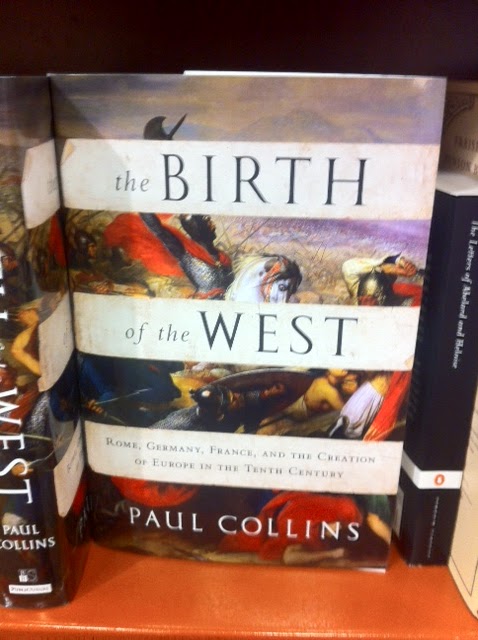
The Birth of the West: Rome, Germany, France, and the Creation of Europe in the Tenth Century
By Paul Collins
PublicAffairs
ISBN: 978-1610390132
The tenth-century tends to be a somewhat overlooked period in medieval history, so I am intrigued by this lengthy (496 pages) account of what was going on in continental Europe, which includes some of strangest popes in history and the emergence of states from the Carolingian Empire.
Click here to read an excerpt from the Publisher's site
Deadly Sisterhood
By Leonie Frieda
Non Basic Stock Line
ISBN: 978-0297852087
Covers some of the famous women of the Italian Renaissnace: Lucrezia Turnabuoni, Clarice Orsini, Beatrice d'Este, Caterina Sforza, Isabella d'Este, Giulia Farnese, Isabella d'Aragona and Lucrezia Borgia. It looks like the character list of the show Borgias.
Before Galileo: The Advancement of Modern Science in Medieval Europe
By John Freely
Overlook Press
ISBN: 978-1-59020-607-2
The First Muslim: The Story of Muhammad
By Lesley Hazelton
Riverhead
ISBN: 978-1594487286
From the publisher: Hazleton follows the arc of Muhammad’s rise from powerlessness to power, from anonymity to renown, from insignificance to lasting significance. How did a child shunted to the margins end up revolutionizing his world? How did a merchant come to challenge the established order with a new vision of social justice? How did the pariah hounded out of Mecca turn exile into a new and victorious beginning? How did the outsider become the ultimate insider?
Click here to visit the First Muslim website
See also this video:
The History, by Michael Attaleiates
Translated by Anthony Kaldellis and Dimitris Krallis
Dumbarton Oaks Medieval Library (Harvard University Press)
ISBN: 978-0-674-05799-9
I quite enjoy reading through primary sources - the stories written by the the eyewitnesses of the Middle Ages - so I picked up this edition and translation of a Byzantine chronicle that covers the years 1034 to 1079, including the Battle of Manzikert (1071). I hope to post a review of the book on Medievalists.net in a few weeks.
The Birth of the West: Rome, Germany, France, and the Creation of Europe in the Tenth Century
By Paul Collins
PublicAffairs
ISBN: 978-1610390132
The tenth-century tends to be a somewhat overlooked period in medieval history, so I am intrigued by this lengthy (496 pages) account of what was going on in continental Europe, which includes some of strangest popes in history and the emergence of states from the Carolingian Empire.
Click here to read an excerpt from the Publisher's site
Deadly Sisterhood
By Leonie Frieda
Non Basic Stock Line
ISBN: 978-0297852087
Covers some of the famous women of the Italian Renaissnace: Lucrezia Turnabuoni, Clarice Orsini, Beatrice d'Este, Caterina Sforza, Isabella d'Este, Giulia Farnese, Isabella d'Aragona and Lucrezia Borgia. It looks like the character list of the show Borgias.
Before Galileo: The Advancement of Modern Science in Medieval Europe
By John Freely
Overlook Press
ISBN: 978-1-59020-607-2
The First Muslim: The Story of Muhammad
By Lesley Hazelton
Riverhead
ISBN: 978-1594487286
From the publisher: Hazleton follows the arc of Muhammad’s rise from powerlessness to power, from anonymity to renown, from insignificance to lasting significance. How did a child shunted to the margins end up revolutionizing his world? How did a merchant come to challenge the established order with a new vision of social justice? How did the pariah hounded out of Mecca turn exile into a new and victorious beginning? How did the outsider become the ultimate insider?
Click here to visit the First Muslim website
See also this video:
The History, by Michael Attaleiates
Translated by Anthony Kaldellis and Dimitris Krallis
Dumbarton Oaks Medieval Library (Harvard University Press)
ISBN: 978-0-674-05799-9
I quite enjoy reading through primary sources - the stories written by the the eyewitnesses of the Middle Ages - so I picked up this edition and translation of a Byzantine chronicle that covers the years 1034 to 1079, including the Battle of Manzikert (1071). I hope to post a review of the book on Medievalists.net in a few weeks.
Monday, January 07, 2013
Rich Man, Poor Man: The radical visions of St. Francis
“Why you?” a man asked Francesco di Bernardone, known to us now as St. Francis of Assisi. Francis (1181/2-1226) was scrawny and plain-looking. He wore a filthy tunic, with a piece of rope as a belt, and no shoes. While preaching, he often would dance, weep, make animal sounds, strip to his underwear, or play the zither. His black eyes sparkled. Many people regarded him as mad, or dangerous. They threw dirt at him. Women locked themselves in their houses.
Francis accepted all this serenely, and the qualities that at the beginning had marked him as an eccentric eventually made him seem holy. His words, one writer said, were “soothing, burning, and penetrating.” He had a way of “making his whole body a tongue.” Now, when he arrived in a town, church bells rang. People stole the water in which he had washed his feet; it was said to cure sick cows.
Years before he died, Francis was considered a saint, and in eight centuries he has lost none of his prestige. Apart from the Virgin Mary, he is the best known and the most honored of Catholic saints. In 1986, when Pope John Paul II organized a conference of world religious leaders to promote peace, he held it in Assisi. Francis is especially loved by partisans of leftist causes: the animal-rights movement, feminism, ecology, vegetarianism (though he was not a vegetarian). But you don’t have to be on the left to love Francis. He is the patron saint (with Catherine and Bernardino of Siena) of the nation of Italy.
Consequently, a vast number of books have been written about him. The first of the biographies appeared a few years after his death, and they’ve been coming ever since. Two more have recently appeared in English. One, Francis of Assisi: The Life and Afterlife of a Medieval Saint (Yale), is by André Vauchez, a professor emeritus of medieval studies at the University of Paris. The book appeared in France in 2009 and has now been published in English, in a translation by Michael F. Cusato. The other volume, Francis of Assisi: A New Biography (Cornell), is by Augustine Thompson, a Dominican priest and professor of history at the Dominican School of Philosophy and Theology at the Graduate Theological Union in Berkeley. The two books show that the Church is still trembling from the impact of this great reformer.
Click here to read this article from the New Yorker Magazine
Monday, November 26, 2012
When stealing corpses was popular
When you bury family members in a cemetery, you expect them to stay there. Not so 200 years ago, however, when body snatchers prowled the nation’s burial grounds looking for subjects. This lucrative cottage industry was driven by an acute shortage of bodies that were available for dissection by the growing number of medical students.
Now, a new book has amassed, for the first time, archaeological evidence for what happened to the corpses, from dissection and autopsy through to reburial and display. Many of the new findings have never been published before.
The book reveals how the macabre activities of the body snatchers helped to further the progress of medicine and science by improving understanding of how the human body worked.
Click here to read this article from Early Modern England
An Interview With Jeri Westerson, Author of Blood Lance and the Crispin Guest Book Series
Author Jeri Westerson has done it again: She's managed to craft another fascinating, entertaining, engaging book in a style that's been dubbed "medieval noir."
Her latest book, Blood Lance, is the fifth in her series of books about Crispin Guest, a detective of sorts during the medieval era, a man who was previously a knight.
One of the many aspects of this book and series I enjoy is how Westerson combines history with fiction, even historical figures with fictional ones, with grace and eloquence.
In our latest interview--I previously interviewed her about her book Troubled Bones--she also talks about her concerns about the state of the publishing industry and how it will affect authors including herself.
Click here to read this interview from the Seattle Post Intelligencer
You can follow Jeri Westerson (and Crispin Guest) on Facebook
Friday, November 23, 2012
New Book on ‘The Book of Kells’ launched
The Book of Kells is widely recognised as one of the world’s most beautiful decorated manuscripts and a masterpiece of European medieval art, with images that are staggering in their richness, intricacy and inventiveness. This handsome new volume, by Dr Bernard Meehan, Keeper of Manuscripts at Trinity College Library, brims with fresh insights and interpretations and features the extraordinary imagery on a generous scale. The publication which was introduced by Professor of History of Art, Roger Stalley also marks the tercentenary of the foundation of the Old Library building, Trinity College Library, Dublin, one of the great historic libraries of the world.
The Book of Kells dates from around 800 AD and contains a Latin text of the four Gospels. There is great uncertainty about its origins. It is thought that the Book of Kells was first worked on at the monastery on the island of Iona off the west coast of Scotland, and was continued, after Viking raids, at the monastery of Kells in Ireland. The Book remained in Kells until the mid-1600s, and in 1661 was presented to Trinity College, Dublin, where it is on permanent display, and is regarded as a national treasure. It is seen every year by half a million visitors from all over the world.
Click here to read this article from Medievalists.net
The Book of Kells dates from around 800 AD and contains a Latin text of the four Gospels. There is great uncertainty about its origins. It is thought that the Book of Kells was first worked on at the monastery on the island of Iona off the west coast of Scotland, and was continued, after Viking raids, at the monastery of Kells in Ireland. The Book remained in Kells until the mid-1600s, and in 1661 was presented to Trinity College, Dublin, where it is on permanent display, and is regarded as a national treasure. It is seen every year by half a million visitors from all over the world.
Click here to read this article from Medievalists.net
Friday, November 16, 2012
Medieval bestseller explores morality through science
Imagine a stick partially submerged in a pool of water. It appears to be broken at the point where water meets air, but in fact it is in one piece. This optical illusion is called refraction: as light passes from one medium to another, it bends and changes speed based on each medium’s refractive index, causing the stick in water to appear bent.
Most people are familiar with the scientific definition of refraction. But have you ever considered it as a moral concept? Say there’s a man on the street digging through a dumpster. You might see him as being “broken.” But as refraction teaches us, things are not always as they appear.
The idea that scientific principles might also have philosophical applications is explored in The Moral Treatise on the Eye, a text written in the late 13th century by Peter of Limoges. The Moral Treatise is a compilation of short narratives, or exempla, meant to help preachers deliver sermons. Each chapter offers a piece of knowledge about the field of optics. Peter of Limoges first explains the concept scientifically, and then gives a moral or religious interpretation, like in the refraction example.
“Peter quotes Paul, saying that we see things in this world through a dark veil, but in the next life, you’ll see things as they really are,” says Richard Newhauser, an English professor in the College of Liberal Arts and Sciences at ASU. “In effect, what he’s saying is, in heaven there’s no reflection or refraction but only lines of direct sight.”
The Moral Treatise on the Eye combines scientific thought with concepts of moral theology. This blending of disciplines is part of what appealed to Newhauser, who recently published a translation of the text with extensive explanatory footnotes.
Click here to read this article from Arizona State University
Most people are familiar with the scientific definition of refraction. But have you ever considered it as a moral concept? Say there’s a man on the street digging through a dumpster. You might see him as being “broken.” But as refraction teaches us, things are not always as they appear.
The idea that scientific principles might also have philosophical applications is explored in The Moral Treatise on the Eye, a text written in the late 13th century by Peter of Limoges. The Moral Treatise is a compilation of short narratives, or exempla, meant to help preachers deliver sermons. Each chapter offers a piece of knowledge about the field of optics. Peter of Limoges first explains the concept scientifically, and then gives a moral or religious interpretation, like in the refraction example.
“Peter quotes Paul, saying that we see things in this world through a dark veil, but in the next life, you’ll see things as they really are,” says Richard Newhauser, an English professor in the College of Liberal Arts and Sciences at ASU. “In effect, what he’s saying is, in heaven there’s no reflection or refraction but only lines of direct sight.”
The Moral Treatise on the Eye combines scientific thought with concepts of moral theology. This blending of disciplines is part of what appealed to Newhauser, who recently published a translation of the text with extensive explanatory footnotes.
Click here to read this article from Arizona State University
Thursday, October 25, 2012
Deadly Dancing: Could a Nocebo Effect Explain Medieval Europe's Dancing Plagues?
Excerpt from Mind Over Mind: The Surprising Power of Expectations, by Chris Berdik.
The largest wave of compulsive dancing hit Strasbourg in the summer of 1518. By the end of August, hundreds of people were dancing wildly throughout the city. Town officials overruled local physicians who said the dancers should be bled, but their chosen prescription was just as alarming: more dancing! They gathered the stricken into guildhalls and even built a stage for them in the public square. They hired dancers to keep up the energy and musicians to play a lively accompaniment. Not surprisingly, the dancers kept going and kept dying. Eventually the town leaders changed their minds and deemed the dancing a curse from an angry Saint Vitus, an early Christian whom the Romans tossed into a cauldron of boiling oil and then to the lions for refusing to renounce his faith. By the fourteenth century, the Vatican declared Saint Vitus a "holy helper" who could answer the prayers of people who had epilepsy or trouble conceiving. On his feast day, it was customary to dance at his shrine. However, saints who could heal when venerated could afflict when angered, so the town's next remedy for the dancing was civic contrition—which meant cracking down on gambling and prostitution, and the banishment of those known to traffic in vice.
Click here to read more of the excerpt from the Huffington Post
The largest wave of compulsive dancing hit Strasbourg in the summer of 1518. By the end of August, hundreds of people were dancing wildly throughout the city. Town officials overruled local physicians who said the dancers should be bled, but their chosen prescription was just as alarming: more dancing! They gathered the stricken into guildhalls and even built a stage for them in the public square. They hired dancers to keep up the energy and musicians to play a lively accompaniment. Not surprisingly, the dancers kept going and kept dying. Eventually the town leaders changed their minds and deemed the dancing a curse from an angry Saint Vitus, an early Christian whom the Romans tossed into a cauldron of boiling oil and then to the lions for refusing to renounce his faith. By the fourteenth century, the Vatican declared Saint Vitus a "holy helper" who could answer the prayers of people who had epilepsy or trouble conceiving. On his feast day, it was customary to dance at his shrine. However, saints who could heal when venerated could afflict when angered, so the town's next remedy for the dancing was civic contrition—which meant cracking down on gambling and prostitution, and the banishment of those known to traffic in vice.
Click here to read more of the excerpt from the Huffington Post
Monday, October 08, 2012
If you love history, read on
Lovers of great history books, awake! Next week, Canada’s Cundill Prize, the richest non-fiction prize in the world ($75,000 to the winner), will announce its list of six books for the 2012 award.
Someone in a position to have the list is going to publish it here, as a help to those who love history or to those who just like a large read on big subjects.
A word about the prize. It was established in 2008 by Peter Cundill, a McGill University graduate who set aside money for his alma mater to give this prize in history (he died in January, 2011). The university selects jurors from different countries, usually the United States, Britain and Canada, because the prize goes to the best book written in, or translated into, English in the wide field of history. The general criteria for the shortlisted books and, of course, the eventual winner: a book whose author wears great learning lightly.
Click here to read this article from The Globe and Mail
Click here to visit the Cundill Prize website
Someone in a position to have the list is going to publish it here, as a help to those who love history or to those who just like a large read on big subjects.
A word about the prize. It was established in 2008 by Peter Cundill, a McGill University graduate who set aside money for his alma mater to give this prize in history (he died in January, 2011). The university selects jurors from different countries, usually the United States, Britain and Canada, because the prize goes to the best book written in, or translated into, English in the wide field of history. The general criteria for the shortlisted books and, of course, the eventual winner: a book whose author wears great learning lightly.
Click here to read this article from The Globe and Mail
Click here to visit the Cundill Prize website
Tuesday, July 10, 2012
Amazon withdraws controversial Caravaggio book
But the book, which contained 1,000 images of Caravaggio's work and the supposed "new" drawings, was abruptly withdrawn from Amazon's website on Tuesday, with the title crossed out and a blank space where the cover of the book had been displayed.
Maurizio Bernardelli Curuz and Adriana Conconi Fedrigolli, the art historians who wrote it, claimed to have found 100 previously unrecognised sketches and drawings by the Baroque master after sifting through an archive of art work held by a castle in Milan.
Click here to read this article from the Telegraph
Wednesday, June 13, 2012
New cookbook looks at old recipes — live frog pie, anyone?
Adventurous cooks might consider one of the recipes in Peter Ross's new book, but the author of the tome on unusual historical cuisine says it's probably best not to try a dish featuring animals like swans, peacocks or porpoises.
"You could cook a meal, but it could be quite a strange meal," said Ross, the chief librarian at Guildhall Library in London and the author of The Curious Cookbook, which looks at a wild range of cookery from medieval times right through to the Second World War.
"It's mostly the medieval recipes where you're going to have a problem — because they were eating things like swans, peacocks, porpoises."
The new book also features a live frog pie that dates from the 17th century.
Ross said the dish containing live frogs was "basically an entertainment" that was served during a high-class meal.
Click here to read this article and listen to an interview with the author from the CBC
Saturday, June 09, 2012
What Happened to Aged Priests in the Late Middle Ages?
While it might seem that disease and war made it unlikely that someone would survive to old age in ancient and medieval times, many men and women did live on into their 60s, 70s and even older. A recently published book, On Old Age: Approaching Death in Antiquity and the Middle Ages, explores some aspects of being elderly hundreds of years ago.
Among the sixteen essays in this volume is “What Happened to Aged Priests in the Late Middle Ages?” by Kirsi Salonen. Salonen, a Research Fellow at the University of Tampere, uses Canon Law and ecclesiastical records to examine what happened with bishops, priests and clerics as they got older. She notes that while Canon Law made it in theory difficult for religious officials to retire, there were hundreds of cases appearing in Papal records where various solutions were worked out.
For example, Salonen notes there are “numerous entries in the papal register series concerning old priests who resigned their benefices in favour of someone who agreed to pay them a yearly pension.” For example, in 1477 Johannes de Meynringha, the priest in a parish church near Metz, France, resigned from his position because “he was over eighty years old and had health problems, and thus was no longer capable to carrying out his priestly functions.” In a papal letter signed off by Pope Sixtus IV, Johannes was assigned a yearly pension of 8 tournois, which would be paid by the new parish priest, Theodericus Raynoldi.'
Click here to read this article from Medievalists.net
Among the sixteen essays in this volume is “What Happened to Aged Priests in the Late Middle Ages?” by Kirsi Salonen. Salonen, a Research Fellow at the University of Tampere, uses Canon Law and ecclesiastical records to examine what happened with bishops, priests and clerics as they got older. She notes that while Canon Law made it in theory difficult for religious officials to retire, there were hundreds of cases appearing in Papal records where various solutions were worked out.
For example, Salonen notes there are “numerous entries in the papal register series concerning old priests who resigned their benefices in favour of someone who agreed to pay them a yearly pension.” For example, in 1477 Johannes de Meynringha, the priest in a parish church near Metz, France, resigned from his position because “he was over eighty years old and had health problems, and thus was no longer capable to carrying out his priestly functions.” In a papal letter signed off by Pope Sixtus IV, Johannes was assigned a yearly pension of 8 tournois, which would be paid by the new parish priest, Theodericus Raynoldi.'
Click here to read this article from Medievalists.net
Wednesday, June 06, 2012
New book offers translation of medieval Islamic debate
A recently published book is offering readers a glimpse into how medieval Muslims debated their own religion. Abu Hatim al-Razi: The Proofs of Prophecy offers an English translation of a debate between two celebrated figures of the medieval Islamic era who diverge on notions of prophecy, miracles and the origins of science.
Tarif Khalidi, Shaykh Zayid Professor of Arabic and Islamic Studies at the American University of Beirut, edited and and translated the work, one of the that few surviving records of a medieval debate.
The debate took place around 920 AD between Abu Hatim al-Razi, a well known Isma’ili missionary, and Abu Bakr al-Razi, a physician and philosopher known in Europe as Rhazes.
Rhazes, during the debate, expresses deep religious skepticism. He attacks the Qur’an and Bible, points to contradictions in holy scriptures and religious narratives, and dismisses scripture as superstition.
Click here to read this article from Medievalists.net
Monday, June 04, 2012
The Medieval Cookbook and The Classical Cookbook published in revised editions
The Getty Museum and British Museum have published two cookbooks for those wanting to try recipes dating back to the Middle Ages or ancient times. The Medieval Cookbook, by food hisorian Maggie Black offers collection of medieval recipes, but a social history of the time.
This revised edition has eighty recipes, drawn from the earliest English cookbooks of the fourteenth and fifteenth centuries, are presented in two formats: the original Middle English version and one adapted and tested for the modern cook. The author also describes the range of available ingredients in medieval times and the meals that could be prepared from them—from simple daily snacks to celebratory feasts—as well as the preparation of the table, prescribed dining etiquette, and the various entertainments that accompanied elite banquets.
Click here to read this article from Medievalists.net
This revised edition has eighty recipes, drawn from the earliest English cookbooks of the fourteenth and fifteenth centuries, are presented in two formats: the original Middle English version and one adapted and tested for the modern cook. The author also describes the range of available ingredients in medieval times and the meals that could be prepared from them—from simple daily snacks to celebratory feasts—as well as the preparation of the table, prescribed dining etiquette, and the various entertainments that accompanied elite banquets.
Click here to read this article from Medievalists.net
Monday, May 14, 2012
Margot Fassler wins 2012 Otto Gründler Book Prize
Margot Fassler, Keough-Hesburgh Professor of Music History and Liturgy at the University of Notre Dame, was awarded the 2012 Otto Gründler Book Prize for her book The Virgin of Chartres: Making History Through Liturgy and the Arts.
The prize was announced on Friday at the International Congress on Medieval Studies at Western Michigan University. Her book examines the history of the Cathedral of Notre Dame in Chartres, France, drawing on local histories, letters, obituaries, chants, liturgical sources, and reports of miracles to explore the cult of the Virgin of Chartres and its development in the 11th and 12th centuries. The book explores how the past was made in the central Middle Ages and argues for an understanding of the liturgical framework of time.
“It was especially meaningful to win this prestigious award in 2012,” Fassler says, “because I am the third Notre Dame faculty member in a row to win, joining my colleagues John Van Engen and Thomas Noble— all three of us fellows of Notre Dame’s Medieval Institute.”
Click here to read this article from Medievalists.net
The prize was announced on Friday at the International Congress on Medieval Studies at Western Michigan University. Her book examines the history of the Cathedral of Notre Dame in Chartres, France, drawing on local histories, letters, obituaries, chants, liturgical sources, and reports of miracles to explore the cult of the Virgin of Chartres and its development in the 11th and 12th centuries. The book explores how the past was made in the central Middle Ages and argues for an understanding of the liturgical framework of time.
“It was especially meaningful to win this prestigious award in 2012,” Fassler says, “because I am the third Notre Dame faculty member in a row to win, joining my colleagues John Van Engen and Thomas Noble— all three of us fellows of Notre Dame’s Medieval Institute.”
Click here to read this article from Medievalists.net
Thursday, April 05, 2012
Guest professor talks medieval connection to modern issues
Lisa Lampert-Weissig, author and professor from the University of California, San Diego, held a lecture titled “Reading the Palimpsest of Race: Medieval Traces in Modern Discourse” in Swan Hall yesterday she discussed the issues highlighted in her latest book, Medieval Literature and Postcolonial Studies.
In her work, she connected medieval subject matters, such as post-colonialism studies and orientalism, to contemporary problems in today’s society, including Islamophobia and racial profiling. According to her body of work, in order to think about current issues regarding race in an intelligent and political way, it is important to also think about how these subject matters were handled in medieval literature and culture. This is because history is a palimpsest, said Lampert-Weissig, and it is something that is meant to be read.
“A palimpsest is a writing material, such as a parchment or tablet, used one or more times after an earlier writing has been erased,” Lampert-Weissig said, quoting Merriam-Webster Dictionary. “It is also something that has diverse aspects or layers beneath the surface. History can be a palimpsest of place, and it can relate to a person’s identity.”
Click here to read this article from The Good 5 Cent Cigar
In her work, she connected medieval subject matters, such as post-colonialism studies and orientalism, to contemporary problems in today’s society, including Islamophobia and racial profiling. According to her body of work, in order to think about current issues regarding race in an intelligent and political way, it is important to also think about how these subject matters were handled in medieval literature and culture. This is because history is a palimpsest, said Lampert-Weissig, and it is something that is meant to be read.
“A palimpsest is a writing material, such as a parchment or tablet, used one or more times after an earlier writing has been erased,” Lampert-Weissig said, quoting Merriam-Webster Dictionary. “It is also something that has diverse aspects or layers beneath the surface. History can be a palimpsest of place, and it can relate to a person’s identity.”
Click here to read this article from The Good 5 Cent Cigar
Subscribe to:
Posts (Atom)