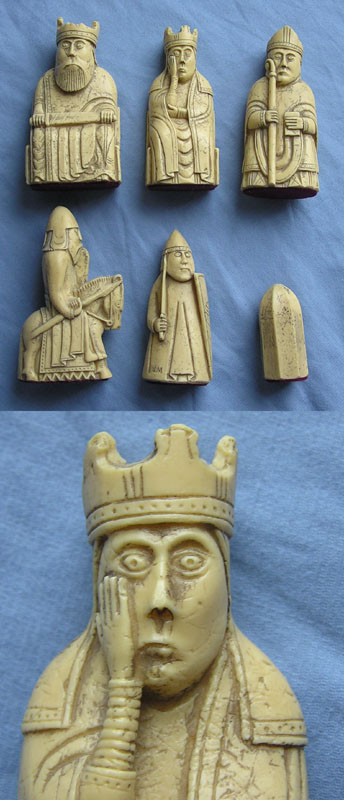
In 1831, a hoard of luxury goods—including more than 70 chess pieces and several other objects, all made of carved walrus ivory and dating from the 12th century—was unearthed on the Isle of Lewis off the west coast of Scotland. The chess pieces (thereafter known as the Lewis Chessmen), which come from at least four distinct, but incomplete sets, are today arguably the most famous chess pieces in the world, and are among the icons of the collections of the British Museum in London and the National Museum of Scotland in Edinburgh.
Beginning today, over 30 chessmen from the collection of the British Museum will be shown at The Cloisters, the branch of The Metropolitan Museum of Art devoted to the art and architecture of medieval Europe. The Metropolitan’s presentation of The Game of Kings: Medieval Ivory Chessmen from the Isle of Lewis represents the first time such a large ensemble of the chessmen has traveled outside the United Kingdom. After the showing in New York, they will return to London.
In 1831, an ancient set of chess pieces was found in the Isle of Lewis, in Scotland. The most amazing fact about these chessmen—made of walrus ivory and whale teeth—is that they were the oldest figures showing a clear resemblance to modern pieces. Since then, it had been believed that the most important chess set of all time was handcrafted in Norway in the 12th century. But recently things have changed with the discovery of a little chess piece found in an excavation at Siglunes, Iceland. And guess what? Surprisingly, this Icelandic piece, handcrafted from fishbone, bears similarities to those Lewis Chessmen, but might be older. The plot thickens!
A Scottish Member of Parliament is demanding that the entire collection of Lewis Chessmen be permanently kept in Scotland. He is upset that the British Museum, which houses some of these medieval figures, is now saying that the chessmen were created in Norway instead of northern Scotland.
Western Isles SNP MP Angus MacNeil said “The British Museum’s treatment of this link raises real questions about where the chessmen should be displayed permanently.
“If the British Museum isn’t able to do justice to some of Scotland’s most important historical artifacts, then it’s time to bring them back to the Hebrides.
“It’s great to see that the pieces held by the British Museum will be temporarily reunited with those in the National Museum of Scotland as part of a major touring exhibition, giving people across Scotland the chance to see them. But questions must be asked over the long-term placement of the pieces which remain in London.”
Mr MacNeil said last night he had raised the issue because of the way the British Museum’s advertisement for the exhibition attributed the chessmen to Norway, which ruled the Western Isles around the time the pieces were made.
The research was led by Dr David Caldwell of the National Museum of Scotland, who believes the Lewis chessmen were more likely to have belonged to a high-ranking person who lived on Lewis.
Dr Caldwell said that many of the pieces could have doubled for Hnefatafl, another conflict game which also pitted a king against pawns or warriors on the other side.
Dr Caldwell said the research team believed the pieces were Scandinavian in origin, perhaps made in a workshop by several masters in a city such as Trondheim.
Their research was published in the journal Medieval Archaeology.
In a separate interview, MacNeil disputes these findings, saying, "We only know two real things about the Lewis chessmen prior to 1831.
"They were made from walrus ivory, or whale teeth, and they were buried on Lewis for hundreds of years.
"They might well have been made in Norway, but they might well have been made in Lewis and there are some who say the carvings on the side of them would place them on Lewis."
A spokeswoman for the British Museum said: "It is generally accepted that the chessmen were made in Norway, during this period the Western Isles, where the chessmen were buried, were part of the kingdom of Norway not Scotland."
The British Museum is also working with the National Museums of Scotland on a tour of a group of the chessmen to four venues across Scotland in 2010-11.
Some of the Lewis Chessmen may not have been chessmen at all according to new research.
The 12th and 13th century gaming pieces which were discovered in Uig on the Isle of Lewis in 1831 are considered to be Scotland’s most renowned archaeological find.
An article in the journal Medieval Archaeology by David Caldwell, Mark Hall and Caroline Wilkinson suggests that many of the 93 ivory pieces may have been used in a game called hnefatafl – an ancient Viking board game that pre-dates chess.
Hnefatafl is similar to chess in that it also pits a king against pawns or warriors on the other side.
In an interview with the BBC, Dr. Caldwell said, "We certainly still believe the pieces are Scandinavian in origin, perhaps made in a workshop by several masters in a city like Trondheim.
"But one of the main things I think we are saying in our research is that it is much more likely that the horde is in Lewis because it belonged to somebody who lived there rather than being abandoned by a merchant who was passing through.
"To take a relatively easy example, there is a praise poem written in the middle of the 13th century to Angus Mor of Isla, and the poem says that he inherited his ivory chess pieces from his father Donald - that makes Angus the very first Macdonald, and the poem also makes him the king of Lewis.
"Now you of course you would be foolish to implicitly believe everything in a praise poem, but nevertheless it gives you some idea that we are dealing with a society in the west of Scotland - great leaders like Angus Mor, bishops, clan chiefs - who really valued playing chess and saw it as being one of their accomplishments."
They concluded that while most of the items were likely to have been crafted in the same workshop, up to five different craftsmen of differing ability may have created them.
Dr Caldwell said the chessmen suggested that there was a reasonable amount of wealth in the western Isles in the 13th century, perhaps because the medieval economy placed greater value on fairly barren land that could be used to raise cattle.
He added: "It was certainly leading men there, people who could make a lot of money either by raising cattle or frankly by going raiding - there was still in some ways a Viking way of life surviving into the 13th century."
Despite the extensive research, Dr Caldwell said he still believed there was plenty of mystery surrounding the chessmen.
"I would be very disappointed if we have written the last word on the - what I hope we have done is opened up the debate and shown it is possible, even with something very well known, to discover new things," he said.
All but 11 of the chessmen are housed in the British Museum. The rest are held in the National Museums Scotland in Edinburgh and next year will go on tour around the country. Click here to read more about this tour.
The paper, which will be published next week, concludes by suggesting that more information should be gathered from further detailed study of the constituents of the hoard, including chemical analysis of the ivory.
It also promotes a fieldwork project to pinpoint the exact area where the pieces were discovered.
A major touring exhibition of the Lewis Chessmen will open in May 2010, visiting the Scottish cities of Stornoway, Shetland, Aberdeen and Edinburgh.
The exhibition will open at the National Museum of Scotland in Edinburgh and will showcase 30 of the Lewis chess pieces - 24 from the British Museum and six from the National Museum of Scotland.
The Lewis Chessmen were discovered on the Isle of Lewis in 1831 and they are thought to have been made in Norway in the late 12th or 13th century. The majority of chess pieces are with the British Museum and eleven pieces are on display in Scotland in the National Museum of Scotland
Scotland's Culture Minister Michael Russell said, "The Lewis Chessmen are a significant part of our culture and this major touring exhibition will give people across country an opportunity to see some of the most significant archaeological artefacts ever discovered in Scotland.
"The free exhibition will showcase 30 of the intricately worked chess pieces from walrus ivory and whales' teeth - it will be a major attraction for tourists both locally and internationally. Visitors will also learn more about the fascinating story of the chessmen as the exhibition details the many stories and myths surrounding these iconic objects.
"The Chessmen reflect the strong cultural and political links between Scotland and Scandinavia in the Middle Ages and the growing popularity of the game of chess in Europe."
The Scottish Government has provided £75,000 towards the exhibition, which has been created in partnership with National Museums Scotland and the British Museum.
Dr Gordon Rintoul, Director, National Museums Scotland, said, "I am pleased to announce this major touring exhibition, which will cast new light on the fascinating story of the chessmen and enhance their place in the public imagination. We are delighted to be creating the exhibition in partnership with the British Museum and grateful for support from the Scottish Government for this significant tour."
The tour dates are:
National Museum of Scotland, Edinburgh: May 21 - September 19, 2010
Aberdeen Art Gallery: October 7, 2010 - January 8, 2011
Shetland Museum & Archives: January 29, 2011 - March 27, 2011
Museum nan Eilean, Stornoway: April 15, 2011 - September 12, 2011