Showing posts with label Medieval Crime. Show all posts

Wednesday, July 24, 2013

Doctors can now figure out if you have the Black Death; and more medieval news

In a development that could have been very useful over six hundred years ago, scientists have discovered a simple and effective way of determining if someone has Yersinia pestis, the bacterium that is responsible for the Black Death. A team based out of the Max Planck Institute in Germany were able to create a sugar-protein that serves as biomarker when tested on the blood of individuals who carry the plague.

 The Black Death, which swept through the medieval world in the mid-14th century, could infect and kill people within hours. “Early identification of an infection is of paramount importance for survival,“ explains Chakkumkal Anish, Leader of the Glycobiology Research Group at the Max Planck Institute. “So our work may have direct and positive consequences on patient survival rates.“

 While the plague is not ravaging society as it once did, there have been sporadic outbreaks, including in India, China, Libya and New Mexico in recent years. The scientists also believe the process they used to develop this test will be useful with detecting other kinds of diseases.

 Click here to read the full details from the Max Planck Institute.

The Banu Sasan Criminal Network 

The Smithsonian Institute blog Past Imperfect has a very interesting article on Islam’s Medieval Underworld. It focuses on the Banu Sasan, a loosely organized criminal network that operated throughout many Muslim lands during the Middle Ages. They were thieves, burglars, murderers and con artists, and their activities often got mentioned in Arabic literature.

Their exploits would include the "so-called prince of camel thieves, for instance — one Shaiban bin Shihab — developed the novel technique of releasing a container filled with voracious camel ticks on the edges of an encampment. When the panicked beasts of burden scattered, he would seize his chance and steal as many as he could. To immobilize any watchdogs in the area, other members of the Banu Sasan would “feed them a sticky mixture of oil-dregs and hair clippings” — the contemporary writer Damiri notes — ”which clogs their teeth and jams up their jaws.”

Click here to read this article from Past Imperfect

More Medieval News

Archaeologists working in the imperial forum area of the city of Rome have uncovered the remains of an 8th-century workshop and a residential area dating to the 14th century. You can read more from ANSA.

In Birmingham, England, archaeologists are working outside of The Barley Mow pub. The pub owner believes they will find the remains of one of Richard III’s knights. However, a spokesman for the construction company behind the dig is less sure. “The archaeological investigation has found several 17th century post-medieval rubbish pits," he said.“There is no truth in the suggestion the team were looking for the remains of a follower of Richard III and nothing was found relating to the late medieval period.” You can read more from the Birmingham Mail.

A more promising find has occurred in Heslington, just outside of York. A Roman well, dating from the late fourth to early fifth centuries, has been uncovered, along with more than a 1000 pieces of Romano-British pottery, including two almost complete Huntcliff-type jars, and a similar number of animal bone fragments. Steve Roskams, Senior Lecturer at the University of York said, “It is striking that all of the material found in our well would have been familiar to those inhabiting this landscape. Its construction incorporates a finial which, we argue, probably came from the dismantling of a nearby, good-quality structure. The jars circulated here widely, the Huntcliff-type probably being connected directly to water usage. The other pottery and the animal bones also comprise well-understood 'mundane' elements that were available locally."

Click here to read the full article from the University of York

Finally, what is new on Youtube for medievalists? There is this video, entitled '5 Of The Most Gruesome Medieval Torture Devices' - please keep in mind that only one of the five torture devices mentioned here - the Rack - was actually used in the Middle Ages. Most of the others are first mentioned in the Early Modern period.

Thursday, May 23, 2013

Why Pope Celestine V wasn't murdered and why Stephen le Clerk probably wished he had been

Turning to medieval violence, we have two items to share:

Medieval Hermit Pope Not Murdered, as Believed

Discovery.com reports that Italian researchers have debunked the theory that Pope Celestine V was killed by a nail to the head. They explain that a half-inch hole that can be seen in the remains of his skull was made long after he died, probably during one of his reburials.

Pope Celestine was a hermit monk who accepted the papacy in 1294 at age 85, but then months later resigned. It was believed that his successor, Pope Boniface VIII, had him murdered.

Tor Vergata of the University of Rome explained, “We can’t establish the real cause of death. A previous research carried test for heavy metal poisoning with negative results.”

The researchers have also reconstruct Celestine’s face in the form of a silver mask. Click here to read the article from Discovery.com

See also The Five Worst Popes of the Middle Ages

Husband Castrates Wife's Lover, Then Sues (Medieval Style!)

Katherine O'Meara, writing in The Prodigal Ex Pat, tells us about a court case from Ireland in the year 1307. She came across the court case while her writing her thesis - it involves John Don (Dunne) of Youghal, Cork, his wife Basilia, and her lover Stephen le Clerk. I won't give it away, for it is a good read, but now I know what 'abciderunt ejus testiculos' means and that I should never trust a taverner!

You can read the post here.

Thursday, October 28, 2010

A Fresh Look at Torture in the Middle Ages

A German researcher has studied medieval criminal law and found that our image of the sadistic treatment of criminals in the Dark Ages is only partly true. Torture and gruesome executions were designed in part to ensure the salvation of the convicted person's soul.

Peter Nirsch would have been seen as a monster at any time in history. While traveling south through Germany, he had a penchant for cutting open pregnant women and removing their unborn babies. Nirsch butchered more than 500 people before he was captured near Nuremberg in September 1581.

The courts were not squeamish in their treatment of the serial killer. First he was tortured, and then hot oil was poured into his wounds. Then the culprit was tied to the rack, where his arms and legs were broken. In the end, he was quartered. Anyone who, like Nirsch, was convicted of serious crimes in medieval Germany was subjected to similarly resolute forms of punishment.

The enforcers of the law tormented suspects with red-hot iron bars or boiled them alive in water. "The carrying out of inhuman sentences was part of everyday life," concludes Wolfgang Schild, a legal scholar from the western German city of Bielefeld.

Click here to read this article from Der Spiegel

Saturday, March 06, 2010

Cambridge University’s bloody beginnings given the crime fiction treatment

The infamous murder which ultimately led to the foundation of the University of Cambridge in 1209 has been re-imagined by crime fiction author Susanna Gregory in a brand-new short story for World Book Day (Thursday, March 4th).

In December 1209, as reported by the contemporary scholar Roger of Wendover, "a certain clerk at Oxford, absent from his studies, killed a woman by chance, and fled when he realised that she was dead".

The murder, mixed with growing resentment towards the scholars from the townsfolk, triggered a wave of violent vigilante justice and three of the murderer's fellow students were subsequently hanged. More terrified scholars fled the city, and many eventually settled in the fenland market town of Cambridge.

Little more is known about the crime, or Cambridge's inauspicious beginnings, but using what few sources remain, Gregory, who is best known for her Matthew Bartholemew series of medieval crime stories, has created her own interpretation of how those dark events might have played out. The result, entitled "Bloody Beginnings", can be downloaded from www.admin.cam.ac.uk/news/special/downloads/bloody-beginnings.pdf.

She wrote the story with her husband, Simon Beaufort, and was particularly attracted to the uncertainty which surrounds the episode. "This is what made it fun to write about," she said. "If the story had been well known, we couldn't have written a murder mystery around it!"

Opening with the brutal murder, the story then follows a group of scholars as they escape Oxford and start a new university in Cambridge, all the while trying to uncover who amongst them is the killer. The hunt is led by Geoffrey Gryme, whose brother Adam had been one of the innocents hanged in Oxford.

All the characters in the story were based upon real people of the time, many of whom would have fled Oxford and made the precarious journey eastwards in the winter of 1209. Gregory's research uncovered the names of scholars through the witnessing of charters at the time, but not much more. 'They were probably all perfectly decent men' said Gregory, 'but we have taken liberties and made some of them less than pleasant. We hope they will forgive us!'

In writing the story, she also had to deal with some conflicting accounts. "The victim may or may not have been a prostitute and some sources say she was shot with an arrow," Gregory added. "Bearing in mind that murder was probably a lot more common then than it is now, it seems reasonable to suppose it all happened on the spur of a moment - a tryst in a tavern, followed by a spat that ended in violence."

"Drink may have been involved… It was a sorry, sordid little incident that had consequences the culprit almost certainly did not foresee. But Oxford was an uneasy place at this particular time anyway, so perhaps the resulting exodus was inevitable. In other words, if the scholar had not murdered the woman, would the crime have been invented?"

Susanna Gregory, the pen name of a former Cambridge academic, has become well-known for her series featuring Matthew Bartholemew, a teacher of medicine and an investigator of murders in 14th-century Cambridge. She is currently busy writing the 16th instalment in the series, due for publication in the summer.

Saturday, January 09, 2010

Medieval Irish Archbishop was corrupt, says scholar


A recent article has detailed the corruption of a 14th century Archbishop of Dublin, showing how he was caught for extensive embezzlement and forgery.

It is found in the article, "The Case Against Alexander Bicknor, Archbishop and Perculator," by James W. Lydon, which is part of a collection of essays entitled Ireland and the English World in the Late Middle Ages.

Alexander Bicknor had come to Ireland in 1302, serving Edward I and Edward II in various administrative duties, including deputy chancellor and justiciar, before being appointed by the Pope as Archbishop of Dublin in 1317.

Eight years later, an investigation carried out by the Royal Exchequer in London began turning up evidence that the Archbishop had been for years skimming money sent out by the English king, which Bicknor was in charge of distributing.

For example, a writ was sent to Bicknor ordering him to pay the earl of Ulster £2500, 15s. for wages in serving in the war in Scoltand, and Bicknor kept 500 marks for himself, while stating that he had sent the full amount to the earl.

As the investigation proceeded, the English government found that the Archbishop, along with the treasurer and other royal officials in Ireland, were routinely embezzling royal funds and then forging false records.  A clerk named John of Manchester was hired by Bicknor to commit the forgeries.

One of the illegal scams goes back to 1313, when they concocted a letter patent from the prior of the Dominicans in Dublin stating that he had received 35 marks in alms granted by the King - in reality the Dominicans only got 5 marks.

The royal court was able to get several of the archbishop's underlings to admit to the forgeries and frauds, including John of Manchester.  Bicknor was summoned to London, and when questioned, said they he did not wish to deny that he knew about or consented to them.

The court ruled that the corruption involved the sum of £1168. 6s. and ordered all those involved, including the archbishop, to be confined to the Fleet Prison and have their property seized. Besides property around Dublin, the crown seized other lands in Gloucester, Shropshire and Staffordshire from Bicknor.

The imprisonment of Alexander Bicknor did not last long. Within days, King Edward II had sent order releasing him, "because of devotion to the holy church and reverence for the episopal dignity." Lydon adds that Bicknor was an effective administrator and increased royal revenues, which may have also been reason enough for Edward to be lenient with him.

The other people imprisoned spent months or years in prison before they were able to pay large fines to obtain their release, and some were even banned from serving a royal office again. Although Bicknor was given a pardon, officials from the Royal Exchequer spent the next twenty years continuing to investigate and question the archbishop, in particular about revenues and goods confiscated from the Templars.

One question left unanswered was why Bicknor spent years defrauding the royal government. Lydon writes, "there is no apparent reasons for his actions. It can be said with some certainty that he did not need the money for personal use. He certainly did not live a life of extravagance and did not acquire wealth by the time of his death."

Saturday, December 19, 2009

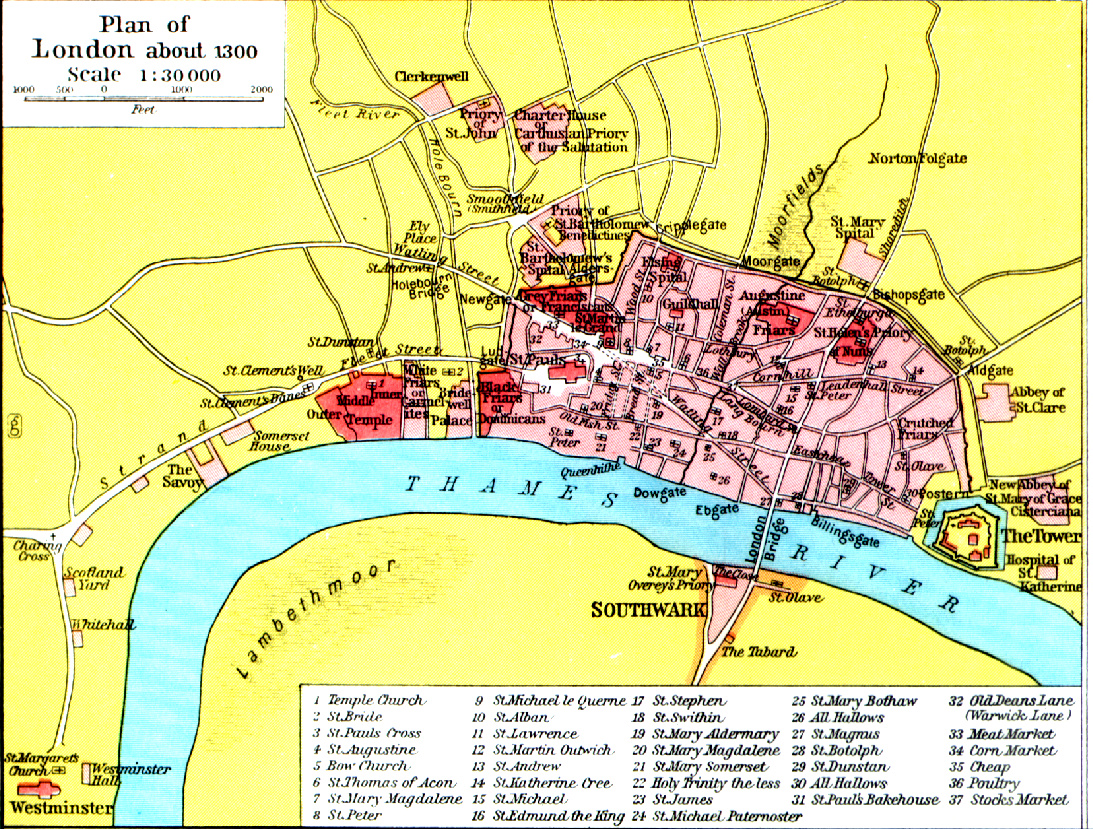
Murder in Medieval London was relatively low, study says

A new article on homicides in the medieval London suggests that the homicide rate was relatively low, and was lower than the rates for other English counties from the time.  The conclusion comes from the article, "Peacekeepers and Lawbreakers in London, 1276-1321," by Henry Summerson, which has been published in the latest volume of Thirteenth Century England.

Summerson examines the roll of crown pleas from the London Eyre of 1321, which detail various criminal events in England, including homicides from 1276 to that year.  During that 44-year period, the author finds that 674 deaths that were likely murders that took place in London.

The medieval records often give lurid details of these crimes, such as when two men take a prostitute to a latrine and then get in argument over who gets to have her first. The argument leads to one man striking the other dead.  In another case, a chaplain persuades a young man to grant him sexual favours in the church of All Saints Barking, and then while sodomising him with a stick, inflicts a mortal injury.

The most serious crime took place on June 16, 1298, when 144 people were killed near St. Paul's Cathedral, after a group of sixteen armed men attacked a crowd of  paupers - the people either were killed as the bandits cut down them while robbing them, or were crushed and trampled in the panic to escape.


But Summerson finds that despite these incidents, the homicide rate averaged only about 15 murders a year, which he finds low, especially compared with other English counties. For example, Essex averaged 25 murders a year between 1272 and 1285, while Devon had close to 37 homicides on average between 1268 and 1281.

The author attributes the low homicide rate to a variety of factors, including the involvement of civic authorities, namely the Mayor and Aldermen of London, in enacting and enforcing laws to keep the peace. Laws against the carrying of weapons, or being out at night, were frequently issued.  Meanwhile, an early form of a police force had developed in London, where the Sheriff of London could have a permanent force to assist him in finding and apprehending criminals. By 1319 there were twelve serjeants working in London.

Summerson adds that other institutions, such as the church and the local guilds, probably also played a role in peacekeeping throughout the city.  He concludes that Londoners had a "fair degree of success" in keeping violent crime under control.

The study finds that most of the people suspected or convicted of homicides in London were poor - of the 850 felons named in the eyre, 668 were said to have no chattels. Summerson adds, "Paupers and vagrants could be found anywhere, but the geographical pattern of London homicide shows that it was most frequent where poor people were likeliest to be found, in three wards in the north-west suburbs extending well outside the city walls - Aldersgate, Farringdon and Cripplegate - and in some of the wards fronting the Thames, where cheap labour was in demand on the wharves and the presence of sailors probably had an additional destabilising effect."

Summerson also notes that "Londoners were no more successful than anyone else when it came to arresting suspects and convicting those that were caught." 750 of those accused of a homicide escaped arrest, while a further 112 were acquitted or pardoned. Only 104 men and women described as killers were convicted and hanged, or died in prison.