Showing posts with label Ships. Show all posts

Wednesday, December 19, 2012

Denmark’s only medieval rowboat dated

Researchers have now assigned a date to the sensational find of a rowboat. The dating cements the small vessel’s position as Denmark’s only preserved medieval rowboat.


Archaeologists in the Danish town of Vordingborg have every reason to be excited.

During a recent excavation of the moat surrounding the Vordingborg Castle ruins, they came across a fallen castle tower and a rowboat from the Middle Ages. The latter has never previously been found in Denmark.

Lars Sass Jensen, who headed the excavation, says that a dating of the boat’s wooden planks reveals that the little vessel was in its prime around the year 1400.

“A tree-ring dating of the rowboat reveals that the wood that the boat was built of was felled around the year 1390. So a good estimate would be that the boat has been sailing around in the moat around the year 1400,” he says.

With this dating, the soon-to-be-opened Danish Castle Centre in Vordingborg can boast of housing Denmark’s only preserved medieval rowboat.

Click here to read this article from ScienceNordic

Monday, November 19, 2012

The Mary Rose archers were among the elite soldiers of the 16th century, research reveals


The archers who fought on Henry VIII’s warship the Mary Rose, which sank in 1545, would have been elite soldiers for their time, standing over 6 feet tall and able to pull weights over 200 lbs. These findings come from a new research project being carried out by sports scientists at Swansea University and the Mary Rose Trust to discover more about the lives of the 16th century archers on board the ship.

When the ship was raised from the Solent in 1982, many thousands of medieval artefacts along with 92 fairly complete skeletons of the crew of the Mary Rose were recovered.

Nick Owen, Sport and Exercise Biomechanist from the College of Engineering at Swansea University said, “This sample of human remains offers a unique opportunity to study activity related changes in human skeletons. It is documented that there was a company of archers aboard when the ship sank, at a time when many archers came from Wales and the South West of England."

Click here to read this article from Early Modern England

Tuesday, September 18, 2012

Newport’s Medieval Ship could have been Basque

The origins of the Newport Medieval Ship may have finally been solved – with new research announced yesterday pointing to the north of Spain.

 Thanks to recent advances in tree-ring dating, experts have obtained the first scientific evidence that the ship may come from the Basque Country.

 A Basque origin had been suspected for some time but it was only with research into the ship's timbers and historic buildings in Northern Spain that the new results were possible.

 Experts from the University of Wales Trinity Saint David and the Arkeolan Foundation based in the Basque town of Irun had conducted the research.

Click here to read this article from the South Argus Wales

Tuesday, September 11, 2012

Medieval shipwreck found in Danube river

Hungarian archaeologists have found what they believe may be an intact medieval shipwreck in the Danube river. Partially buried in mud and gravel near the riverbank at Tahitótfalu, some 18 miles north of Budapest, the flat bottom river wreck has yet to be excavated.

 A preliminary survey from the Argonauts Research Group in cooperation with the county museum of Szentendre, revealed that the ship is about 40 feet long and 10 feet wide. The archaeologists could distinguish oak floor-planks, floor-timbers, and L-shaped ribs. They also noticed that the junction piece of the bottom and the side wall of the wreck is carved from a single log.

 "Only a few river ships of this kind have been found in Europe," Attila J. Tóth, associate of the National Office of Cultural Heritage, told Discovery News.

Click here to read this article from Discovery News

Tuesday, June 19, 2012

800 year old shipwreck discovered in Baltic Sea

An 800-year-old shipwreck has been found by divers off the south coast of Sweden, prompting archaeologists to ponder the potential treasures inside.


Lars Einarsson, underwater archaeologist at the Kalmar County museum, was amazed at the results of the exploration of the ship found off the coast of Sturkö, near Karlskrona. “This is an extraordinary medieval wreck. We’ve found that the wood was cut down between 1250 and 1300,” he told The Local.
The long and narrow ship, measuring 14 by two metres, would have been sleek and fast, and most likely used for attacking and looting.

The ship is 1.8 metres underwater, and is still almost completely buried under the seafloor, which makes for “troublesome diving conditions” according to Einarsson. “When the divers recovered fragments for dating, they were literally ‘looking’ with their hands. The sediment is so easily disturbed that it makes it almost impossible to see what you’re doing. In some ways, it would be easier if the ship was ten times deeper.”


Click here to read this article from The Local


See also Iron and sulphur compounds threaten old shipwrecks

Wednesday, May 30, 2012

Two Roman shipwrecks found in deep waters around Greece

Two Roman-era shipwrecks have been found in deep water off a western Greek island, challenging the conventional theory that ancient shipmasters stuck to coastal routes rather than risking the open sea, an official said Tuesday.

 Greece's culture ministry said the two third-century wrecks were discovered earlier this month during a survey of an area where a Greek-Italian gas pipeline is to be sunk. They lay between 1.2 and 1.4 kilometers (0.7-0.9 miles) deep in the sea between Corfu and Italy. That would place them among the deepest known ancient wrecks in the Mediterranean, apart from remains found in 1999 of an older vessel some 3 kilometers (1.8 miles) deep off Cyprus.


 Angeliki Simossi, head of Greece's underwater antiquities department, said sunken ancient ships are generally found 30-40 meters (100-130 feet) deep. Most scholars believe that ancient traders were unwilling to veer far offshore, unlike warships which were unburdened by ballast and cargo.

 "There are many Roman shipwrecks, but these are in deep waters. They were not sailing close to the coast," Simossi said.


 "The conventional theory was that, as these were small vessels up to 25 meters (80 feet) long, they did not have the capacity to navigate far from the coast, so that if there was a wreck they would be close enough to the coast to save the crew," she said.

Click here to read this article from NRToday

Monday, May 28, 2012

Newport's medieval ship set to mark decade of discovery

A decade of the Newport Medieval Ship will be celebrated next month at the site of the original discovery.

 ‘The Newport Medieval Ship: A Decade of Discovery’ event will be held at The Riverfront on June 1. Visitors will be taken on a journey from the initial excavation to present day discoveries.

 Speakers will include the Friends of the Newport Ship and local historian Bob Trett. The National Poet of Wales Gillian Clarke will also debut her poem marking the anniversary.

Click here to read this article from the South Wales Argus Click here to see more videos about the Newport Ship

Tuesday, May 01, 2012

Smuggled cargo found on Roman shipwreck


Evidence of ancient smuggling activity has emerged from a Roman shipwreck, according to Italian archaeologists who have investigated the vessel's cargo.

Dating to the third century AD, the large sunken ship was fully recovered six months ago at a depth of 7 feet near the shore of Marausa Lido, a beach resort near Trapani.

Her cargo, officially consisting of assorted jars once filled with walnuts, figs, olives, wine, oil and fish sauce, also contained many unusual tubular tiles.

The unique tiles were apparently valuable enough for sailors to smuggle them from North Africa to Rome, where they sold for higher prices.

Click here to read this article from Discovery News

Wednesday, April 04, 2012

Medieval Ship will not be excavated in Estonia

Remnants of a relatively well-preserved 13-century ship discovered under a Tallinn warehouse will remain unresearched for the time being due to a lack of funds.

A recent radiocarbon dating of excavated wooden details conducted by the Tallinn University of Technology put the ship's construction date between 1210 and 1280. There is now reason to believe that the ship, discovered in the fall of 2009 by builders pouring concrete below Lootsi street near the Old City Harbor's D-terminal, is the best-preserved late medieval era ship discovered in Estonia so far.

Click here to read this article from Estonian Public Broadcasting

Wednesday, March 21, 2012

Sports scientists examine the medieval archers of the Mary Rose

A unique project about the historical warship the Mary Rose which is providing information about life in medieval times is benefitting from 21st century technology.

For the past 18 months the Mary Rose Trust has been working with sports scientists from the College of Engineering at Swansea University to discover more about the lives of the medieval archers on board the ship.

When Henry VIII’s warship, which sunk in 1545, was raised from the Solent in 1982, many thousands of medieval artefacts along with 92 fairly complete skeletons of the crew of the Mary Rose were recovered.

Nick Owen, Sport and Exercise Biomechanist from the College of Engineering at Swansea University said, “This sample of human remains offers a unique opportunity to study activity related changes in human skeletons. It is documented that there was a company of archers aboard when the ship sank, at a time when many archers came from Wales and the South West of England."

Click here to read this article from Early Modern England

Thursday, February 23, 2012

Archaeologists begin restoring ancient boat near pyramids

Archaeologists on Monday began restoration on a 4,500-year-old wooden boat found next to the pyramids, one of Egypt's main tourist attractions.

The boat is one of two that were buried next to the Pharaoh Khufu, spokesmen for a joint Egyptian-Japanese team of archeologists said. The boats are believed to have been intended to carry pharaohs into the afterlife.


Khufu, also known as Cheops, is credited with building the Great Pyramid of Giza, the largest of the pyramids. Khufu, son of Snefru, was the second ruler of the 4th Dynasty around 2680 B.C. and ruled Egypt for 23 years.

Both boats, made from Lebanese cedar and Egyptian acacia trees, were originally discovered in 1954. One of the boats is on display at a museum near the pyramids.

The second boat, which is now undergoing the restoration, remained buried. It is thought to be smaller than its sister ship, which is about 140 feet (43 meters) long.

Click here to read this article from TheDailyNewsEgypt.com

Sunday, February 19, 2012

Seabed with 13th century Mongol shipwreck may become historic site

The Agency for Cultural Affairs plans to have the seabed off Nagasaki Prefecture where the wreck of a ship believed to have been used by 13th century Mongol invaders has been found declared a national historical site, agency sources said.

The declaration would make the area off Takashima Island in Matsuura, Nagasaki Prefecture, the first underwater ruins to be registered as such a site in Japan. The designation will in principle prohibit the area from being altered.

The agency sees the need to take immediate measures in the area, given that the relics there are expected to provide archeologists with crucial information on the 1274 and 1281 Mongol attacks that, until the discovery of the relatively intact shipwreck, has mostly been available only from documents and drawings.

Click here to read this article from the Japan Times

Friday, February 10, 2012

Istanbul to launch replica of Byzantine ship

Turkey is going to build the perfect replica of a Byzantine ship for scientific purposes. The copy of the medieval ship, nearly 10 metres long and more than 2.5 metres wide, will be put to sea next year under the name ''Yenikapi 12''.

The project of the Istanbul University's Cultural Artifacts Protection and Restoration Department was recently announced by a Turkish news website and ANSAmed has received photos of the initiative from the University. Construction will start this summer and the ship's launch is scheduled "mid-2013". The organisers of the project suggested that visitors will have an opportunity to come on board: "they will have a magnificent experience in a boat from the Middle Ages," they announced.

The ship will be the same type of one of the 36 that were found, along with thousands of other artifacts, during the ongoing excavations for the Istanbul underground that started in Yenikapi in 2004. It will also be exhibited to the public, probably in a museum, before being launched. The shipwrecks that were found on the coasts of Istanbul are estimated to have been constructed between the fifth and 10th century AD, are regarded as the world's largest shipwreck collection, associate professor of the Department that leads the initiative Isil Kocabas said. The ships shed light on the construction technology that was used in the Byzantine era. A doctorate thesis has already shown how the "Yenikapi 12" was designed and constructed, indicating the process of making its replica.

Click here to read this article from ANSAmed

Thursday, December 29, 2011

Secrets of life on Newport's medieval ship revealed

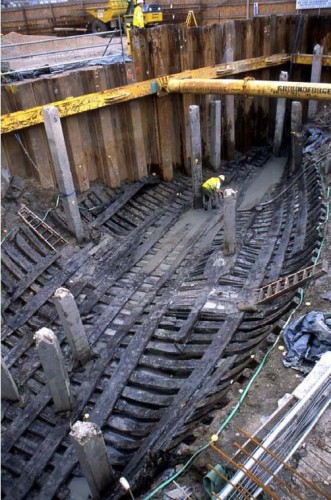
In the summer of 2002, thousands flocked to the banks of the River Usk in Newport, to see a piece of history. In the middle of a building site, the mud had been cleared to reveal the 500-year-old remains of a trading ship.

Built in 1447, it is the world's best preserved example of a 15th Century vessel. Nearly ten years after it was uncovered, archaeologists are still making new discoveries about life on board. They hope that in the next decade the ship will be rebuilt and put on display in its own museum.


Charles Ferris, from the Friends of the Newport Ship group, remembers the excitement as news of the discovery spread. "It was amazing, it was absolutely palpable. I often think the Newport ship floats on a sea of goodwill," he said. "The Newport public did us proud and came out to support her in their thousands. People used to queue for two to three hours just to see her."

The timbers were uncovered during work to build the Riverfront Theatre and Arts Centre. After a campaign to ensure it was preserved, the ship was moved timber by timber to an industrial unit nearby.

Click here to read this article from the BBC

Wednesday, October 26, 2011

Shipwreck from Mongol Invasion fleet discovered off Japan

Archaeologists from the University of the Ryukyus in Japan have discovered large parts of a Mongolian/Chinese ship that was likely part of the Mongol invasion fleet that tried to invade the island in 1281. The find is the first intact wreck related to invasion attempts of Japan by the Mongolian ruler, Kublai Khan.

Led by Yoshifumi Ikeda, the archaeologists found the near complete hull structure about 1-meter under the seabed, and about 20-25 meters beneath the ocean’s surface off the Takashima Island near Nagasaki. The discovery is so monumental because much of the hull has remained intact, including a 12-meter section of the keels with rows of planks attached to the keel, Ikeda reported. The vessel appears to be well preserved due to the cover of sand.

Click here to read this article from Medievalists.net

Tuesday, October 25, 2011

Treasure hunters on verge of finding Sir Francis Drake's watery grave after locating two ships off Panama coast

A team of international treasure hunters is close to finding the final resting place of British Naval hero Sir Francis Drake. They have found two of his ships which were scuttled off the coast of Panama over 400 years ago following the adventurer's death.

The team believes Drake's lead-lined coffin could be near to the location of the two ships 'Elizabeth' and Delight' and have begun a search for the historical artefact.

The ships were scuttled by Drake's crews in 1596 after the English captain was buried at sea following his death at the age of 55 from dysentery. Drake is considered one of Britain's greatest naval heroes having led the English fleet in victory over the Spanish Armada in 1588 as they prepared for an invasion of Britain.

Click here to read this article from the Daily Mail

Tuesday, October 11, 2011

Developers sought for museum for medieval Newport ship

A medieval ship discovered on the banks of the River Usk in Newport in 2002 could be a step closer to finding a home.

Newport Council has put a tender out to developers asking them to recommend a suitable location for the vessel. It is seeking a specialist company who would be able to provide a new museum based around the ship's history.

The vessel has been called the world's best example of a 15th Century ship. Its medieval remains were discovered on the banks of the River Usk as work began on the foundations of a theatre complex.

Click here to read this article from the BBC

See also "Sealing the Fate of the Newport Ship"

Tuesday, August 30, 2011

5th century shipwreck discovered in Istanbul

In the course of the ongoing archeological excavations at Istanbul's Yenikapı Marmaray construction site, the world’s best preserved shipwreck, a merchant vessel whose contents and wooden parts are in exceptionally good condition, was revealed. The archaeologists believe that the ship is from the fourth or fifth century and that it sank in a storm. Surprisingly, most of the amphorae on the ship are in perfect condition.

The archeological excavation started in 2004 at the Yenikapı Marmaray construction site and reaches 8,500 years into the history of İstanbul. Skeletons, chapel remains, water wells and footprints, in addition to 35 shipwrecks, have been uncovered by archeologists so far.

A 15 to 16-meter-long, six-meter-wide shipwreck loaded with dozens of amphorae found last May brings new historical data to life. The amphorae are shaped and colored differently than previously found examples. It is assumed that the ship was completely buried in mud and that this oxygen-free atmosphere protected the vessel and its contents from breaking down or being damaged. The ship was loaded with pickled fry, while almonds, walnuts, hazels, muskmelon seeds, olives, peaches and pine cones found on the shipwreck were also in good condition.

Click here to read this article from Today's Zaman

Thursday, July 21, 2011

Medieval shipwreck found off Sweden – could be lost treasure ship of King Valdemar Atterdag

Swedish archaeologists have announced earlier this month the discovery what appears to be a medieval cog from built between the 12th and 14th centuries. Sonar images reveal that the vessel is 28 metres long and seven metres wide.

The shipwreck was discovered at a depth of 100 metres in waters between the islands of Gotland and Öland off the east coast of Sweden.

There is speculation that the ship might be the lost ship from the fleet of the Danish king Valdemar Atterdag, who invaded Gotland in 1361. “There is a theoretical possibility that it is Atterdag’s ship,” said Richard Lundgren, who works for the exploration firm Ocean Recycling, in an interview with The Local.

Click here to read this article from Medievalists.net

Friday, April 29, 2011

Ancient Roman ship found in Italy

A ship that sailed the Mediterranean in the days of the Roman empire has emerged from the ground at the ancient port of Rome, scientists said Thursday.

Archaeologists so far have uncovered a 35-foot section of one side of the ship, the Italian news agency ANSA reported. The ship was discovered during a rescue dig at the site of a new road.

Ostia was located at what was then the mouth of the Tiber River. The Emperor Claudius built facilities there that turned the town into a major port.

Click here to read this article from UPI

Click here to read an article about this find from Discovery.com