The University of Leicester and Leicester City Council, in association with the Richard III Society, are starting an archaeological dig to find the remains of King Richard III, the only English monarch whose resting place remains unknown.
On Saturday 25 August 2012 – five hundred years after King Richard III was buried in Leicester – the historic archaeological project will begin with the aim of discovering whether Britain’s last Plantagenet King lies buried in Leicester City Centre.
Richard was killed in 1485 at the Battle of Bosworth (the last significant battle of the War of the Roses that pitched Richard’s Yorkists against the Tudor Lancastrians), just up the road from the City of Leicester. His body was brought back and publicly displayed, then interred by the Grey Friars, a local order of Franciscan monks. A few years later, a tomb was erected within the Grey Friars’ church. Meanwhile the victor of Bosworth, Henry Tudor, was crowned King Henry VII – then in 1538 his son, Henry VIII, split from Rome. Across the land monasteries were demolished and dissolved, and the Grey Friars were no exception.
Click here to read this article from Medievalists.net
Showing posts with label Medieval Warfare. Show all posts
Showing posts with label Medieval Warfare. Show all posts
Friday, August 24, 2012
Thursday, March 29, 2012
Towton was our worst ever battle, so why have we forgotten this bloodbath in the snow?
Today, March 29th, should be a significant and melancholy date in the English calendar, known and marked by all schoolchildren. For on Palm Sunday, March 29th 1461, as church bells rang out across the land, two vast armies met on a bleak, snow-swept Yorkshire plateau near the village of Towton to fight what was to be our country's biggest, bloodiest and longest battle.

When it comes to superlatives, Towton has them all. Even England's other epochal, history-changing clashes, Hastings in 1066 and the Somme in 1916, for example, cannot challenge Towton for the butcher's bill of the slain. Hastings was a battle that changed the ethnic, political, and linguistic culture of the land forever, and lasted across an autumn day until dark. Yet neither the numbers that fought there (7/8,000 on each side) nor the casualties inflicted, approach anywhere near the later medieval battle. The first day on the Somme, July 1st 1916, when almost 20,000 died, is generally seen as Britain's greatest military disaster, cutting the flower of the nation down like summer corn. Yet Towton trumped even that bloody day in carnage and sheer savagery. As the Civil War battle of Antietam, America's bloodiest single day, is to the US, so Towton is to England. Why, then, is it not better remembered?
Click here to read this article from the Daily Mail

When it comes to superlatives, Towton has them all. Even England's other epochal, history-changing clashes, Hastings in 1066 and the Somme in 1916, for example, cannot challenge Towton for the butcher's bill of the slain. Hastings was a battle that changed the ethnic, political, and linguistic culture of the land forever, and lasted across an autumn day until dark. Yet neither the numbers that fought there (7/8,000 on each side) nor the casualties inflicted, approach anywhere near the later medieval battle. The first day on the Somme, July 1st 1916, when almost 20,000 died, is generally seen as Britain's greatest military disaster, cutting the flower of the nation down like summer corn. Yet Towton trumped even that bloody day in carnage and sheer savagery. As the Civil War battle of Antietam, America's bloodiest single day, is to the US, so Towton is to England. Why, then, is it not better remembered?
Click here to read this article from the Daily Mail

Wednesday, December 28, 2011
Sandal Castle: Celebrations to delve into battle’s past

Medieval weapons, clothes and crafts from the era of the Battle of Wakefield will be used by the Frei Compagnie re-enactors to help bring 15th century history to life.
On December 30, 1460, Richard, Duke of York – the disputed king of England – and his small army of around 5,000 left the safety of Sandal Castle, pictured, only to be overwhelmed by King Henry VI’s Lancastrian forces estimated at 15,000 strong during the Wars of the Roses.
Richard and his 17-year-old son Edmund, Earl of Rutland, were killed in the slaughter and their heads infamously stuck on poles at Micklegate Bar in York.
Click here to read this article from the Yorkshire Evening Post
Wednesday, September 21, 2011
Sword discovered in Japan was forged in the year 570
An ancient sword bearing kanji characters that show the year 570 according to the Chinese sexagenary cycle has been unearthed from an ancient burial mound here, the local education board announced on Sept. 21.
The discovery made by the Fukuoka Municipal Board of Education is consistent with the Chronicles of Japan, one of Japan's oldest history books, which says Japan imported the Chinese calendar from Paekche, one of the countries that existed on the Korean Peninsula.
It is an epoch-making discovery in that it is the oldest item showing that Japan used a calendar in ancient times.
It was the seventh sword with inscriptions of characters excavated from an ancient burial mound, and fourth with the inscriptions of characters indicating years. All the previous ones had been discovered before the 1980s.
Click here to read this article from the Mainichi Daily News
The discovery made by the Fukuoka Municipal Board of Education is consistent with the Chronicles of Japan, one of Japan's oldest history books, which says Japan imported the Chinese calendar from Paekche, one of the countries that existed on the Korean Peninsula.
It is an epoch-making discovery in that it is the oldest item showing that Japan used a calendar in ancient times.
It was the seventh sword with inscriptions of characters excavated from an ancient burial mound, and fourth with the inscriptions of characters indicating years. All the previous ones had been discovered before the 1980s.
Click here to read this article from the Mainichi Daily News
Wednesday, March 23, 2011
Towton: Mass graves to shed light on Britain's bloodiest battle
It was one of the biggest and probably the bloodiest battle ever fought on British soil. Such was its ferocity almost 1 per cent of the English population was wiped out in a single day. Yet mention the Battle of Towton to most people and you would probably get a blank stare.
Next week marks the 550th anniversary of the engagement that changed the course of the Wars of the Roses. It is estimated that between 50,000 and 80,000 soldiers took part in the battle in 1461 between the Houses of York and Lancaster for control of the English throne. An estimated 28,000 men are said to have lost their lives.
But this bloody conflict is unlikely to remain forgotten for much longer. Archaeologists believe they will unearth what is likely to be Britain's largest mass grave this summer.
Click here to read this article from the Independent
Next week marks the 550th anniversary of the engagement that changed the course of the Wars of the Roses. It is estimated that between 50,000 and 80,000 soldiers took part in the battle in 1461 between the Houses of York and Lancaster for control of the English throne. An estimated 28,000 men are said to have lost their lives.
But this bloody conflict is unlikely to remain forgotten for much longer. Archaeologists believe they will unearth what is likely to be Britain's largest mass grave this summer.
Click here to read this article from the Independent
Monday, November 22, 2010
Handguns from the Battle of Towton discovered
Two men have discovered what are believed to be the earliest known fragments of battlefield handguns, which are thought to have been used at the Battle of Towton, fought in northern England in 1461. The find has been described as being of “genuine historical importance” and both men talk to presenter Jamie Coulson from BBC One’s Inside Out programme at 7.30pm on Monday 22 November.
Metal detectorist Simon Richardson and archaeologist Tim Sutherland found the fragments on the former battlefield of Towton near Tadcaster where 28,000 men are believed to have been killed more than 500 years ago during the Wars of the Roses.
Click here to read this article from Medievalists.net
Metal detectorist Simon Richardson and archaeologist Tim Sutherland found the fragments on the former battlefield of Towton near Tadcaster where 28,000 men are believed to have been killed more than 500 years ago during the Wars of the Roses.
Click here to read this article from Medievalists.net
Tuesday, April 06, 2010
Medieval document reveals new insights into a 13th century Welsh uprising

"The Penmachno Letter Patent and the Welsh Uprising of 1294-95" by G. Rex Smith appeared in the most recent issue of Cambrian Medieval Celtic Studies. The article details a letter patent signed by Madog ap Llywelyn, one of the main leaders of the revolt, in December 1294. Smith provides the text and translation of the document, in which Madog reasserts a land grant to a minor noble named Bleddyn Fychan of property in northern Wales.
Smith believes that while Fychan and his family had remained loyal to Edward I during the conflict, they also wanted to make sure their property was protected in case the Welsh proved victorious in the conflict.
The letter patent is also interesting in that Madog ap Llywelyn refers to himself as "prince of Wales, lord of Snowdonia", the latter of which refers to the Welsh tradition that Snowdonia was once the seat of power for previous Welsh princes. Smith writes that "Madog, willingly or unwillingly, had become the leader of the rebellion in the north and why not call himself prince of Wales and lord of Snowdonia to boost his position there, not to mention his morale."
The article also details the revolt, which Smith believes was a popular uprising caused by harsh treatment by Edward's officials in Wales. In September and October of 1294 Welsh forces overran several castles and took control of large parts of the territory - this forced Edward to abandon a planned campaign in Gascony and send his troops to Wales. In what Smith called "more of a show of strength, a flag-waving exercise, than a military campaign," Edward was able to regain most of his castles and territory, although at a cost of about £55 000. Madog ap Llywelyn either surrendered or was captured in the summer of 1295, and spent the rest of his life in the Tower of London.
"The Penmachno Letter Patent and the Welsh Uprising of 1294-95" by G. Rex Smith, can be found in Cambrian Medieval Celtic Studies, Vol.58 (Winter 2009).
Tuesday, December 01, 2009
New evidence found about the Battle of Fulford

The discovery of over a thousand pieces of iron, including arrowheads and axe heads, may provide valuable new details about the Battle of Fulford, which was fought between a Viking and Anglo-Saxon army in 1066.
The battle was won by the Norse forces led by the Norwegian king Harold Hardrada on September 20, 1066. Historians and archaeologists have now evidence that the Vikings spent the next few days setting up hearths to reprocess metal left over from the battle. Their efforts came to a sudden halt when the Vikings were decisively defeated by the English king Harold Godwinson five days later at the Battle of Stamford Bridge.
"We always knew that it would be very difficult to locate the precise site of this ancient battle" said Charles Jones, who leads the research project at Fulford. "Medieval battles were brief events and, compared with later conflict, were modest in size; but there were probably between 10 and 15 thousand warriors at Fulford. What we are finding suggests that the victors systematically cleared the site of the items that would help modern searchers like us to identify this forgotten battle. We have been very fortunate at Fulford. If, as I expect, it turns out that this recycling work was interrupted by the arrival of King Harold with another army, then our hearth-finds might also explain why the site at Hastings has not yielded a single weapon fragment."
King Harold’s army annihilated the invaders and the written sources suggest that only 1 in 10 returned to Norway. Charles Jones continued "So the metal workers had only done a few days recycling work before they were either killed or driven out of England. This was unfinished business, interrupted by King Harold’s arrival."
"These finds are particularly exciting because they confirm the work that we have done by drilling over 100 holes to plot the landscape of the Battle of Fulford. What we found when we reconstructed the surface on which the battle was fought in 1066 was that it not only fitted the one detailed account of the battle from the Nordic sources extremely well, but actually allowed us to make better sense of the description of events in the saga than the modern landscape which has been changed by the regular flooding. These physical finds leave very little room for doubt that we have identified a missing piece of our history - the site of the Battle of Fulford."
According to the York Press, the finds are currently undergoing X-ray fluorescence examination at the University of York’s Department of Archaeology.
“The X-ray fluorescence allows the precise metal composition to be determined and this will help eliminate modern iron alloys and match related pieces of metal,” Jones added.
The site of the battle of Fulford is not fully accessible to archaeologists, as a developer who wants to build 700 homes in the area is blocking access to lands they own. Charles Jones and other members of the research project are campaigning to prevent the housing development from proceeding, and hope to protect the site of the battle of Fulford for its historical importance.
Study reveals how small wars were fought in medieval France

According to an upcoming article, small scale wars between siegneurial lords were fairly common in fourteenth century France.
"Techniques of seigneurial war in the fourteenth century," by Justine Firnhaber-Baker is set to appear early next year in the Journal of Medieval History. Firnhaber-Baker, who is a post-doctoral research fellow at Oxford University, used records drawn from royal courts and royal letters of pardon to examine somewhere between 59 and 72 local wars that were fought in southern wars between 1300 and 1400.
"These wars," writes Firnhaber-Baker, "fought by the hereditary nobility, ecclesiastical lords, and even municipalities, generally arose over claims to lordship: conflicts over inheritance, over the possession of a castle, over the marriage of an heiress, over the right to execute justice or to collect taxes, and so forth. Theywere not ‘feuds’ in the sense of cyclical, vindicatory violence waged by kin groups, but rather political struggles pursued through military means."
Castles played an important role in local wars, serving as the headquarters for lords and to shelter their soldiers. Sieges did occur, but because local commanders did not have the resources for long, drawn out attempts to starve the enemies into submission or to use large siege machines such as trebuchets, these attacks on castles would last only a few hours, or at most a few days. Therefore, the sieges of castles were more like an attack on it that was meant to take the fortification immediately.
Another tactic to capture was castles was to use surprise or some type of subterfuge. "Stephen de Vissac, for example, took a castle in 1359 by tricking a chaplain into handing the castle over to two of his men, who had gained entry by asking to see relics kept there. After viewing the relics, they asked for some wine. Left alone while the man went to the wine cellar, they threw open the doors, allowing Stephen and his accomplices to enter and take the castle."
Firnhaber-Baker also finds that raiding was an instrumental part of local wars in medieval France. These include frequent attacks on peasants and civilians, many of whom were tortured to force them to pay ransom. Another popular tactic was animal stealing.
The article also finds that as the century went on mercenaries were more frequently being hired to carry out attacks. Firnhaber-Baker notes, "in addition to increasing the number of seigneurial wars, mercenary participation also exacerbated their violence as the routiers' brutality influenced their employers. Their baleful effect on seigneurial war is apparent in the increasingly common complaint that non-combatants were kidnapped and forced to redeem themselves with exorbitant ransoms."
 In an interview with Medievalists.net, Firnhaber-Baker says, "This article comes out of a bigger project on seigneurial war in relation to royal power in the later Middle Ages, though most of my work is concerned more with political and legal questions than with military history. I became interested in the topic when reading through fourteenth-century royal pardons and finding a large number were for what appeared to be sheer banditry. When I took a closer look, I realized that many of the people who had perpetrated this violence were actually nobles and that many of these episodes were part of longer-term wars -- i.e. not "banditry" at all."
Firnhaber-Baker is currently working on a book entitled Violence and the State: Seigneurial Warfare and Royal Authority in Later Medieval France which focuses on so-called "private war" and royal responses to that violence from ca. 1250 to 1415. The book argues that although French kings and their administrators had neither the intention nor the ability to construct a modern state by asserting a monopoly over legitimate violence to seigneurial detriment, they nevertheless durably increased royal power by creating judicial and administrative networks through which seigneurial conflicts could be negotiated.
Firnhaber-Baker's article,"Techniques of seigneurial war in the fourteenth century," is set to appear in an upcoming issue of the Journal of Medieval History. See also her article: From God’s Peace to the King’s Order: Late Medieval Limitations on Non-Royal Warfare
Wednesday, October 28, 2009
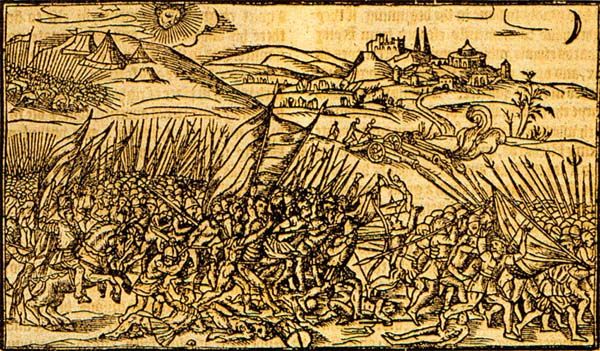
Site of the Battle of Bosworth discovered
One of the most important battles in British history is marked in the wrong place, according to new research.
Bosworth, fought in 1485 and ending in the death of Richard III, was believed to have taken place on Ambion Hill, near Sutton Cheney in Leicestershire. But following a three-year project, the Battlefields Trust said the discovery of ammunition two miles to the south west proved the location was wrong.
The battle ended decades of civil war which is now known as the Wars of The Roses. The death of Richard ended the Plantagenent dynasty and ushered in the Tudors.
The traditional site has a flag at the crest of the hill, a stone to mark the spot where Richard fell and a recently renovated visitors' centre. But debate over the actual site of the battle had been going on for more than 25 years before a project, with £154,000 funding from the Heritage Lottery Fund, was set up to settle the matter.
Dr Glenn Foard, from the Battlefields Trust, said: "The battle was not fought on Ambion Hill at all, we have found the battlefield two miles away, down in the valley. That is where the Wars of the Roses were decided."
He said studying medieval documents, matching their descriptions to the surrounding area and archaeological excavations had all pointed to the same place. Foard added, "it was systematic archaeological survey with metal detectors that was the method by which we finally located the battlefield. In all 7 square kilometres have been surveyed. More than 5000 finds have been recorded, though only a tiny proportion of these relate to the battle."
The combined evidence proves that the battle was fought in the area between the villages of Dadlington, Shenton, Upton and Stoke Golding – in a location not previously suggested. But the exact whereabouts of the battlefield have not been released, as the researchers want to prevent the site from being looted by treasure hunters.
The newly discovered location will be announced sometime next year – and negotiations with land owners may allow some public access through existing rights of way.
The investigation also turned up much evidence related to use of gunpowder during the battle. Foard noted that, "The archaeological survey of Bosworth battlefield has so far produced 22 lead roundshot fired from artillery and bullets fired from early hand guns – more than all the lead roundshot from all the other battlefields of the 15th and 16th century in Europe put together. They range in size up to 93mm – so the train of artillery at Bosworth already contained some guns as large as saker, the largest mobile field pieces normally deployed on battlefields in succeeding centuries.
"The scatter of roundshot from artillery and of bullets from hand guns extends over a distance of more than a kilometre. Because no comparable evidence has been seen before from a medieval battlefield, the interpretation of the pattern we have recovered demands various new research. This will involve the application of modern ballistics and other methods of scientific analysis."
Thursday, August 27, 2009
The Bayeux Tapestry: New Interpretations

A new book on The Bayeux Tapestry has just been released which offers a wide variety of new ideas about the famous embroidered cloth. The Bayeux Tapestry: New Interpretations, published by Boydell and Brewer, gives eleven essays on the Bayeux Tapestry, which depicts events leading up to the Battle of Hastings in 1066 and scenes from the battle iself, and is renowned among scholars of medieval history, art and literature.
Edited by Dan Terkla, Martin Foys and Karen Eileen Overbey, the book is a collection from a combination of well-established scholars and voices new to Tapestry studies. “We truly hope to live up to the title of the book, New Interpretations,” said Terkla. “Not only does the book take a multi-disciplinary approach, with scholars from fields ranging from history to art to Anglo-Saxon studies contributing, but its particular mix of seasoned and young scholars can provide a new perspective.”
Terkla’s chapter, titled “From Hastingus to Hastings and Beyond: Inexorable Inevitability on the Bayeux Tapestry,” situates the Norman invasion of 1066 in a context that reaches back to the first Viking ruler in Normandy, Hastingus, forward to William and the Norman invasion, and beyond to the broader history of Norman conquests. Setting the Tapestry in this broad context causes one to wonder, as Terkla does, “Did Hastingus’s presence in Normandy set into motion an inevitable link that runs all the way to William?” He argues that the Tapestry’s design creates a sense of historical inevitability through its use of line.
“You can look at the Tapestry and see the ways in which the ground and waterlines run, how gestures are configured,” said Terkla. “It all pulls the eyes from left to right. All of the visual elements come together to imply the inevitability of this Norman conquest and future conquests.”
The idea for the book surfaced during a National Endowment for the Humanities Summer Seminar, directed by R. Howard Bloch at Yale, that Terkla attended in 2005. Inspired by the seminar, he co-organized sessions in 2006 for the International Medieval Congress at the University of Leeds, England, and then co-organized an international conference at the British Museum dedicated to the Tapestry in 2008.
“The Tapestry has captured the interest of scholars and leaders for centuries,” said Terkla, who noted that Napoleon and the Nazis studied it for tips on invading England. The Tapestry “invites viewers to see it as part of a continuum of history. I am hoping the book encourages readers to step back and discover something they have not realized about the Tapestry before.”
Articles
Problematizing Patronage: Odo of Bayeux and the Bayeux Tapestry, by Elizabeth Carson Pastan and Stephen D White
Auctoritas, Consilium et Auxilium: Images of Authority in the Bayeux Tapestry, by Shirley Ann Brown
Taking Place: Reliquaries and Territorial Authority in the Bayeux Embroidery, by Karen Eileen Overbey
On the Nature of Things in the Bayeux Tapestry and its World, by Valerie Allen
Making Sounds Visible in the Bayeux Tapestry, by R. Brilliant
Anglo-Saxon Women, Norman Knights and a 'Third Sex' in the Bayeux Embroidery, by Madeline H. Caviness
Behind the Bayeux Tapestry, by Gale R. Owen-Crocker
Embroidery Errors in the Bayeux Tapestry and Their Relevance for Understanding Its Design and Production, by Michael Lewis
From Hasting to Hastings and Beyond: Inexorable Inevitability on the Bayeux Tapestry, by Daniel Terkla
Pulling the Arrow Out: The Legend of Harold's Death and the Bayeux Tapestry, by Martin Foys
The Bayeux Tapestry: A Selective Bibliography, by Daniel Terkla
Please also see our featured section The Bayeux Tapestry for more articles and news
Click here to purchase The Bayeux Tapestry: New Interpretations from Amazon.com

Wednesday, July 22, 2009
Hundred Years War Online Database Launched
250,000 medieval soldier service records published online offer a unique insight into social mobility in the ranks of England's first professional army.
An invaluable new resource for genealogists and people interested in social, political and military history has been launched this week. An online database containing 250,000 service records of soldiers who saw active duty in the latter phases of the Hundred Years War, has been published as part of the Medieval Soldier Research project.
Funded by the Arts and Humanities Research Council, the researchers at the University of Reading and University of Southampton have analysed historic sources such as muster rolls records in the National Archives at Kew and the Bibliothèque nationale de France in Paris ( for records of English garrisons in France ). The resulting Medieval Soldier database enables people to search for soldiers by surname, rank or year of service.
Using resources such as the proceedings of the Court of Chivalry, the researchers have also been able to build a picture of career progression and class mobility through what they believe are the origins of England's first professional army, creating complex profiles of individual soldiers. The database includes, for example, the names of many archers who served with Henry V at Agincourt.
The researchers have been able to identify where individual soldiers fought and for how long, who advanced in rank as a result of military success, which campaigns they fought in, what they were paid, who was off work sick, who was knighted, how much they received in ransoms, who was the most modest, the youngest or even who rode the furthest. Examples include Thomas, Lord Despencer, who began his career in arms at just 12 years old in 1385 or Thomas Gloucestre, esquire, who fought at Agincourt, and whose career can be traced over a 43 year period from Prussia to Jerusalem.
Dr Adrian Bell, Senior Lecturer at the ICMA Centre, Henley Business School, University of Reading, said: "The service records survive because the English Exchequer had a very modern obsession with wanting to be sure that the Government's money was being spent as intended. Therefore we have the remarkable survival of indentures for service detailing the forces to be raised; muster rolls showing this service and naming every soldier from Duke to Archer; accounts from the captains demonstrating how the money had been spent; and entries showing when the Exchequer made the requested payments.
"It is the survival of the muster roll evidence that allows us to begin to reconstruct the service of soldiers. This allows us to look for repeated service in the retinues of particular captains, and also service alongside a network of colleagues and family members. We can see that careers in arms regularly lasted over 20 years, and soldiers served from their teenage years to their 60s and older!"
The social mobility made possible by progressing through the ranks is demonstrated by the case of Robert de Fishlake. He enlisted, aged 16, in 1378 and progressed from humble archer to man-at-arms through the military campaigns at St Malo in 1378; the Duke of Buckingham's expedition to Brittany in 1380 and subsequent campaigns in Scotland. He even visited the Middle East. His stature had increased sufficiently to be called as a witness, aged 46, by Sir Edward Hastings at a Court of Chivalry.
Volunteers have played a large part in helping to build profiles of individual medieval soldiers, such as that of Robert de Fishlake. David Judd, volunteer, said: "The project has given me a feel for my medieval ancestors, who I had an inkling may have been Men at Arms or Archers but never had the evidence to prove it. With the soldier database I now have the evidence and material with which to research and add to my knowledge of early medieval family. It is absolutely fascinating to learn more about the detail of my medieval ancestors who must have lived through very troubled times."
Dr Bell recognises the involvement of the volunteers in the project: "Putting these records freely online has inspired a number of interested volunteers to write 'soldier profiles' of ancestors or of interesting individuals. The quality of the work by the contributing authors is of a very high standard, and demonstrates what can be produced, once original sources have been made accessible online."
The project was undertaken jointly by Dr Adrian Bell at the ICMA Centre, Henley Business School, University of Reading and Professor Anne Curry of the University of Southampton.
You can access the database here.
An invaluable new resource for genealogists and people interested in social, political and military history has been launched this week. An online database containing 250,000 service records of soldiers who saw active duty in the latter phases of the Hundred Years War, has been published as part of the Medieval Soldier Research project.
Funded by the Arts and Humanities Research Council, the researchers at the University of Reading and University of Southampton have analysed historic sources such as muster rolls records in the National Archives at Kew and the Bibliothèque nationale de France in Paris ( for records of English garrisons in France ). The resulting Medieval Soldier database enables people to search for soldiers by surname, rank or year of service.
Using resources such as the proceedings of the Court of Chivalry, the researchers have also been able to build a picture of career progression and class mobility through what they believe are the origins of England's first professional army, creating complex profiles of individual soldiers. The database includes, for example, the names of many archers who served with Henry V at Agincourt.
The researchers have been able to identify where individual soldiers fought and for how long, who advanced in rank as a result of military success, which campaigns they fought in, what they were paid, who was off work sick, who was knighted, how much they received in ransoms, who was the most modest, the youngest or even who rode the furthest. Examples include Thomas, Lord Despencer, who began his career in arms at just 12 years old in 1385 or Thomas Gloucestre, esquire, who fought at Agincourt, and whose career can be traced over a 43 year period from Prussia to Jerusalem.
Dr Adrian Bell, Senior Lecturer at the ICMA Centre, Henley Business School, University of Reading, said: "The service records survive because the English Exchequer had a very modern obsession with wanting to be sure that the Government's money was being spent as intended. Therefore we have the remarkable survival of indentures for service detailing the forces to be raised; muster rolls showing this service and naming every soldier from Duke to Archer; accounts from the captains demonstrating how the money had been spent; and entries showing when the Exchequer made the requested payments.
"It is the survival of the muster roll evidence that allows us to begin to reconstruct the service of soldiers. This allows us to look for repeated service in the retinues of particular captains, and also service alongside a network of colleagues and family members. We can see that careers in arms regularly lasted over 20 years, and soldiers served from their teenage years to their 60s and older!"
The social mobility made possible by progressing through the ranks is demonstrated by the case of Robert de Fishlake. He enlisted, aged 16, in 1378 and progressed from humble archer to man-at-arms through the military campaigns at St Malo in 1378; the Duke of Buckingham's expedition to Brittany in 1380 and subsequent campaigns in Scotland. He even visited the Middle East. His stature had increased sufficiently to be called as a witness, aged 46, by Sir Edward Hastings at a Court of Chivalry.
Volunteers have played a large part in helping to build profiles of individual medieval soldiers, such as that of Robert de Fishlake. David Judd, volunteer, said: "The project has given me a feel for my medieval ancestors, who I had an inkling may have been Men at Arms or Archers but never had the evidence to prove it. With the soldier database I now have the evidence and material with which to research and add to my knowledge of early medieval family. It is absolutely fascinating to learn more about the detail of my medieval ancestors who must have lived through very troubled times."
Dr Bell recognises the involvement of the volunteers in the project: "Putting these records freely online has inspired a number of interested volunteers to write 'soldier profiles' of ancestors or of interesting individuals. The quality of the work by the contributing authors is of a very high standard, and demonstrates what can be produced, once original sources have been made accessible online."
The project was undertaken jointly by Dr Adrian Bell at the ICMA Centre, Henley Business School, University of Reading and Professor Anne Curry of the University of Southampton.
You can access the database here.
Monday, June 29, 2009
Stirling Castle Skeleton Reveals Violent Life Of A Medieval Knight
Archaeologists believe that bones discovered at Stirling Castle may have belonged to a young knight killed in battle or during a siege.
Even though the warrior was probably only in his mid-20s he appears to have suffered several serious wounds in earlier fights. Indeed, he may have been living for some time with a large arrowhead in his chest. Bone re-growth around a dent in the front of the skull suggest he had recovered from a severe blow, possibly from an axe. The fatal wound, however, occurred when something, possibly a sword, sliced through his nose and jaw.
The unknown warrior, who lived in or around the early 1400s, was laid to rest under the floor of a chapel near the castle’s royal apartments. Peter Yeoman, Historic Scotland head of cultural resources, said: “We know little about this burial area but the evidence suggests it was sometimes used during extreme circumstances, for example to bury the dead during a siege. However, by using modern analysis techniques we have started to discover quite remarkable information about this man. It appears he died in his mid-20s after a short and violent life. His legs were formed in a way that was consistent with spending a lot of time on horseback, and the upper body points to someone who was well-muscled, perhaps due to extensive training with medieval weapons. This evidence, and the fact that he was buried at the heart of a royal castle, suggests he was a person of prestige, possibly a knight.”
The skeleton was excavated in 1997 when archaeologists were working in an area of the castle which turned out to be the site of a lost medieval royal chapel. Some research was carried out at the time, and though the information gleaned was limited it was recognised that the remains were of interest and merited future study.
Advances in technology and analytical techniques led to a recent re-examination of the skeleton for which the results are now available. This has included minute recording by laser scanning carried out by Colin Muir of Historic Scotland’s Technical Conservation Group.
In addition to the three serious wounds, it seems the man had also lost a number of teeth – perhaps from a blow, or a fall from a horse. A large, tanged arrowhead was found in skeleton and appears to have struck through the back or under the arm. Crystalised matter attached to the arrowhead may have been from flies or other insect larvae and could have been from clothing the arrow forced into the wound.
Gordon Ewart, of Kirkdale Archaeology, who carried out the excavation and some of the research for Historic Scotland, said: “This is a remarkable and important set of discoveries. There were a series of wounds, including a dent in the skull from a sword or axe, where bone had re-grown, showing that he had recovered. At first we had thought the arrow wound had been fatal but it now seems he had survived it and may have had his chest bound up.”
Little is known about who the man was or where he came from – he need not even have been a Scot. Further study is planned on tooth enamel and bone samples which may shed light on his origins. The man appeared to have been buried in the same grave as a small boy of one to three years old.
Archaeologists cannot be certain that the two were linked but radiocarbon dating suggests both date from the early 15th century, and there was no evidence of one grave having been cut through the other. They were part of a group of 12 skeletons, some highly fragmentary, which were discovered. Among them was a female, probably buried some time in the 13th century, who had two neat, square holes through her skull which were consistent with blows from a war hammer.
The area of the castle where the bones were discovered is now known as the Governor’s Kitchen. There was strong evidence that this was built around a medieval structure. There are known to have been several chapels at the castle, one dedicated to St Michael.
The excavation which revealed the skeletons was part of the long-term Historic Scotland project to discover more about the castle’s past and to inform its work to further enhance its appeal as a world-class visitor attraction. A central part of this work is the £12 million Stirling Castle Palace Project, which aims to return the castle’s royal palace to how it may have appeared in the mid-16th century.
The palace is currently closed to the public and is due to reopen in 2011.
Even though the warrior was probably only in his mid-20s he appears to have suffered several serious wounds in earlier fights. Indeed, he may have been living for some time with a large arrowhead in his chest. Bone re-growth around a dent in the front of the skull suggest he had recovered from a severe blow, possibly from an axe. The fatal wound, however, occurred when something, possibly a sword, sliced through his nose and jaw.
The unknown warrior, who lived in or around the early 1400s, was laid to rest under the floor of a chapel near the castle’s royal apartments. Peter Yeoman, Historic Scotland head of cultural resources, said: “We know little about this burial area but the evidence suggests it was sometimes used during extreme circumstances, for example to bury the dead during a siege. However, by using modern analysis techniques we have started to discover quite remarkable information about this man. It appears he died in his mid-20s after a short and violent life. His legs were formed in a way that was consistent with spending a lot of time on horseback, and the upper body points to someone who was well-muscled, perhaps due to extensive training with medieval weapons. This evidence, and the fact that he was buried at the heart of a royal castle, suggests he was a person of prestige, possibly a knight.”
The skeleton was excavated in 1997 when archaeologists were working in an area of the castle which turned out to be the site of a lost medieval royal chapel. Some research was carried out at the time, and though the information gleaned was limited it was recognised that the remains were of interest and merited future study.
Advances in technology and analytical techniques led to a recent re-examination of the skeleton for which the results are now available. This has included minute recording by laser scanning carried out by Colin Muir of Historic Scotland’s Technical Conservation Group.
In addition to the three serious wounds, it seems the man had also lost a number of teeth – perhaps from a blow, or a fall from a horse. A large, tanged arrowhead was found in skeleton and appears to have struck through the back or under the arm. Crystalised matter attached to the arrowhead may have been from flies or other insect larvae and could have been from clothing the arrow forced into the wound.
Gordon Ewart, of Kirkdale Archaeology, who carried out the excavation and some of the research for Historic Scotland, said: “This is a remarkable and important set of discoveries. There were a series of wounds, including a dent in the skull from a sword or axe, where bone had re-grown, showing that he had recovered. At first we had thought the arrow wound had been fatal but it now seems he had survived it and may have had his chest bound up.”
Little is known about who the man was or where he came from – he need not even have been a Scot. Further study is planned on tooth enamel and bone samples which may shed light on his origins. The man appeared to have been buried in the same grave as a small boy of one to three years old.
Archaeologists cannot be certain that the two were linked but radiocarbon dating suggests both date from the early 15th century, and there was no evidence of one grave having been cut through the other. They were part of a group of 12 skeletons, some highly fragmentary, which were discovered. Among them was a female, probably buried some time in the 13th century, who had two neat, square holes through her skull which were consistent with blows from a war hammer.
The area of the castle where the bones were discovered is now known as the Governor’s Kitchen. There was strong evidence that this was built around a medieval structure. There are known to have been several chapels at the castle, one dedicated to St Michael.
The excavation which revealed the skeletons was part of the long-term Historic Scotland project to discover more about the castle’s past and to inform its work to further enhance its appeal as a world-class visitor attraction. A central part of this work is the £12 million Stirling Castle Palace Project, which aims to return the castle’s royal palace to how it may have appeared in the mid-16th century.
The palace is currently closed to the public and is due to reopen in 2011.
Subscribe to:
Posts (Atom)