Adam Davis is a historian whose research causes him to straddle centuries on a daily basis. Now, the associate professor has received a yearlong fellowship from the National Endowment for the Humanities to dig deeper into the 12th and 13th centuries in Champagne, France. Davis will study hospitals, wills, charitable practices of the day, and even medieval guilt.
On the face of it, examining the source documents of medieval French hospitals doesn’t sound like uncovering King Solomon’s mines, but Davis begs to differ. He says he’s actually studying a previously unknown charitable revolution.
In earlier times, monasteries provided care for the poor and sick. But during the 12th and 13th centuries, wealthy laypeople founded hundreds of hospitals to provide for Europe’s needy. In the Middle Ages, hospitals were multifunctional religious institutions—almost a hybrid between a shelter, nursing home, and inn—housing the sick, poor, and powerless, as well as travelers.
“By the 13th century, hospitals had become one of the most popular recipients of charitable bequests,” says Davis. “In a number of regions, well over half of testaments, left by people from all cross-sections of life included bequests for hospices, hospitals, and leprosaries (quarantined houses for patients suffering from leprosy).”
Click here to read this article from Denison University
Showing posts with label France. Show all posts
Thursday, January 17, 2013
Thursday, August 23, 2012
Castle for Sale: Fortress of Miolans, Savoy
This impressive medieval castle is located in the heart of the Savoy Valley, and is situated on a strategic site 200 meters (550 feet) above the hamlet of Miolans, which part of the small town of St-Pierre Albigny in eastern France.
The site has been occupied since the 4th century AD, with the earliest reference to the fortress going back to 1083. By the second half of the 14th century, the lords of Miolans extended the fortifications with a second tower, and a third tower was added in the early 16th century.
In 1523 the ownership of the castle passed to the Counts of Savoy, and for the next two hundred years would serve as a prison. More than 200 people could be kept within the fortress, which became known as the Bastille of the Alps. The names of its dungeons included Hell, Purgatory, Paradise and Treasury. Among its most notable ‘guests’ was the Marquis de Sade, until he escaped in 1792. All the prisoners were freed during the French Revolution and the castle fell into ruin. It has currently been in the same family for almost six generations and the entire fortress was given full listing by the French Historic Monument Society in 1944.
Click here to read this article from Medievalists.net
Wednesday, August 01, 2012
Guédelon: Trades come alive at ‘medieval’ site
Visitors are not usually welcome at building sites but not so at Guédelon, a site in Burgundy which is being run entirely along medieval lines.
Its castle-builders of all trades are keen to show off their skills, whether they are woodcutters, carpenters, blacksmiths, tile makers, stonemasons or basket and rope makers. Master mason Florian Renucci, in charge of daily organisation, checks that the work carried out is historically, architecturally and archaeologically correct.
Learning to use 13th century building techniques effectively has not been easy, he says, especially when the walls are three metres thick and the stone is being quarried locally, by hand (the site is located in an old quarry).
“It’s ironstone, a very hard stone that we had to learn to extract,” he said. Quarry workers also had to master the art of searching for lines of weakness in blocks of sandstone, before drilling holes and inserting steel wedges with sledgehammers, creating shock waves to neatly split the rock.
Click here to read the rest of this article from The Connexion
Its castle-builders of all trades are keen to show off their skills, whether they are woodcutters, carpenters, blacksmiths, tile makers, stonemasons or basket and rope makers. Master mason Florian Renucci, in charge of daily organisation, checks that the work carried out is historically, architecturally and archaeologically correct.
Learning to use 13th century building techniques effectively has not been easy, he says, especially when the walls are three metres thick and the stone is being quarried locally, by hand (the site is located in an old quarry).
“It’s ironstone, a very hard stone that we had to learn to extract,” he said. Quarry workers also had to master the art of searching for lines of weakness in blocks of sandstone, before drilling holes and inserting steel wedges with sledgehammers, creating shock waves to neatly split the rock.
Click here to read the rest of this article from The Connexion
France's hidden gem...not any more! Beautiful medieval hamlet overrun with tourists after scooping travel award
Recognition in the lucrative holiday market is what most destinations dream of garnering. However, one pretty French hamlet is experiencing the pitfalls of over-exposure after its tourist figures soared when it picked up a prestigious award.
On some days during the summer, the local population of Saint-Cirq-Lapopie - just 217 people - has been dwarfed by visitors flocking to the medieval village, which lies 20 miles east of Cahors in south west France. Perched on a steep cliff 100ft above a river, the hamlet has a riveting history of battling off feudal rulers, Richard the Lionheart and religious fanatics in the Middle Ages.
But its tourist office has been almost overrun. 'The sudden increase in visitors has taken us a bit by surprise, not that I'm complaining,' said office chief Clare.
Click here to read the rest of this article from The Daily Mail
On some days during the summer, the local population of Saint-Cirq-Lapopie - just 217 people - has been dwarfed by visitors flocking to the medieval village, which lies 20 miles east of Cahors in south west France. Perched on a steep cliff 100ft above a river, the hamlet has a riveting history of battling off feudal rulers, Richard the Lionheart and religious fanatics in the Middle Ages.
But its tourist office has been almost overrun. 'The sudden increase in visitors has taken us a bit by surprise, not that I'm complaining,' said office chief Clare.
Click here to read the rest of this article from The Daily Mail
Wednesday, May 23, 2012
France: A Medieval Castle in the Making
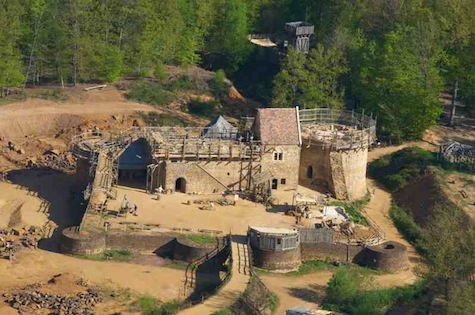
The construction of Guédelon about 100 miles southeast of Paris has already been underway for 15 years, yet workers are proud about how long it’s taking. That’s because you don’t build a medieval castle in a day using 13th-century techniques only.
The project, begun in 1997, is the brainchild—or, as it was said at the time, the idée folle—of Michel Guyot, an architectural historian who restored the nearby Château de St.-Fargeau. In the process he discovered the remains of a castle that predated the elegant 17th manor. Fascinated by the building they suggested, he decided to recreate it in the forest a dozen miles from St.-Fargeau, enlisting experts who studied illuminated manuscripts, stained-glass windows and extant medieval structures to devise a fully authentic design.
With Guédelon now on the rise, no one’s calling Guyot crazy and the point of the exercise grows ever more apparent. Like one of those illustrated children’s books by David Macaulay—”Cathedral,” “Castle,“ “City,“ “Pyramid”—it is aimed at answering a question everyone asks when visiting remarkable edifices from the Middle Ages: How did workers do it without trucks, bulldozers and power tools?
Click here to read this article from Smithsonian.com
Click here to visit the Castle's website
The project, begun in 1997, is the brainchild—or, as it was said at the time, the idée folle—of Michel Guyot, an architectural historian who restored the nearby Château de St.-Fargeau. In the process he discovered the remains of a castle that predated the elegant 17th manor. Fascinated by the building they suggested, he decided to recreate it in the forest a dozen miles from St.-Fargeau, enlisting experts who studied illuminated manuscripts, stained-glass windows and extant medieval structures to devise a fully authentic design.
With Guédelon now on the rise, no one’s calling Guyot crazy and the point of the exercise grows ever more apparent. Like one of those illustrated children’s books by David Macaulay—”Cathedral,” “Castle,“ “City,“ “Pyramid”—it is aimed at answering a question everyone asks when visiting remarkable edifices from the Middle Ages: How did workers do it without trucks, bulldozers and power tools?
Click here to read this article from Smithsonian.com
Click here to visit the Castle's website
Saturday, May 05, 2012
France celebrates Joan of Arc's 600th birthday
The normally tranquil city of Orleans is buzzing with festivities over the next two weeks to mark the 600th birthday of one of France's best cultural exports: Joan of Arc.
Looking appropriately cinematic, the Loire River swarmed with wooden boats carrying locals in medieval garb last week, re-enacting Joan of Arc's famous entry into the city in 1429.
The day that saw Orleans liberated from English invaders has been dramatized in film the world over, most famously in 1948's Oscar-winning epic of the French martyr with Ingrid Bergman, and more recently, in Luc Besson's award-winning 1999 blockbuster with Milla Jovovich.
Joan's place in the history books has not only been sealed through cinema, but also through myriad novels, poems, rock songs, operas and plays over the centuries — making her one of the most talked-about figures in history.
Click here to read this article from the Chicago Daily Herald
See more articles about Joan of Arc
Looking appropriately cinematic, the Loire River swarmed with wooden boats carrying locals in medieval garb last week, re-enacting Joan of Arc's famous entry into the city in 1429.
The day that saw Orleans liberated from English invaders has been dramatized in film the world over, most famously in 1948's Oscar-winning epic of the French martyr with Ingrid Bergman, and more recently, in Luc Besson's award-winning 1999 blockbuster with Milla Jovovich.
Joan's place in the history books has not only been sealed through cinema, but also through myriad novels, poems, rock songs, operas and plays over the centuries — making her one of the most talked-about figures in history.
Click here to read this article from the Chicago Daily Herald
See more articles about Joan of Arc
Friday, January 06, 2012
Celebrating the real Joan of Arc
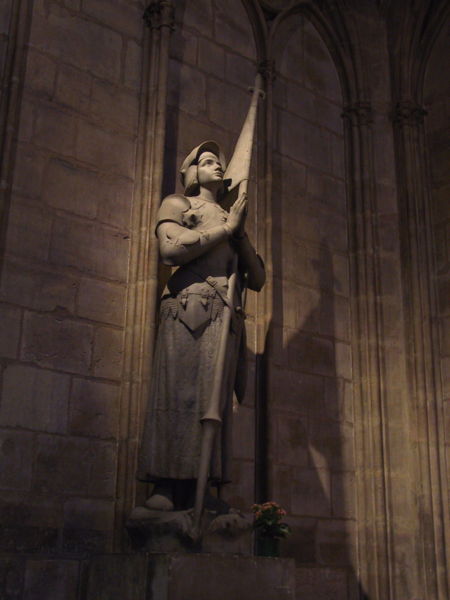
On January 6, people around the world will come together to celebrate the 600th anniversary of the birth of St. Joan of Arc, the brave peasant girl from the French countryside who in 1429 lifted the English siege of Orleans, walloped the enemy army and led her king to be crowned at Reims. French President Nicolas Sarkozy plans a special visit to the village of Domremy, her birthplace. There will be a parade at 6 o'clock in New Orleans, a French pilgrimage retracing the route that led to Joan's martyrdom at the stake in Rouen, prestigious classical music concerts and ceremonial viewings of Carl Theodor Dryer's silent-screen masterpiece, "The Passion of Joan of Arc."
And how typical of the magic of Joan's story that she should have been born on so important a Christian holiday, the Feast of the Epiphany, celebrating Christ's baptism and the coming of the Magi. Just another wonder in the life of the transcendent young woman who heard the voices of angels and presented the dauphin of France with a secret sign that only he would know, a sign that convinced him of her authenticity as a messenger from God.
Except that, like so much of the irresistible mystery surrounding Joan, this date, accepted by so many for so long as fact, was almost certainly created six centuries ago as a deliberate fiction for political purposes.
Click here to read this article from the Kansas City Star
And how typical of the magic of Joan's story that she should have been born on so important a Christian holiday, the Feast of the Epiphany, celebrating Christ's baptism and the coming of the Magi. Just another wonder in the life of the transcendent young woman who heard the voices of angels and presented the dauphin of France with a secret sign that only he would know, a sign that convinced him of her authenticity as a messenger from God.
Except that, like so much of the irresistible mystery surrounding Joan, this date, accepted by so many for so long as fact, was almost certainly created six centuries ago as a deliberate fiction for political purposes.
Click here to read this article from the Kansas City Star
Joan of Arc: Enduring Power
Joan of Arc was born 600 years ago. Six centuries is a long time to continue to mark the birth of a girl who, according to her family and friends, knew little more than spinning and watching over her father’s flocks. But type her name into Amazon’s search engine and you get more than 6,000 results. France’s national archives include tens of thousands of volumes about her. She has been immortalized by Shakespeare, Voltaire, Twain, Shaw, Brecht, Verdi, Tchaikovsky and Rubens; more recently, her life was fodder for the CBS television series “Joan of Arcadia.”
What is it about Joan of Arc? Why is her story of enduring interest more than a half a millennium after her birth?
By the time Joan of Arc was 16 and had proclaimed herself the virgin warrior sent by God to deliver France from her enemies, the English, she had been receiving the counsel of angels for three years. Until then, the voices she said she heard, speaking from over her right shoulder and accompanied by a great light, had been hers alone, a rapturous secret.
Click here to read this article from the New York Times
What is it about Joan of Arc? Why is her story of enduring interest more than a half a millennium after her birth?
By the time Joan of Arc was 16 and had proclaimed herself the virgin warrior sent by God to deliver France from her enemies, the English, she had been receiving the counsel of angels for three years. Until then, the voices she said she heard, speaking from over her right shoulder and accompanied by a great light, had been hers alone, a rapturous secret.
Click here to read this article from the New York Times
Nicolas Sarkozy, far-right leader Marine Le Pen in tug-of-love over Joan of Arc
![]() |
| Joan of Arc painted in 1854. |
The two leaders are to stage rival celebrations of the 600th anniversary of the birth of the 15th-century Catholic martyr who has been appropriated by the far-right partly for her booting out of medieval English “immigrants.”
The teenage peasant led the French army against the English after experiencing religious visions and was later burned at the stake, but her broad appeal to French of all political colours has ensured her immortality.
France is officially a secular state, but the story of Joan’s struggle against the English and Burgundians on behalf of the French crown has often served as an inspiration in patriotic causes.
She is regularly wheeled out as a symbol of French unity, alongside such Gallic icons as general Charles de Gaulle or Vercingetorix, who defied the Romans like a real-life Asterix.
Her broad appeal is key: French Catholics see in her a saint, nationalists see her as a royalist warrior who kicked out the English, while Socialists can hail her humble origins, although she was the daughter of a landowner.
Click here to read this article from the National Post
Remembering Joan of Arc, the Maid of Orléans
No one knows for sure when Joan of Arc was born in the village of Domrémy. But many believe the date was Jan. 6, 1412 — six centuries ago today.
After all this time, the tale of Joan of Arc remains a strange one. A peasant girl who never learned to read or write, she answered a call from God by leaving her family and travelling across France on a personal mission.
Although just 17 when she left home, with no training beyond spinning wool and sheep-herding, Joan’s goals were ambitious. She planned to lift the siege of Orleans, free France of its English occupiers, restore the Kingdom of France and see its leader, Charles VII, crowned King.
Joan began her mission about 1429, having been guided by interior voices for about two years. When she set out for Chinon, where Charles the Dauphin was staying, much of France, including Orleans, was occupied by English armies. For anyone considering it, the prospect of restoring the French monarchy must have seemed slim.
Click here to read this article from the National Post
After all this time, the tale of Joan of Arc remains a strange one. A peasant girl who never learned to read or write, she answered a call from God by leaving her family and travelling across France on a personal mission.
Although just 17 when she left home, with no training beyond spinning wool and sheep-herding, Joan’s goals were ambitious. She planned to lift the siege of Orleans, free France of its English occupiers, restore the Kingdom of France and see its leader, Charles VII, crowned King.
Joan began her mission about 1429, having been guided by interior voices for about two years. When she set out for Chinon, where Charles the Dauphin was staying, much of France, including Orleans, was occupied by English armies. For anyone considering it, the prospect of restoring the French monarchy must have seemed slim.
Click here to read this article from the National Post
Tuesday, November 15, 2011
French towns sells off 14th century cloister to pay debts
The mayor of the southern French town of Saint Emilion has discreetly sold off its 14th century Cordeliers cloister to a private winemaker, leaving local residents shocked and upset. The medieval site was sold for 750 000 euros to help the town pay off its growing financial debts and continue upkeep on other historical buildings.
The town, which lies near Bordeaux, was named a UNESCO World Heritage site in 1999. The Cordelier’s cloisters property includes a reception hall, cellars, offices and a garden. Over 570,000 euros were spent on its restoration in recent years.
Click here to read this article from Medievalists.net
The town, which lies near Bordeaux, was named a UNESCO World Heritage site in 1999. The Cordelier’s cloisters property includes a reception hall, cellars, offices and a garden. Over 570,000 euros were spent on its restoration in recent years.
Click here to read this article from Medievalists.net
Monday, November 07, 2011
The Farce of the Fart – new book offers scandalous plays from medieval France
They were the sitcoms of their time –– lowbrow comedies that lampooned every serious topic, from sex and relationships to politics and religion. In her new book, ‘The Farce of the Fart’ and Other Ribaldries –– Twelve Medieval French Plays in Modern English, Jody Enders, a professor of French at University of California – Santa Barbara, translates a dozen of these theatrical gems and brings them into the 21st century.
More than a study in literary criticism, for entertainment value and a peek into 15th- and 16th-century life and wit, ” ‘The Farce of the Fart’ and Other Ribaldries, ” is unequaled. Enders captures the colorful characters, coarse humor, and outrageous plot lines of medieval dramas that have, for the most part, been inaccessible to contemporary readers and theater audiences. “Except for about a dozen from the hundreds that have survived over the centuries, none have been translated into English,” Enders said. “And many of them haven’t been translated into modern French, or any modern vernacular. So they’re kind of untouched.”
Click here to read this article from Medievalists.net
More than a study in literary criticism, for entertainment value and a peek into 15th- and 16th-century life and wit, ” ‘The Farce of the Fart’ and Other Ribaldries, ” is unequaled. Enders captures the colorful characters, coarse humor, and outrageous plot lines of medieval dramas that have, for the most part, been inaccessible to contemporary readers and theater audiences. “Except for about a dozen from the hundreds that have survived over the centuries, none have been translated into English,” Enders said. “And many of them haven’t been translated into modern French, or any modern vernacular. So they’re kind of untouched.”
Click here to read this article from Medievalists.net
Thursday, October 13, 2011
Stanford scholar finds the origins of Western poetry in troubadours’ songs
Stanford Assistant Professor Marisa Galvez has written a book about medieval songbooks, pointing to troubadours as the models for modern poets.
The poem can seem like a timeless art form. When we talk about the poetry of nature or dance, we’re referring to a primeval form of language – it’s as if verse existed before other words even made it on the scene.
But, in reality, the European poem as we know it was invented, and fairly recently, too. What we in the West think of as poetry is largely the result of 12th-century troubadours and their controversial insistence on singing about the profane.
Click here to read this article from Medievalists.net
The poem can seem like a timeless art form. When we talk about the poetry of nature or dance, we’re referring to a primeval form of language – it’s as if verse existed before other words even made it on the scene.
But, in reality, the European poem as we know it was invented, and fairly recently, too. What we in the West think of as poetry is largely the result of 12th-century troubadours and their controversial insistence on singing about the profane.
Click here to read this article from Medievalists.net
Monday, October 03, 2011
Book Review: The Friar of Carcassonne, by Stephen O’Shea
Providence author Stephen O’Shea is more than a writer of historical narratives. He is designing engineer and pilot of a time machine that transports readers back in time 800 years or more.
He takes us to medieval Europe, a world alien to modern sensibilities, and makes it understandable by illuminating the historical record with the storytelling techniques of new journalism: scene setting, character development, and dialogue.
I first became acquainted with O’Shea’s historical scholarship and narrative craftsmanship a decade ago when I read “The Perfect Heresy,” his engrossing account of a little-known Christian heresy that took root in southern France in the 13th century, then was savagely suppressed by Pope Innocent III and crusading knights from the north. The heretics were pacifist Christians of austere belief who followed holy men (and women) whom the Roman church labeled as “perfect,” as in fully committed to their spiritual quest. Hence it became the “perfect” heresy; otherwise known to historians as the Albigensian heresy since it was rooted in Albi in south-central France.
Click here to read this article from The Providence Journal
He takes us to medieval Europe, a world alien to modern sensibilities, and makes it understandable by illuminating the historical record with the storytelling techniques of new journalism: scene setting, character development, and dialogue.
I first became acquainted with O’Shea’s historical scholarship and narrative craftsmanship a decade ago when I read “The Perfect Heresy,” his engrossing account of a little-known Christian heresy that took root in southern France in the 13th century, then was savagely suppressed by Pope Innocent III and crusading knights from the north. The heretics were pacifist Christians of austere belief who followed holy men (and women) whom the Roman church labeled as “perfect,” as in fully committed to their spiritual quest. Hence it became the “perfect” heresy; otherwise known to historians as the Albigensian heresy since it was rooted in Albi in south-central France.
Click here to read this article from The Providence Journal
Friday, June 24, 2011
Bayeux Medieval Fair to celebrate all things Norman
As part of the pageant of events planned to celebrate the 1100th birthday of the French province of Normandy, the town of Bayeux will turn its 25th annual Medieval Fair, held July 1-3, into a celebration of all things Norman.
Descended from a band of marauding Vikings who founded the province, the Normans conquered Britain in 1066 at the Battle of Hastings. A re-enactment of that battle will take place on the morning of July 3.
Click here to read this article from the Los Angeles Times
Descended from a band of marauding Vikings who founded the province, the Normans conquered Britain in 1066 at the Battle of Hastings. A re-enactment of that battle will take place on the morning of July 3.
Click here to read this article from the Los Angeles Times
Subscribe to:
Comments (Atom)